IADR Abstract Archives
Effect of Zirconia Surface Treatments on Cement Bonding Strength
Objectives: This study evaluated the effect of different zirconia surface pre-treatments on its bond strength to titanium abutments with different cements.
Methods: 64 zirconia 3Y-TZP tapered rings were pressed from TZ-3YSB-E zirconia powder (Tosoh, Tokyo, Japan), pre-treated with 6 different surface treatments, then cemented to titanium abutment pins using 8 different cements. The partitally sintered zirconia specimens were divided according to design of experment (DOE) with the testing parameters of surface treatment, cement system and post-treatment. Zirconia surface treatments: 1) control group with no surface treatment, 2) airborne particle abrasion of fully sintered zirconia ring (FS-APA50), 3) airborne particle abrasion of partially sintered zirconia(PS-APA50), 4) tribochemical silica coating of fully sintered zirconia(FS-CoJet30), 5) tribochemical silica coating of partial sintered zirconia(PS-CoJet30), and 6) nano-structured alumina coating of fully sintered zirconia(NanoAl). The cement systems included were: 1) Maxcem Elite chroma (Kerr), 2) ThermaCem (Bisco), 3) RelyX Unicem2 (3M ESPE), 4) Multilink Automix (Ivoclar Vivadent), 5) Panavia SA Cement Plus (Kuraray), 6) Ceramir C&B (Doxa), 7) CemEZ Universal (Zest Dental), and 8) Bifix SE (VOCO). Zirconia rings were cemented to Ti pins according to manufucturer‘s instructions and subjected to post-treatment:1) control 24h incubation after cementing proceedure, and 2) accelerated aging (thermocycling of 20,000 cycles and storage at 37o C for 40 days in distilled water). The pull-out axial tensile retention load was tested using an Instron Model 5566A. Multi factorial linear regression model (JMP Pro 15) was used for data analysis (α=0.05).
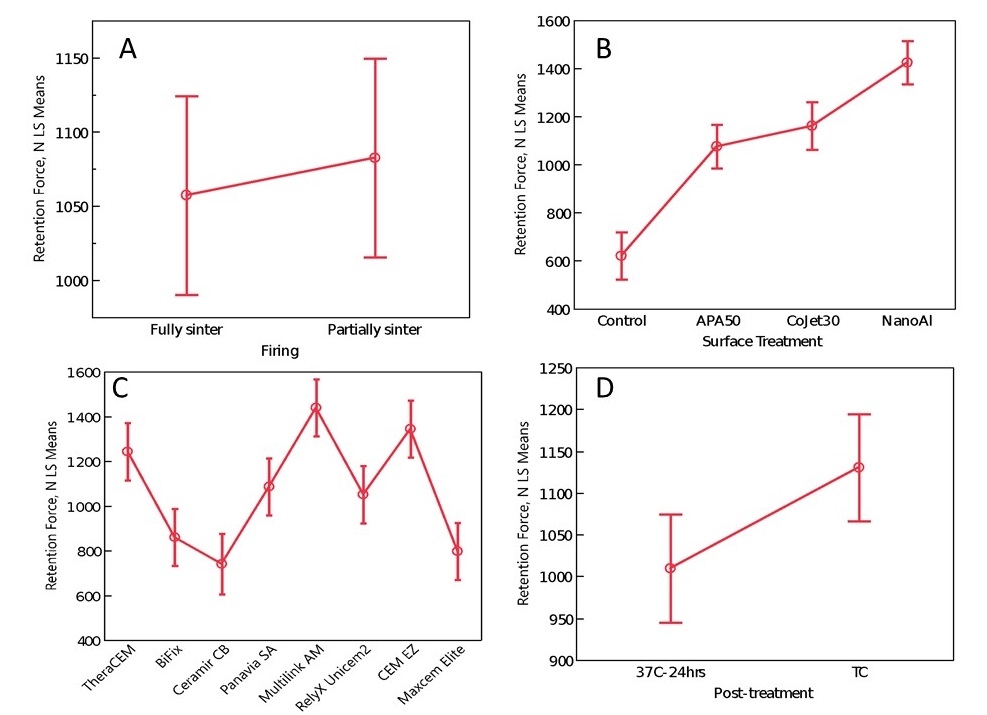
Results: The comparison of cement retention load of tested groups is shown in Figure 1 and Table 1.
Conclusions: Significant different retention loads were found among tested groups. Nano-structured alumina coating surface pre-treatment has significantly higher bond strength than other treatments. Some cement systems had significant higher bond strengths.
Methods: 64 zirconia 3Y-TZP tapered rings were pressed from TZ-3YSB-E zirconia powder (Tosoh, Tokyo, Japan), pre-treated with 6 different surface treatments, then cemented to titanium abutment pins using 8 different cements. The partitally sintered zirconia specimens were divided according to design of experment (DOE) with the testing parameters of surface treatment, cement system and post-treatment. Zirconia surface treatments: 1) control group with no surface treatment, 2) airborne particle abrasion of fully sintered zirconia ring (FS-APA50), 3) airborne particle abrasion of partially sintered zirconia(PS-APA50), 4) tribochemical silica coating of fully sintered zirconia(FS-CoJet30), 5) tribochemical silica coating of partial sintered zirconia(PS-CoJet30), and 6) nano-structured alumina coating of fully sintered zirconia(NanoAl). The cement systems included were: 1) Maxcem Elite chroma (Kerr), 2) ThermaCem (Bisco), 3) RelyX Unicem2 (3M ESPE), 4) Multilink Automix (Ivoclar Vivadent), 5) Panavia SA Cement Plus (Kuraray), 6) Ceramir C&B (Doxa), 7) CemEZ Universal (Zest Dental), and 8) Bifix SE (VOCO). Zirconia rings were cemented to Ti pins according to manufucturer‘s instructions and subjected to post-treatment:1) control 24h incubation after cementing proceedure, and 2) accelerated aging (thermocycling of 20,000 cycles and storage at 37o C for 40 days in distilled water). The pull-out axial tensile retention load was tested using an Instron Model 5566A. Multi factorial linear regression model (JMP Pro 15) was used for data analysis (α=0.05).
Results: The comparison of cement retention load of tested groups is shown in Figure 1 and Table 1.
Conclusions: Significant different retention loads were found among tested groups. Nano-structured alumina coating surface pre-treatment has significantly higher bond strength than other treatments. Some cement systems had significant higher bond strengths.
IMAGES
3570680_File000000.jpg
3570680_File000000.jpg