IADR Abstract Archives
Comparison of Disinfection Performance Between LED and Conventional UVGIs
Objectives: Ultraviolet (UV) light is one of the technologies widely used for inactivating bacteria, viruses, and fungi in disinfection of surfaces. UVC irradiation (200-280 nm) is the main source of the germicidal effect. The present study was to evaluate the disinfection performance of LED and mercury lamps based conventional UV germicidal irradiation (UVGI).
Methods: Porphyromonas gingivalis was spread on the TYHK-agar plates. Plates were covered with plastic lids covered with tin foil to block UV light. A square section is cut from the foil to create a window for controlled exposure of the agar to UV light. Then the plates were treated by the following three commercial portable UVGI sanitizers at the wavelength of 253.7 nm for 1s, 5s, and 10s respectively (Table 1). No UVC treatment and Ampicllin were used as negative and positive controls, respectively. All the plates were then incubated in an anaerobic condition for 48h. Experiment was performed in triplicate to minimize the errors.
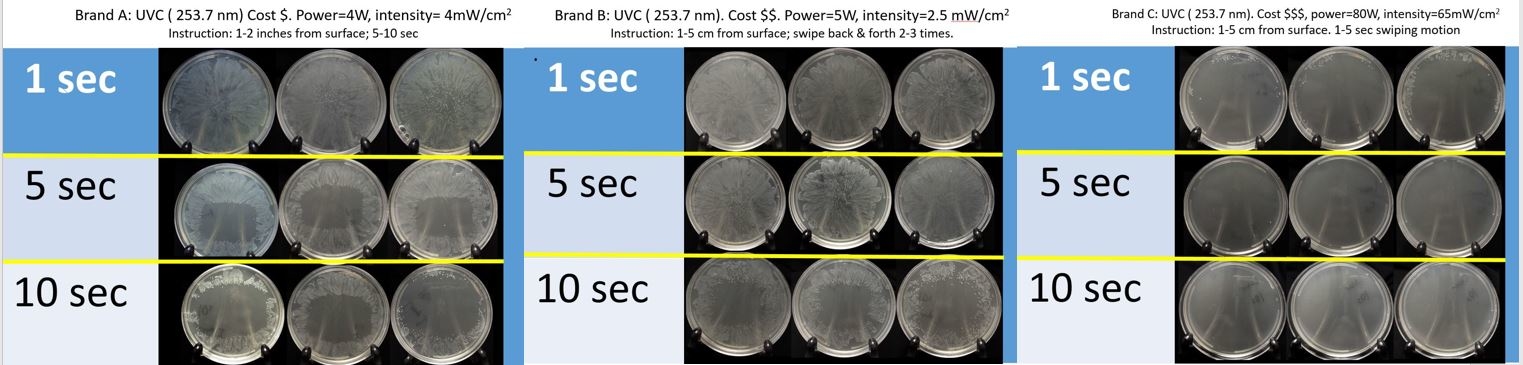
Results: Figure 1 presents a typical experimental progression through time. Brand A could kill P. gingivalis after 5s treatment, while Brand B needed 10s. Brand C with LED lamps could kill all the P. gingivalis after almost 1s.
Conclusions: LED UVGI is much more effective than the mercury lamps based conventional UVGI, probably due to higher power and output UV intensity.
Methods: Porphyromonas gingivalis was spread on the TYHK-agar plates. Plates were covered with plastic lids covered with tin foil to block UV light. A square section is cut from the foil to create a window for controlled exposure of the agar to UV light. Then the plates were treated by the following three commercial portable UVGI sanitizers at the wavelength of 253.7 nm for 1s, 5s, and 10s respectively (Table 1). No UVC treatment and Ampicllin were used as negative and positive controls, respectively. All the plates were then incubated in an anaerobic condition for 48h. Experiment was performed in triplicate to minimize the errors.
Results: Figure 1 presents a typical experimental progression through time. Brand A could kill P. gingivalis after 5s treatment, while Brand B needed 10s. Brand C with LED lamps could kill all the P. gingivalis after almost 1s.
Conclusions: LED UVGI is much more effective than the mercury lamps based conventional UVGI, probably due to higher power and output UV intensity.
IMAGES
3570428_File000000.JPG
3570428_File000000.JPG