IADR Abstract Archives
Physical Properties of Monolithic Zirconia Under Different Sintering Temperatures
Objectives: The purpose of this study is to investigate the relationships between grain size, flexural strength, light transmittance, and reflectance of dental zirconia material under different sintering temperatures.
Methods: 15 disc-shaped specimens from the incisal and coronal third of the dental zirconia block were sintered under 1450°C, 1500°C, and 1550°C. Direct light transmission was determined using a Varian Cary 5000 Spectrometer in the wavelength of 350nm to 800nm. The light transmission coefficient was abstracted mathematically. Specular reflectance was measured using an Ocean Optics USB 400 spectrophotometer coupled to a Thor Labs R200-7 reflection probe.
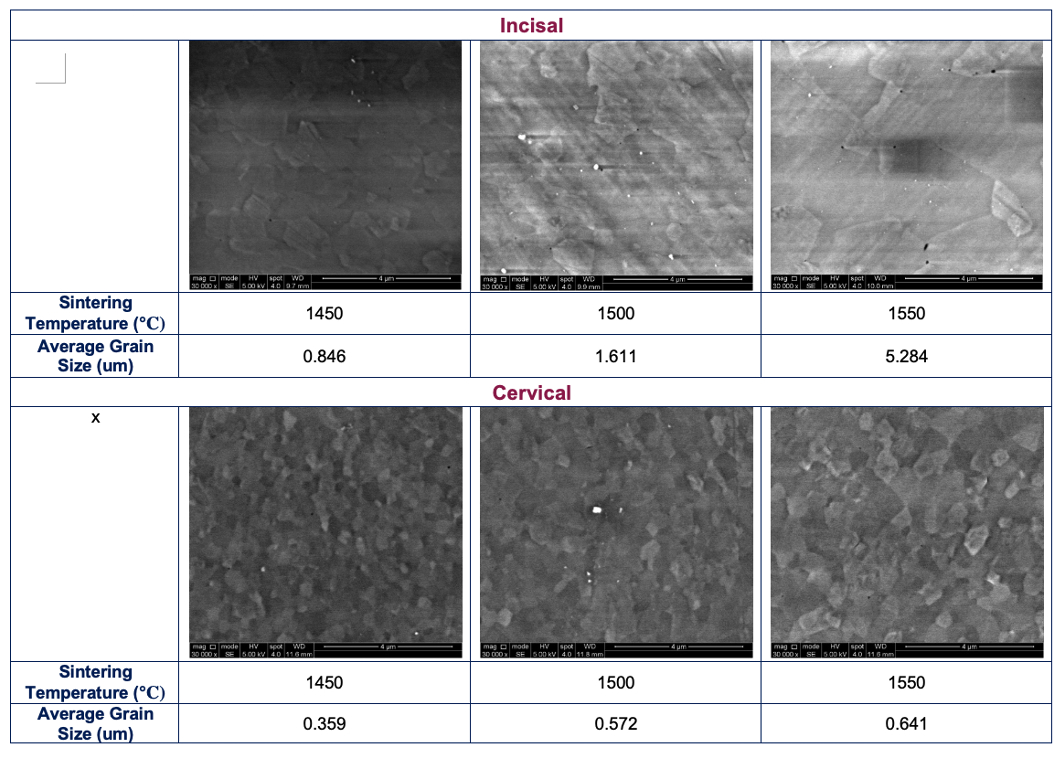
Scanning electron microscope images of zirconia surfaces were obtained using an FEI Quanta 600 FEG Mark II Environmental Scanning Electron. The average grain intercept (AGI) method was used to quantify the grain size of the samples.
The flexural strength of each group (25 20mm x 5mm x 2mm rectangular bars fabricated under the same temperatures from the incisal and coronal portion) was determined using an Instron Mechanical Testing Machine following ISO 6872 and values calculated using standard formulas.
Results: At the same temperature, the cervical portion of the monolithic zirconia material investigated had a higher light transmittance, greater flexural strength, lower reflectance, and smaller grain size compared to the incisal portion. Grain size, light transmittance, and reflectance of zirconia material increased as the sintering temperature increased; and flexural strength decreased as the sintering temperature increased.
Conclusions: The properties of cervical and incisal materials correspond with the expected aesthetic and functional demands for each portion. Sintering temperature had a direct relation with grain size, light transmittance and reflectance; and an indirect relation with flexural strength.
Methods: 15 disc-shaped specimens from the incisal and coronal third of the dental zirconia block were sintered under 1450°C, 1500°C, and 1550°C. Direct light transmission was determined using a Varian Cary 5000 Spectrometer in the wavelength of 350nm to 800nm. The light transmission coefficient was abstracted mathematically. Specular reflectance was measured using an Ocean Optics USB 400 spectrophotometer coupled to a Thor Labs R200-7 reflection probe.
Scanning electron microscope images of zirconia surfaces were obtained using an FEI Quanta 600 FEG Mark II Environmental Scanning Electron. The average grain intercept (AGI) method was used to quantify the grain size of the samples.
The flexural strength of each group (25 20mm x 5mm x 2mm rectangular bars fabricated under the same temperatures from the incisal and coronal portion) was determined using an Instron Mechanical Testing Machine following ISO 6872 and values calculated using standard formulas.
Results: At the same temperature, the cervical portion of the monolithic zirconia material investigated had a higher light transmittance, greater flexural strength, lower reflectance, and smaller grain size compared to the incisal portion. Grain size, light transmittance, and reflectance of zirconia material increased as the sintering temperature increased; and flexural strength decreased as the sintering temperature increased.
Conclusions: The properties of cervical and incisal materials correspond with the expected aesthetic and functional demands for each portion. Sintering temperature had a direct relation with grain size, light transmittance and reflectance; and an indirect relation with flexural strength.
IMAGES
3569409_File000003.jpg
3569409_File000003.jpg