IADR Abstract Archives
Physical and Optical Property Evaluation of New Esthetic Zirconia Materials
Objectives: While zirconia based dental ceramics exhibit unparalled strength, the material exhibits relatively high opacity. To improve esthetics, manufacturers have increased cubic zirconia content and in milling disks created gradient layers from dentin to incisal with pigmentation or by crystalline structure layering with 3Y, 4Y, 5Y zirconia, and transition layers. This study evaluated the Contrast Ratio (CR) and Biaxial Flexural Strength (BFS) of the layers in Zirconia milling disks.
Methods: Biaxial test disks were milled (Wieland) from Zr milling disks from: Lava Plus, 3M; e.max ZrCAD MO, LT and MT (IvoclarVivadent); e.max ZrCAD Multi (IvoclarVivadent)- 4 different layers: Dentin; Transition-B; Transition-A; Incisal; e.max ZrCAD Prime (IvoclarVivadent)- 4 different layers: Core; Gradient 2; Gradient 1; Incisal. Katana STML (Noritake)- 4 different layers: Dentin; Transition-2; Transition-1; Incisal. N= 10/group created with sintering temperatures by manufacturers’ directions to dimensions of 14mm diameter by 1.2mm thickness. Disks were finished and polished to 1200 grit. CR measured with UltraScanVIS spectrophotometer(HunterLab) and translucency calculated as 1 minus CR=Translucency(%). Specimen loaded in Instron Electropuls1000 with piston on 3-ball BFS configuration (ISO 6872). Specimen dimensions, loading parameters and failure loads were entered BFS formula: S= -0.2387xP(X-Y)/d2. Mean (sd) BFS (MPa) was calculated and BFS and Translucency data analyzed with OneWay ANOVA and Tukey test for post-hoc comparisons (α = 0.05).
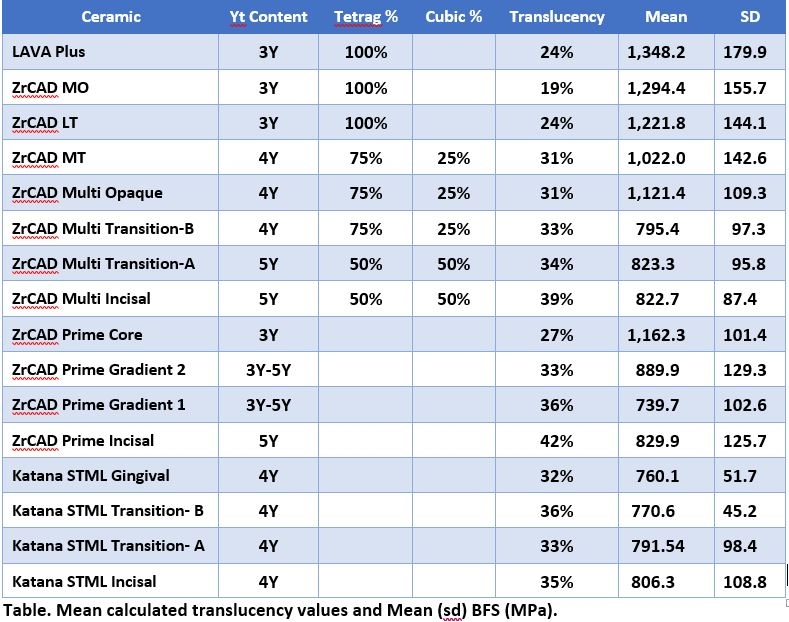
Results: Mean calculated translucency values and Mean(sd) BFS(MPa) shown in Table. ANOVA and Tukey post-hoc tests showed significant differences in BFS between both the control 3Y vs. 5Y and 4Y vs. 5Y at p< 0.05. No significant difference between 3Y vs. 4Y.
Conclusions: Translucency levels ranged for: 3Y TZP = 19 to 24%; 4Y PSZ = 31 to 33%; 5Y PSZ = 34 to 39%. The BFS of the 5Y zirconia with 50% cubic content was significantly lower than 3Y or 4Y zirconia. Interface quality between various layers was good and did not compromise BFS. BFS of transition zones seemed dependent on the cubic zirconia content.
Methods: Biaxial test disks were milled (Wieland) from Zr milling disks from: Lava Plus, 3M; e.max ZrCAD MO, LT and MT (IvoclarVivadent); e.max ZrCAD Multi (IvoclarVivadent)- 4 different layers: Dentin; Transition-B; Transition-A; Incisal; e.max ZrCAD Prime (IvoclarVivadent)- 4 different layers: Core; Gradient 2; Gradient 1; Incisal. Katana STML (Noritake)- 4 different layers: Dentin; Transition-2; Transition-1; Incisal. N= 10/group created with sintering temperatures by manufacturers’ directions to dimensions of 14mm diameter by 1.2mm thickness. Disks were finished and polished to 1200 grit. CR measured with UltraScanVIS spectrophotometer(HunterLab) and translucency calculated as 1 minus CR=Translucency(%). Specimen loaded in Instron Electropuls1000 with piston on 3-ball BFS configuration (ISO 6872). Specimen dimensions, loading parameters and failure loads were entered BFS formula: S= -0.2387xP(X-Y)/d2. Mean (sd) BFS (MPa) was calculated and BFS and Translucency data analyzed with OneWay ANOVA and Tukey test for post-hoc comparisons (α = 0.05).
Results: Mean calculated translucency values and Mean(sd) BFS(MPa) shown in Table. ANOVA and Tukey post-hoc tests showed significant differences in BFS between both the control 3Y vs. 5Y and 4Y vs. 5Y at p< 0.05. No significant difference between 3Y vs. 4Y.
Conclusions: Translucency levels ranged for: 3Y TZP = 19 to 24%; 4Y PSZ = 31 to 33%; 5Y PSZ = 34 to 39%. The BFS of the 5Y zirconia with 50% cubic content was significantly lower than 3Y or 4Y zirconia. Interface quality between various layers was good and did not compromise BFS. BFS of transition zones seemed dependent on the cubic zirconia content.
IMAGES
3329018_File000000.JPG
3329018_File000000.JPG