IADR Abstract Archives
Novel Automated Method for Quick and Precise In-lab Bite Scan
Objectives: The ‘bite scan’, with models mounted in a frame in occlusion, is known to be problematic. The occlusion frames often do not hold the models in the correct relationship leading to open bites. The process is cumbersome and requires a third scan which slows down the digital workflow. The aim of this test is to investigate an automated method for aligning the models and its efficacy in speeding up the workflow and in enhancing the accuracy.
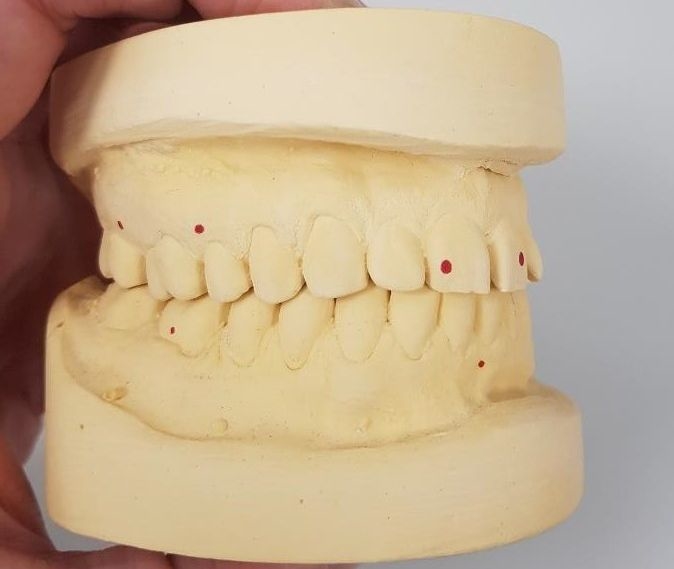
Methods: A high definition, new generation lab scanner (AADVA Lab Scanner 2, GC Corp, Japan) with hybrid-scan technology was selected for his evaluation. 20 realistic dental training models with 3 prepared teeth (15, 11 and 26) were used for this test. The models were fixed in bite position, then following steps were done: 1) marking of 3 dots on right, left and front of the models on vestibular surface, with always 2 dots on upper and 1 on lower jaw, in a equilateral triangle; 2) Scan the set-up; 3) Demount models from articulator and 4) separately scan upper and lower jaw; 5) Use of 3 points alignment software to align models in occlusion; 6) Overlapping of the files from step 2 and 5, aligning the centroids of the 6 upper dots with the reference scan from step 2.
Results: The alignment of the marked models appeared to be quick and easy to obtain. The deviation of the centroids of the dots on the lower model was lower than expected 5µm
Conclusions: The procedure appeared to be less time consuming than many actual in-lab procedures for model scan. The described automated method for aligning the models appeared reliable for speeding up the workflow and enhancing accuracy of the bite obtainable in-lab through the use of a professional scanner
Methods: A high definition, new generation lab scanner (AADVA Lab Scanner 2, GC Corp, Japan) with hybrid-scan technology was selected for his evaluation. 20 realistic dental training models with 3 prepared teeth (15, 11 and 26) were used for this test. The models were fixed in bite position, then following steps were done: 1) marking of 3 dots on right, left and front of the models on vestibular surface, with always 2 dots on upper and 1 on lower jaw, in a equilateral triangle; 2) Scan the set-up; 3) Demount models from articulator and 4) separately scan upper and lower jaw; 5) Use of 3 points alignment software to align models in occlusion; 6) Overlapping of the files from step 2 and 5, aligning the centroids of the 6 upper dots with the reference scan from step 2.
Results: The alignment of the marked models appeared to be quick and easy to obtain. The deviation of the centroids of the dots on the lower model was lower than expected 5µm
Conclusions: The procedure appeared to be less time consuming than many actual in-lab procedures for model scan. The described automated method for aligning the models appeared reliable for speeding up the workflow and enhancing accuracy of the bite obtainable in-lab through the use of a professional scanner
IMAGES
3328813_File000000.jpg
3328813_File000000.jpg