IADR Abstract Archives
Optical Properties Of Dental Hard Structures Compared To Aesthetic Ceramics
Objectives: Compare the transmittance (T) and light reflectivity (RI) within the visible spectrum of human enamel and dentine with those of two different types of ceramic materials in different shades and opacities.
Methods: Freshly extracted human posterior teeth were used to cut a total of 32 sagittal bucco-lingual tooth slices (1mm thick), each containing both enamel and dentine substrate. Ceramic samples of 1mm thickness (n=3), with different shades (A1, A2, A3, A3.5, B2, C2 and D2) corresponding to 2 different ceramic systems -Feldspathic ceramic: Noritake Super Porcelain EX-3 (NKT) and zirconia reinforced lithium silicate ceramics: Vita Suprinity T (VST) and HT (VSHT)- were manufactured or cut from CAD/CAM blocks using a low speed diamond saw. T and RI within the visible spectrum of all samples were calculated using the Kubelka-Munk Theory and reflectance values measured over white and black ceramic backgrounds with a noncontact spectroradiometer (SpectraScan PR-670). Data were analyzed using Mann-Whitney-Wilcoxon rank sum test (α=0.05).
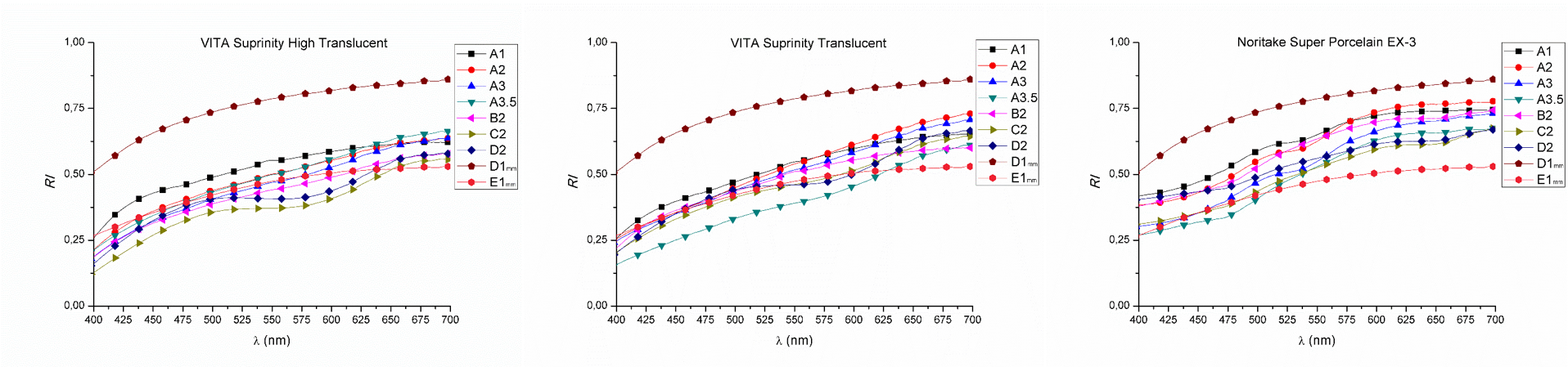
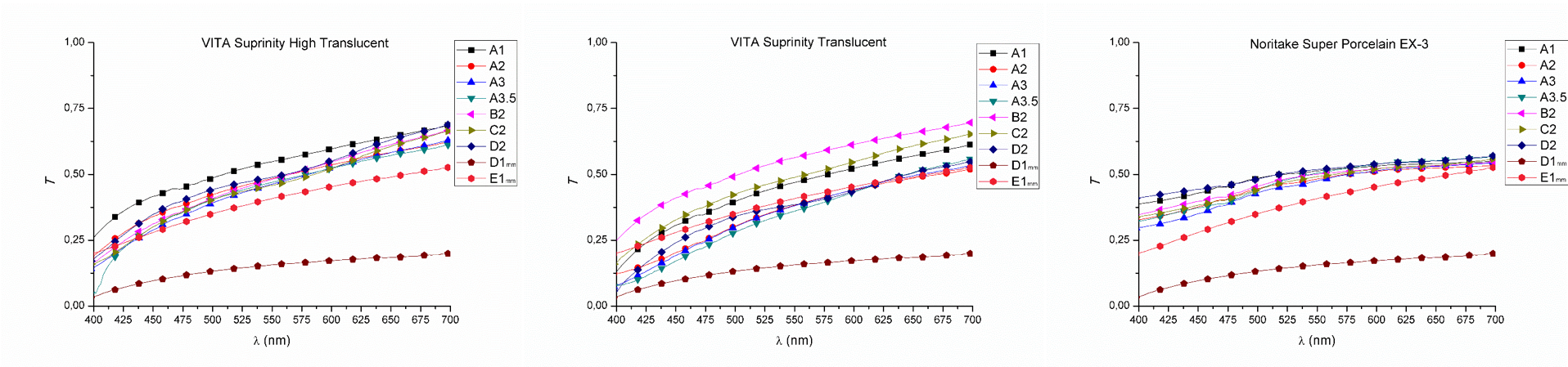
Results: Both transmittance and light reflectivity of 1mm thick dentine samples were statistically different (p<0.001) than all the studied ceramic materials and shades (Fig.1-2). For enamel samples, no statistically significant differences were found in transmittance when compared with A3 (p=0.054) and D2 (p=0.368) shades of VST. For light reflectivity, no statistically significant differences were found between the enamel samples and shades D2 (p=0.289) and C2 (p=0.389) of VST and shades A3 (p=0.241) and B2 (p=0.331) of the VSHT ceramic system.
Conclusions: None of the studied materials nor shades was able to match the transmittance or light reflectivity of the natural dentine for the studied thickness. Only some shades of VST provided a transmittance similar with the values registered for the enamel samples, while for light reflectivity, few shades of both VST and VSHT were able to match values of the enamel samples.
Methods: Freshly extracted human posterior teeth were used to cut a total of 32 sagittal bucco-lingual tooth slices (1mm thick), each containing both enamel and dentine substrate. Ceramic samples of 1mm thickness (n=3), with different shades (A1, A2, A3, A3.5, B2, C2 and D2) corresponding to 2 different ceramic systems -Feldspathic ceramic: Noritake Super Porcelain EX-3 (NKT) and zirconia reinforced lithium silicate ceramics: Vita Suprinity T (VST) and HT (VSHT)- were manufactured or cut from CAD/CAM blocks using a low speed diamond saw. T and RI within the visible spectrum of all samples were calculated using the Kubelka-Munk Theory and reflectance values measured over white and black ceramic backgrounds with a noncontact spectroradiometer (SpectraScan PR-670). Data were analyzed using Mann-Whitney-Wilcoxon rank sum test (α=0.05).
Results: Both transmittance and light reflectivity of 1mm thick dentine samples were statistically different (p<0.001) than all the studied ceramic materials and shades (Fig.1-2). For enamel samples, no statistically significant differences were found in transmittance when compared with A3 (p=0.054) and D2 (p=0.368) shades of VST. For light reflectivity, no statistically significant differences were found between the enamel samples and shades D2 (p=0.289) and C2 (p=0.389) of VST and shades A3 (p=0.241) and B2 (p=0.331) of the VSHT ceramic system.
Conclusions: None of the studied materials nor shades was able to match the transmittance or light reflectivity of the natural dentine for the studied thickness. Only some shades of VST provided a transmittance similar with the values registered for the enamel samples, while for light reflectivity, few shades of both VST and VSHT were able to match values of the enamel samples.
IMAGES
3328478_File000000.jpg
3328478_File000001.jpg
3328478_File000000.jpg
3328478_File000001.jpg