IADR Abstract Archives
Effect of Tri-strontium Phosphate Fillers on Monomer Conversion, Adhesion, Mechanical and Antibacterial Properties of Propylene-based Dental Composites
Objectives: Assess the effect of varying levels of tri-strontium phosphate fillers on monomer conversion, compressive strength, shear-bond strength and antibacterial properties of propylene-based dental composites
Methods: Tri-ethylene-glycol-dimethacrylate, polypropylene-dimethacrylate, camphorquinone and n-tolylglycine-dimethacrylate were mixed to get light curable stock-monomer.Stock-monomer was then mixed with varying levels of tri-strontium-phosphate-fillers(TSP)(0,10,20 and 40 wt%) along with silane-treated-glass-particles to obtained formulations TSP0, TSP10, TSP20, and TSP40 respectively. Z250™was used as a commercial control. Monomer conversion was assessed at 1mm,2mm,3mm and 4mm (20s light cure) using FTIR. Compressive strength was assessed after 1 and 28 days in simulated body fluid(SBF) at 37C. Shear bond strength was measured using ivory dentine following ISO 29022:2013. The anti-biofilm activity was assessed through quantitative assessment of biofilm formation on discs surfaces after three days in the growth-medium. Bioactivity was assessed in SBF using ISO 23317:2014. P-value set at 0.01 (SPSS v25)
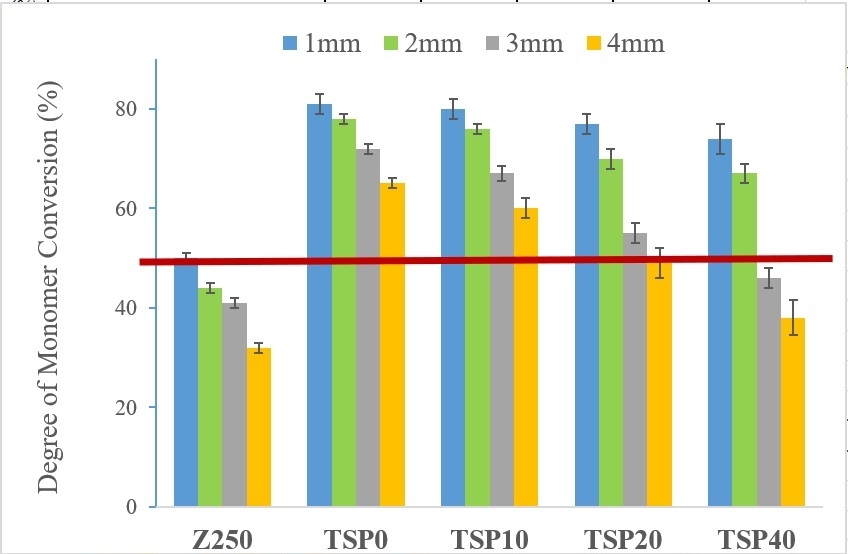
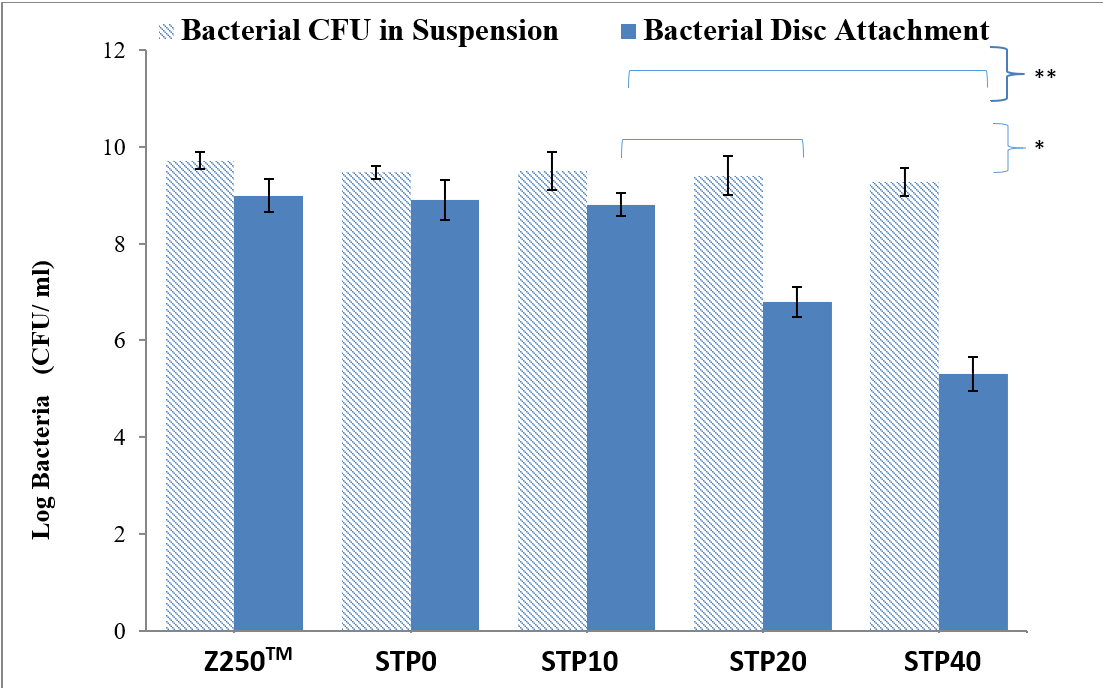
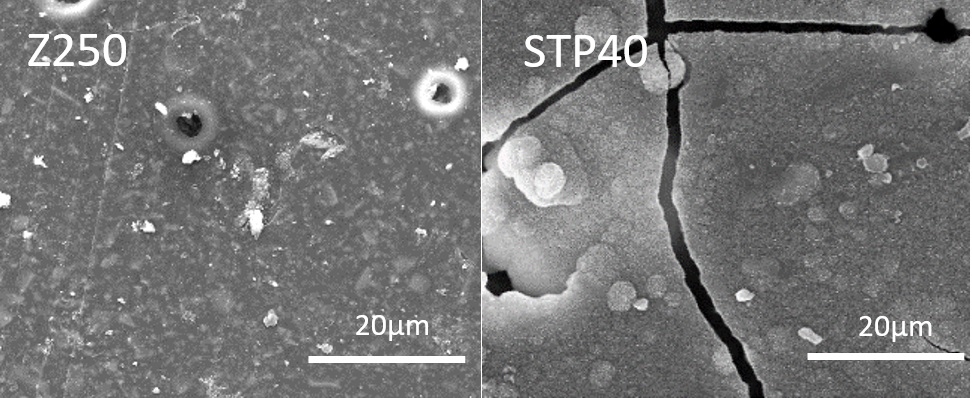
Results: Monomer conversion decreased with the increase in increments level from 1mm to 4mm(Fig1).Furthermore, the monomer conversion of all experimental formulations decreased with an increased in TSP fillers especially at 3mm and 4mm(p<0.01).However,shear bond strength increased with an increased level of STP fillers(p<0.01).Compressive strength decreased with an increase in STP filler levels(Tab-1).Strontium fillers had no significant effect on bacteria growth in suspension, however bacterial attachment on discs decreased significantly with the increase in STP filler levels(p<0.01)(Fig2).Apatite layer was only formed on STP40 after 28days in SBF(Fig3)
Conclusions: Newly-developed tri-strontium phosphate fillers addition showed optimum degree of monomer conversion compared to Z250. Furthermore, it enhances the adhesive property of the composite compared to Z250. STP-added composites showed reduce biofilm formation which could decrease the chances of microbial failure at interface. STP fillers also enhances the apatite formation at the interface, which could be beneficial for a stronger bond between the tooth and composite. Hence, these materials could potentially solve the problem of future micro-leakage
Methods: Tri-ethylene-glycol-dimethacrylate, polypropylene-dimethacrylate, camphorquinone and n-tolylglycine-dimethacrylate were mixed to get light curable stock-monomer.Stock-monomer was then mixed with varying levels of tri-strontium-phosphate-fillers(TSP)(0,10,20 and 40 wt%) along with silane-treated-glass-particles to obtained formulations TSP0, TSP10, TSP20, and TSP40 respectively. Z250™was used as a commercial control. Monomer conversion was assessed at 1mm,2mm,3mm and 4mm (20s light cure) using FTIR. Compressive strength was assessed after 1 and 28 days in simulated body fluid(SBF) at 37C. Shear bond strength was measured using ivory dentine following ISO 29022:2013. The anti-biofilm activity was assessed through quantitative assessment of biofilm formation on discs surfaces after three days in the growth-medium. Bioactivity was assessed in SBF using ISO 23317:2014. P-value set at 0.01 (SPSS v25)
Results: Monomer conversion decreased with the increase in increments level from 1mm to 4mm(Fig1).Furthermore, the monomer conversion of all experimental formulations decreased with an increased in TSP fillers especially at 3mm and 4mm(p<0.01).However,shear bond strength increased with an increased level of STP fillers(p<0.01).Compressive strength decreased with an increase in STP filler levels(Tab-1).Strontium fillers had no significant effect on bacteria growth in suspension, however bacterial attachment on discs decreased significantly with the increase in STP filler levels(p<0.01)(Fig2).Apatite layer was only formed on STP40 after 28days in SBF(Fig3)
Conclusions: Newly-developed tri-strontium phosphate fillers addition showed optimum degree of monomer conversion compared to Z250. Furthermore, it enhances the adhesive property of the composite compared to Z250. STP-added composites showed reduce biofilm formation which could decrease the chances of microbial failure at interface. STP fillers also enhances the apatite formation at the interface, which could be beneficial for a stronger bond between the tooth and composite. Hence, these materials could potentially solve the problem of future micro-leakage
IMAGES
3328114_File000000.jpg
3328114_File000001.jpg
3328114_File000002.jpg
3328114_File000000.jpg
3328114_File000001.jpg
3328114_File000002.jpg