IADR Abstract Archives
Effect of Sodium Hypochlorite on Fracture Strength of Root Dentine
Objectives: Sodium hypochlorite (NaOCl), the most widely used irrigant in endodontics, remains controversial because of its potential impact on the fracture resistance of endodontically treated teeth. This study evaluated the effects of different NaOCl concentrations on the fracture strength of bovine root dentin.
Methods: Bovine tooth roots were horizontally cut into 2-mm thick sections and the root canals were enlarged to a constant taper of 0.06. An outer layer of resin composite was bonded to each section to make the outer to root canal diameter ratio larger than 3. The resulting discs were divided into 4 groups (n=3) and immersed in 5.25%, 2.5%, 1.3% NaOCl and distilled water, separately, for 30min. The discs were then loaded through the center by a steel rod of the same taper attached to a universal test system until fracture. Fracture strength was calculated using an equation derived for homogeneous dentin discs. Thus, finite element analysis (FEA) was conducted to ensure that the stress distribution of the composite-surrounding root section was similar to that of a homogeneous sample of the same dimensions. Scanning electron microscopy (SEM) was used to examine the effects of NaOCl on the structures of the dentinal tubules at the canal wall.
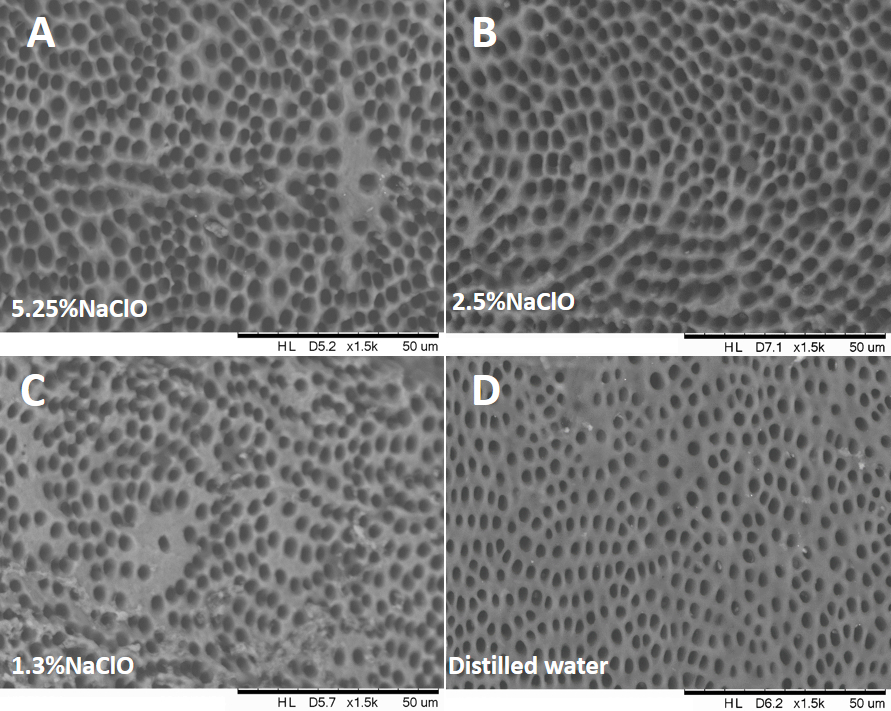
Results: FEA showed that the difference in the fracture-causing stress between a composite-surrounding root section and a homogeneous sample was <2.5%. The fracture strength of samples treated with 5.25%, 2.5%, 1.3% NaOCl and distilled water were 112.78±31.73MPa, 122.67±24.18MPa, 128.24±17.33MPa and 143.68±10.61MPa, respectively. SEM indicated that dentin at the root canal wall was eroded by NaOCl, and the intertubular dentin became thinner with increasing concentration (Fig.1).
Conclusions: NaOCl reduced the fracture strength of root dentin through erosion. The higher the concentration, the greater the reduction. To prevent root fracture, overly high concentration of NaOCl should be avoided for root canal irrigation.
Methods: Bovine tooth roots were horizontally cut into 2-mm thick sections and the root canals were enlarged to a constant taper of 0.06. An outer layer of resin composite was bonded to each section to make the outer to root canal diameter ratio larger than 3. The resulting discs were divided into 4 groups (n=3) and immersed in 5.25%, 2.5%, 1.3% NaOCl and distilled water, separately, for 30min. The discs were then loaded through the center by a steel rod of the same taper attached to a universal test system until fracture. Fracture strength was calculated using an equation derived for homogeneous dentin discs. Thus, finite element analysis (FEA) was conducted to ensure that the stress distribution of the composite-surrounding root section was similar to that of a homogeneous sample of the same dimensions. Scanning electron microscopy (SEM) was used to examine the effects of NaOCl on the structures of the dentinal tubules at the canal wall.
Results: FEA showed that the difference in the fracture-causing stress between a composite-surrounding root section and a homogeneous sample was <2.5%. The fracture strength of samples treated with 5.25%, 2.5%, 1.3% NaOCl and distilled water were 112.78±31.73MPa, 122.67±24.18MPa, 128.24±17.33MPa and 143.68±10.61MPa, respectively. SEM indicated that dentin at the root canal wall was eroded by NaOCl, and the intertubular dentin became thinner with increasing concentration (Fig.1).
Conclusions: NaOCl reduced the fracture strength of root dentin through erosion. The higher the concentration, the greater the reduction. To prevent root fracture, overly high concentration of NaOCl should be avoided for root canal irrigation.
IMAGES
3327888_File000000.jpg
3327888_File000000.jpg