IADR Abstract Archives
Anticaries Potential of Orthodontic Coating Materials
Objectives: Orthodontic patients are at elevated risk for caries. The objective is to evaluate the ability of orthodontic coating materials to protect underlying and adjacent enamel from in vitro cariogenic demineralization.
Methods: Bovine teeth obtained from a packing plant (n=3/group) were polished and covered with acid-resistant nail polish leaving an uncoated window of ~6x8mm. A third of the window was treated with one of the following coatings: RMGI coating with primer (XTP) or without (XT), resin-based coating (OP, PS, BC) or untreated (Table 1). Specimens were then immersed in 0.1M lactic acid gel (pH=5.0) for 20 days at 37°C. Specimens were scanned with micro-computed tomography (micro-CT: 110kV, 90µA, 708ms exposure, 720 projections, 4 frames/projection, 9.8µm resolution). 3D reconstructions were done with CT Pro 3D and visualized with VG Studio MAX 2.1. Integrated mineral loss (IML) under the treatment and adjacent untreated enamel at 0.5mm and 2mm from the coating was calculated from X-ray attenuation coefficient factor profiles. Data from each treatment group were analyzed and compared to the untreated control group via one-way ANOVA with Dunnett Multiple Comparisons (p<0.05).
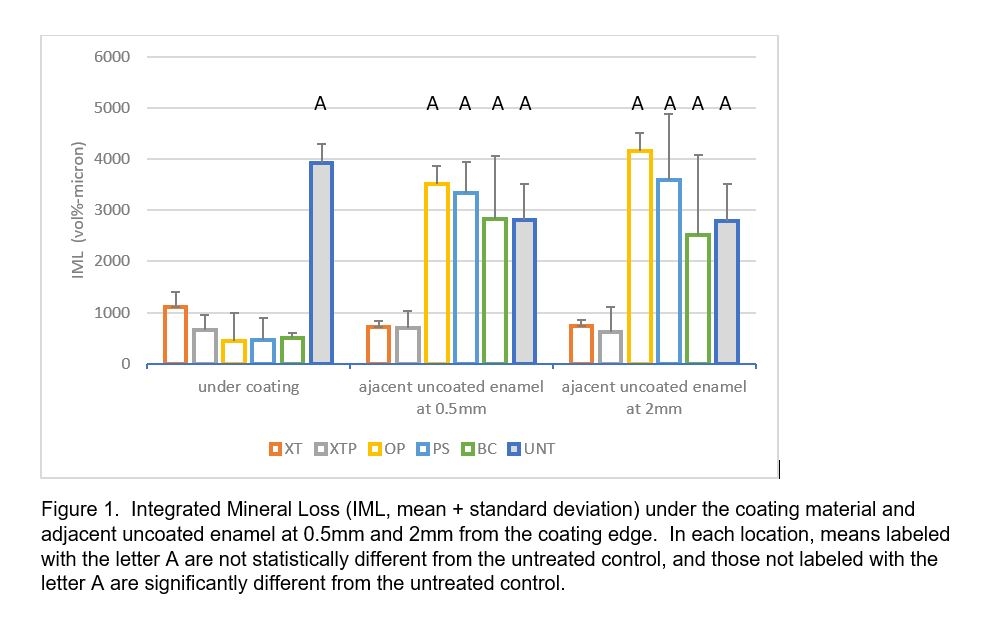
Results: IML (vol%-micron) results are shown in Table 2 and Figure 1. For all five coating treatment groups, IML under the coating material was significantly lower than untreated control. IML of XT and XTP in adjacent uncoated enamel at 0.5mm and 2mm from the coating was significantly lower than the untreated control; IML of OP, PS, and BC was not statistically different from the untreated control.
Conclusions: In this in vitro model, the XT material with and without primer and three resin-based coatings provided physical protection for underlying enamel against the cariogenic acid challenge; XT with and without the primer protected uncoated adjacent enamel against cariogenic acid challenge up to 2mm from the coating, while the resin-based coatings did not.
Methods: Bovine teeth obtained from a packing plant (n=3/group) were polished and covered with acid-resistant nail polish leaving an uncoated window of ~6x8mm. A third of the window was treated with one of the following coatings: RMGI coating with primer (XTP) or without (XT), resin-based coating (OP, PS, BC) or untreated (Table 1). Specimens were then immersed in 0.1M lactic acid gel (pH=5.0) for 20 days at 37°C. Specimens were scanned with micro-computed tomography (micro-CT: 110kV, 90µA, 708ms exposure, 720 projections, 4 frames/projection, 9.8µm resolution). 3D reconstructions were done with CT Pro 3D and visualized with VG Studio MAX 2.1. Integrated mineral loss (IML) under the treatment and adjacent untreated enamel at 0.5mm and 2mm from the coating was calculated from X-ray attenuation coefficient factor profiles. Data from each treatment group were analyzed and compared to the untreated control group via one-way ANOVA with Dunnett Multiple Comparisons (p<0.05).
Results: IML (vol%-micron) results are shown in Table 2 and Figure 1. For all five coating treatment groups, IML under the coating material was significantly lower than untreated control. IML of XT and XTP in adjacent uncoated enamel at 0.5mm and 2mm from the coating was significantly lower than the untreated control; IML of OP, PS, and BC was not statistically different from the untreated control.
Conclusions: In this in vitro model, the XT material with and without primer and three resin-based coatings provided physical protection for underlying enamel against the cariogenic acid challenge; XT with and without the primer protected uncoated adjacent enamel against cariogenic acid challenge up to 2mm from the coating, while the resin-based coatings did not.
IMAGES
3323931_File000000.JPG
3323931_File000000.JPG