IADR Abstract Archives
Mechanical Properties of Restoration-Grade 3DPrinter Resins and Dental Composite
Objectives: To evaluate the mechanical properties of light curing dental composite vs 2 types of 3D printer(3DP)-compatible resins.
Methods: Light curing dental composite BEAUTIFIL II LS (SHOFU, Kyoto, Japan)(Group 1) and 3DP resin material C&B MFH (NextDent, Soesterberg, Netherlands)(Group 2) and Denture Teeth Resin(FormLabs, Sommerville, MA)(Group 3) were evaluated for Flexural strength, Modulus of Elasticity, Diametral tensile strength(InstronNorwood, MA) and Vicker’s hardness(Buehler, Lake Bluff, IL). Each specimen was designed by manufactures suggestion. Each composite was light cured for 20 seconds with a Demi Plus (Kerr Hawe, Middleton, WI) LED light with light intensity of 800mW/cm2. The 3D subjects were created on MeshMixer and printed on their respective compatible system: Group 2 in a Digital Light Projector system Moon Ray S(SprintRay, Los Angeles, CA) and Group 3 Stereolithography system Form2(FormLabs, Sommerville, MA).
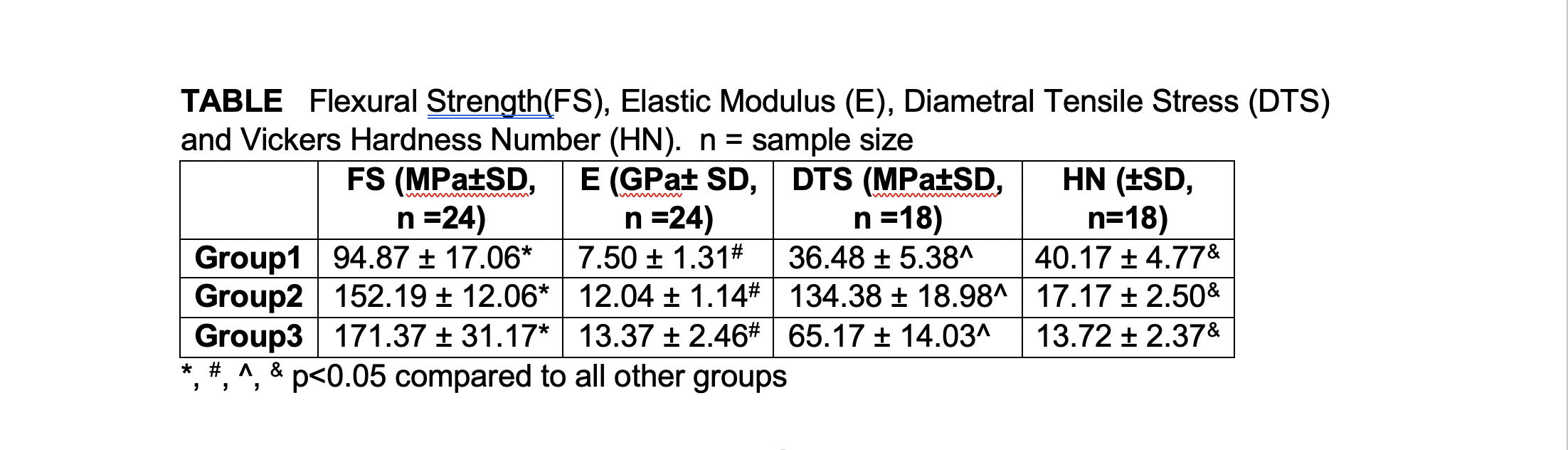
Results: All results are presented in the TABLE. One way ANOVA compared the means of the three experimental groups and Tukey post hoc tests were conducted to analyze the data. 3-point bending tests were completed to measure FS and E. Highest mean FS measured is 171.37 MPa from Group3. The highest E was Group3 at13.37GPa. The highest DTS measured under compressive stress was Group2 at 134.37 MPa. . For the VHN Group1 showed highest value at 40.1.
Conclusions: Mechanical properties of 3DP materials, with exception of hardness numbers, measured in this study were found comparable or superior to a conventional light curing direct restoration composite material. This implicates the possibility of 3DP resins as indirect restorations materials such as inlays and onlays in chairside clinical applications via digital intraoral scanning, software based restoration design then chairside fabrication via additive manufacturing process in a form of 3DP technology. Hardness indicates abrasion resistance and can be better explained by the filler contents in resins.
Methods: Light curing dental composite BEAUTIFIL II LS (SHOFU, Kyoto, Japan)(Group 1) and 3DP resin material C&B MFH (NextDent, Soesterberg, Netherlands)(Group 2) and Denture Teeth Resin(FormLabs, Sommerville, MA)(Group 3) were evaluated for Flexural strength, Modulus of Elasticity, Diametral tensile strength(InstronNorwood, MA) and Vicker’s hardness(Buehler, Lake Bluff, IL). Each specimen was designed by manufactures suggestion. Each composite was light cured for 20 seconds with a Demi Plus (Kerr Hawe, Middleton, WI) LED light with light intensity of 800mW/cm2. The 3D subjects were created on MeshMixer and printed on their respective compatible system: Group 2 in a Digital Light Projector system Moon Ray S(SprintRay, Los Angeles, CA) and Group 3 Stereolithography system Form2(FormLabs, Sommerville, MA).
Results: All results are presented in the TABLE. One way ANOVA compared the means of the three experimental groups and Tukey post hoc tests were conducted to analyze the data. 3-point bending tests were completed to measure FS and E. Highest mean FS measured is 171.37 MPa from Group3. The highest E was Group3 at13.37GPa. The highest DTS measured under compressive stress was Group2 at 134.37 MPa. . For the VHN Group1 showed highest value at 40.1.
Conclusions: Mechanical properties of 3DP materials, with exception of hardness numbers, measured in this study were found comparable or superior to a conventional light curing direct restoration composite material. This implicates the possibility of 3DP resins as indirect restorations materials such as inlays and onlays in chairside clinical applications via digital intraoral scanning, software based restoration design then chairside fabrication via additive manufacturing process in a form of 3DP technology. Hardness indicates abrasion resistance and can be better explained by the filler contents in resins.
IMAGES
3323285_File000000.jpg
3323285_File000000.jpg