IADR Abstract Archives
Multi-Chambered, Microfluidic Oral Mucosa-on-a-Chip for In-Vitro Evaluation of Lidocaine Permeation
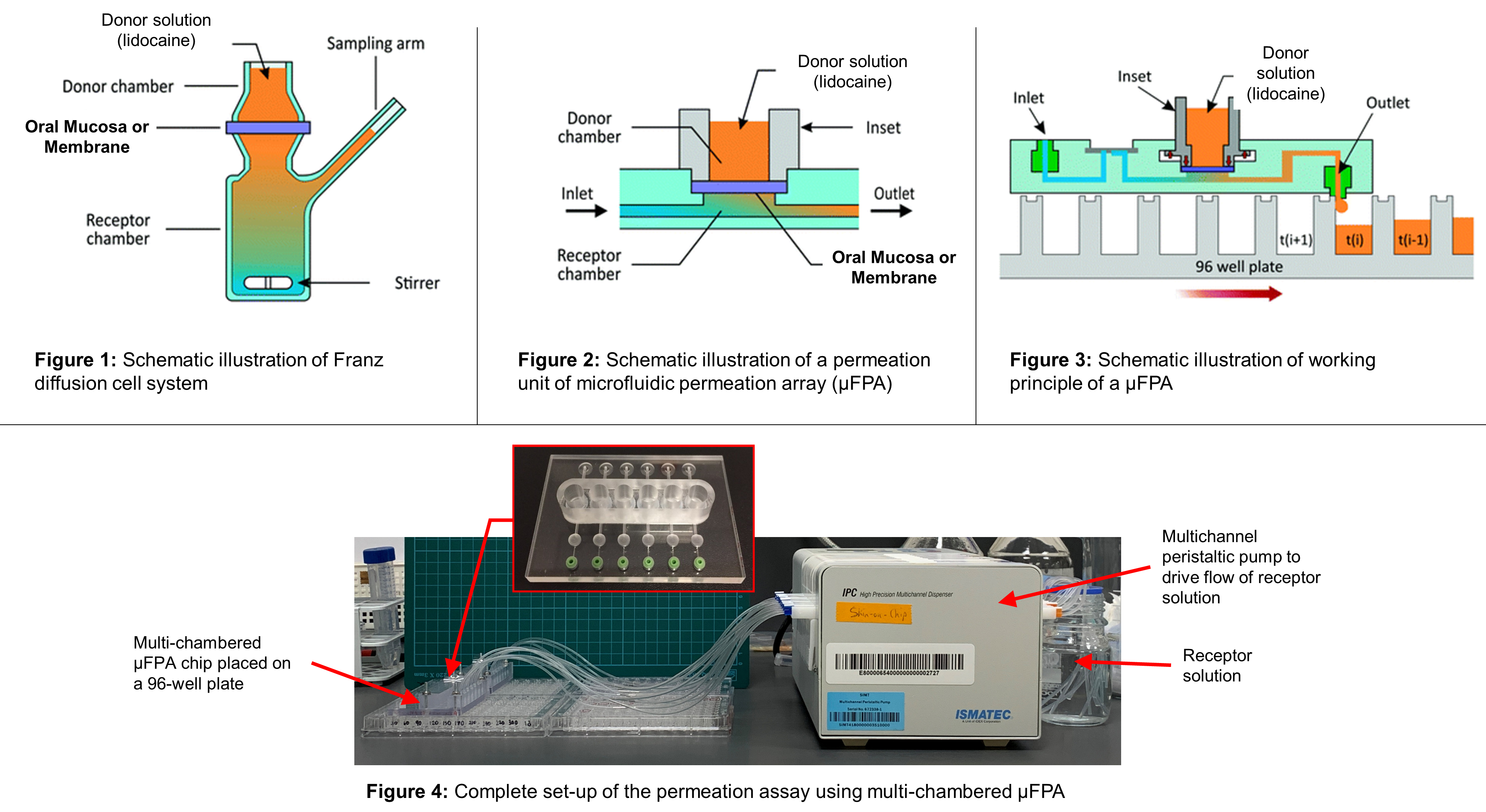
Objectives: Studies on drug permeation through oral mucosa is currently evaluated using Franz cells and porcine tissues or recently using in-vitro human oral mucosa equivalents (hOME) as a substitute for human tissues. However, the use of Franz cells is laborious, require a large piece of tissues, is relatively expensive and low in throughout. Advances in microfluidic organ-on-a-chip technologies provide capabilities for miniaturization, higher throughput, and cost-effectiveness. Here, we present the development of full-thickness hOMEs integrated into a custom-made multi-chambered, microfluidic permeation array (µFPA) (Oral Mucosa-on-a-Chip), to enable high-throughput transmucosal permeation of dental anaesthetics
Methods: hOMEs were fabricated using human oral keratinocytes and oral fibroblasts. The µFPA is composed of microchambers, which allows housing the tissue of interest; and microchannels for perfusion of the test substance and/or buffers needed for assessment of permeation of the test substance through the tissue of interest. Prior to studies on hOMEs, simulation studies were performed using lidocaine hydrochloride with different synthetic membranes.
Results: Simulation studies using synthetic membranes demonstrated a higher flux, lower lag time and higher cumulative penetration of lidocaine through more permeable membranes (porous membrane & collagen sheets) compared to less permeable silicone membranes. These studies validated the use of µFPA for lidocaine permeation studies through hOMEs. Over the course of the study, we experienced a few challenges like design issues, leakage, and problems with the spectrophotometric analysis of lidocaine in the perfusate. These challenges will also be discussed in the presentation.
Conclusions: In this study, we present and validate a microfluidic oral mucosa-on-a-chip for improved, cost-effective drug permeation tests and in future, toxicity and biocompatibility tests. Since oral mucosal tissues are extremely limited by size and availability, miniaturization and use of tissue-engineered hOMEs serve as an effective alternative to conventional Franz cell-based systems and as a physiologically-relevant alternative to animal-derived tissues respectively.
Methods: hOMEs were fabricated using human oral keratinocytes and oral fibroblasts. The µFPA is composed of microchambers, which allows housing the tissue of interest; and microchannels for perfusion of the test substance and/or buffers needed for assessment of permeation of the test substance through the tissue of interest. Prior to studies on hOMEs, simulation studies were performed using lidocaine hydrochloride with different synthetic membranes.
Results: Simulation studies using synthetic membranes demonstrated a higher flux, lower lag time and higher cumulative penetration of lidocaine through more permeable membranes (porous membrane & collagen sheets) compared to less permeable silicone membranes. These studies validated the use of µFPA for lidocaine permeation studies through hOMEs. Over the course of the study, we experienced a few challenges like design issues, leakage, and problems with the spectrophotometric analysis of lidocaine in the perfusate. These challenges will also be discussed in the presentation.
Conclusions: In this study, we present and validate a microfluidic oral mucosa-on-a-chip for improved, cost-effective drug permeation tests and in future, toxicity and biocompatibility tests. Since oral mucosal tissues are extremely limited by size and availability, miniaturization and use of tissue-engineered hOMEs serve as an effective alternative to conventional Franz cell-based systems and as a physiologically-relevant alternative to animal-derived tissues respectively.
IMAGES
3322822_File000000.jpg
3322822_File000000.jpg