IADR Abstract Archives
Discomfort, Negative Sentiments, and Adverse Reactions During Orthodontic Treatment
Objectives: Patients experience a significant amount of discomfort during orthodontic treatment. Studies have shown that patient experience is important for assessing the quality of dental care. Additionally, patients’ level of discomfort could potentially influence their compliance with treatment. However, little has been published on the specific patient experiences during and following orthodontic care that could in part drive quality of care and compliance in these patients. The recent proliferation of web-based dentist reviews has introduced a new source of patient-generated data that could prove useful in gauging these experiences across a large cohort of patients. This study sought to characterize types of patients’ discomfort during orthodontic treatment as well as to identify specific appliances and procedures associated with the discomfort.
Methods: We extracted patient reviews on 18,891 orthodontists in the US from a leading online patient review website called HealthGrades. First, we identified 23 words/phrases of orthodontic appliances and procedures from a glossary provided by the American Association of Orthodontics. Second, we extracted collocation words for each of the 23 words/phrases using Mutual Information. Third, from these collocation, words we identified words of “adverse reactions”, “discomfort”, and “sentiments”. We performed a network analysis of these words in which Average Degrees and Modularity were calculated.
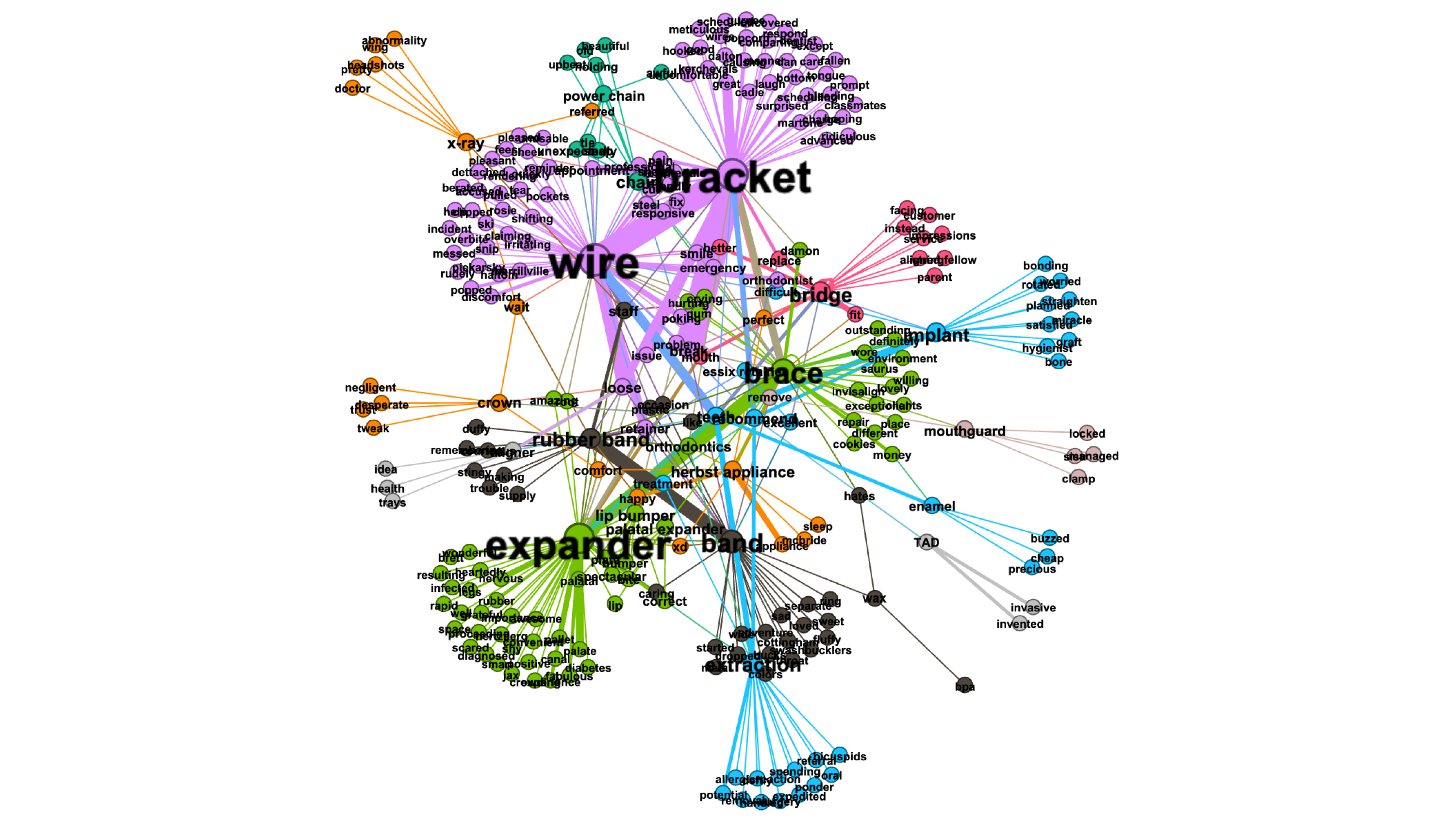
Results: We identified 10 words of “adverse reactions”, 8 “discomfort”, 19 “negative sentiments”, and 38 “positive sentiments” associated with a variety of orthodontic appliances and procedures. “Bracket”, “wire”, and “expander” were most related to patients’ discomfort, negative sentiments, and adverse reactions. “Trust”, “services”, etc., may serve as contributing factors in determining whether discomfort and negative sentiments occurred. (Figure 1)
Conclusions: We presented a new approach to investigating orthodontic patients’ self-reported experiences using social media data. Follow-up studies will focus on a sophisticated network analysis of patients’ reviews and integration with domain experts’ evaluation.
Methods: We extracted patient reviews on 18,891 orthodontists in the US from a leading online patient review website called HealthGrades. First, we identified 23 words/phrases of orthodontic appliances and procedures from a glossary provided by the American Association of Orthodontics. Second, we extracted collocation words for each of the 23 words/phrases using Mutual Information. Third, from these collocation, words we identified words of “adverse reactions”, “discomfort”, and “sentiments”. We performed a network analysis of these words in which Average Degrees and Modularity were calculated.
Results: We identified 10 words of “adverse reactions”, 8 “discomfort”, 19 “negative sentiments”, and 38 “positive sentiments” associated with a variety of orthodontic appliances and procedures. “Bracket”, “wire”, and “expander” were most related to patients’ discomfort, negative sentiments, and adverse reactions. “Trust”, “services”, etc., may serve as contributing factors in determining whether discomfort and negative sentiments occurred. (Figure 1)
Conclusions: We presented a new approach to investigating orthodontic patients’ self-reported experiences using social media data. Follow-up studies will focus on a sophisticated network analysis of patients’ reviews and integration with domain experts’ evaluation.
IMAGES
3321624_File000001.jpg
3321624_File000001.jpg