IADR Abstract Archives
Relaxation Mechanisms in Low-Stress Polymer Networks with Alternative Chemistries
Objectives: Polymerization stress may contribute to dental composite restoration failure. This study evaluated the stress relaxation mechanisms involved in low-stress resin composites based on chain-transfer reactions, modulated photopolymerization, and network reconfiguration.
Methods: BisGMA:UDMA:TEGDMA (50:30:20 wt%) were mixed with 0 (control) or 20 wt% thiourethane oligomer (trimethylol-tris-3-mercaptopropionate+dicyclohexylmethane-4,4'-diisocyanate; Bacchi et al., 2015). Composites were made with 50wt% methacrylate-silanized or thiourethane-silanized filler particles. 0.2/0.8 wt% CQ/EDMAB and 0.5 wt% BHT were the photoinitiator and inhibitor, respectively. Commercial composites included two “low-stress” materials (Surefil SDR Flow, Dentsply and Filtek Bulk Fill, 3M ESPE) and one conventional control (Filtek Supreme, 3M ESPE). Photopolymerization was done with a LED light (Demi Plus; Kerr) at 600 mW/cm2 for 20s. Real-time kinetics was assessed in near-IR. Polymerization stress was assessed with the Bioman system (10 min run time). Stress-relaxation was assessed by dynamic mechanical analysis (DMA) in tension mode (0.1% strain, 1 Hz, 30 min deformation time) between 25 to 145°C. Data were analyzed with one-way ANOVA/Tukey’s test (α=0.05).
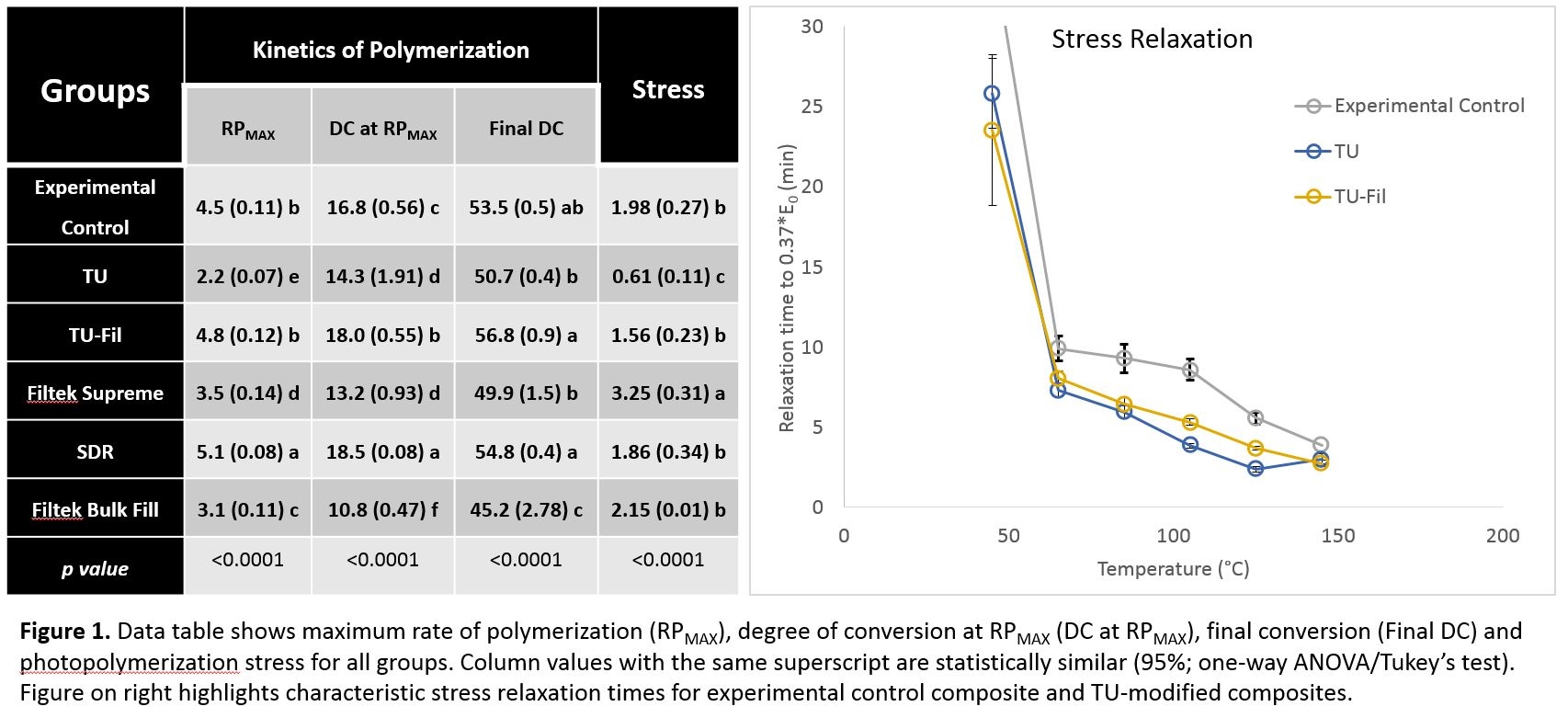
Results: Results are shown in Figure 1. Of the commercial composites, SDR Flow showed the highest RPMAX, DC at RPMAX, and Final DC while also having the lowest stress (1.86 MPa vs 3.25 for Filtek Supreme). TU-modified composites displayed statistically similar Final DC compared to the experimental control, though RPMAX was reduced by more than 50% for the TU group. Polymerization stress was reduced by nearly 70% in the composite modified with TU oligomer (0.61 MPa vs. 1.98 MPa for Control). TU and TU-Fil exhibited faster stress relaxation times than Experimental Control at all tested temperatures.
Conclusions: The results of this study suggest that composites modified with TU oligomers may show improved performance compared with current commercial “low-stress” resin composites, via chain transfer reactions during polymerization and enhanced stress relaxation after polymerization.
Methods: BisGMA:UDMA:TEGDMA (50:30:20 wt%) were mixed with 0 (control) or 20 wt% thiourethane oligomer (trimethylol-tris-3-mercaptopropionate+dicyclohexylmethane-4,4'-diisocyanate; Bacchi et al., 2015). Composites were made with 50wt% methacrylate-silanized or thiourethane-silanized filler particles. 0.2/0.8 wt% CQ/EDMAB and 0.5 wt% BHT were the photoinitiator and inhibitor, respectively. Commercial composites included two “low-stress” materials (Surefil SDR Flow, Dentsply and Filtek Bulk Fill, 3M ESPE) and one conventional control (Filtek Supreme, 3M ESPE). Photopolymerization was done with a LED light (Demi Plus; Kerr) at 600 mW/cm2 for 20s. Real-time kinetics was assessed in near-IR. Polymerization stress was assessed with the Bioman system (10 min run time). Stress-relaxation was assessed by dynamic mechanical analysis (DMA) in tension mode (0.1% strain, 1 Hz, 30 min deformation time) between 25 to 145°C. Data were analyzed with one-way ANOVA/Tukey’s test (α=0.05).
Results: Results are shown in Figure 1. Of the commercial composites, SDR Flow showed the highest RPMAX, DC at RPMAX, and Final DC while also having the lowest stress (1.86 MPa vs 3.25 for Filtek Supreme). TU-modified composites displayed statistically similar Final DC compared to the experimental control, though RPMAX was reduced by more than 50% for the TU group. Polymerization stress was reduced by nearly 70% in the composite modified with TU oligomer (0.61 MPa vs. 1.98 MPa for Control). TU and TU-Fil exhibited faster stress relaxation times than Experimental Control at all tested temperatures.
Conclusions: The results of this study suggest that composites modified with TU oligomers may show improved performance compared with current commercial “low-stress” resin composites, via chain transfer reactions during polymerization and enhanced stress relaxation after polymerization.
IMAGES
3321141_File000000.JPG
3321141_File000000.JPG