IADR Abstract Archives
Thiourethane-functionalized Filler Concentration Affects Polymerization and Clinically-relevant Properties of Composites
Objectives: Introduction of thiourethane (TU) oligomer to restorative materials reduces stress and improves fracture toughness without compromising conversion (Bacchi et al, 2015). The localization of TU at the resin-filler interface via silanization procedures may lead to more substantial stress reduction and clinical property enhancements. The purpose of this study was to evaluate composite properties as a function of TU-functionalized filler concentration.
Methods: TU-functionalized fillers were synthesized using a combination of trimethylol-tris-3-mercaptopropionate, dicyclohexylmethane 4,4'-diisocyanate, and 3-(triethoxysilyl)propyl isocyanate (Faria-e-Silva et al., 2018). These were combined with methacrylate-silanized barium filler (MA) at 0:1, 1:3, 1:1, 3:1 and 1:0 ratios. Composites were formulated using 65wt% TU/MA-filler, 5wt% OX50 fumed silica and 30wt% BisGMA/UDMA/TEGDMA (50/30/20 mass ratio) resin. CQ/EDMAB (0.2/0.8wt%) and BHT (0.2wt%) were used as photoinitiators and inhibitor, respectively. Samples were photocured using LED light at 600 mW/cm2 for 20 seconds (Demi Plus; Kerr). Testing included real-time polymerization kinetics (near-IR), polymerization stress (Bioman) and fracture toughness (SEN-bending; MTS). Gloss (2×2mm, 60°; Novocurve, Rhopoint) and surface roughness (0.8mm cut-off, 2mm trace length; TR200) measurements were taken before and after subjecting the samples to 6 hours of continuous toothbrushing in a custom-built apparatus using a toothpaste/water mixture. Data were analyzed with one-way ANOVA/Tukey’s test (α=0.05).
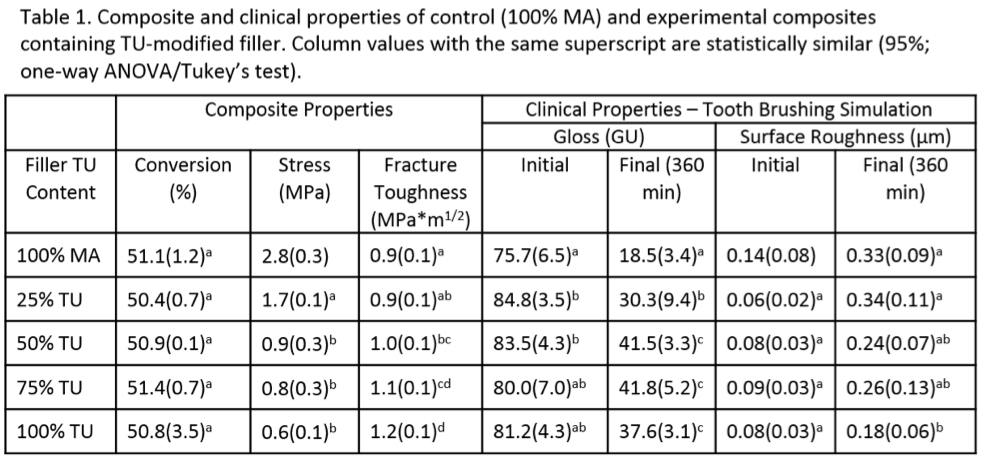
Results: Increasing TU-filler led to up to 80% reduction in stress (0.6 vs. 2.8 MPa for the methacrylate control) and increase in fracture toughness (1.2 vs. 0.9 MPa.m1/2 for the control). Conversion was similar for all groups. After toothbrushing, gloss reduction was lower for TU-containing composites (46 and 64%), compared to 76% reduction for the control, and surface roughness was less than or equal to the control.
Conclusions: Modification of inorganic filler with TU-oligomers can be an effective approach for stress reduction and mechanical property enhancement of dental composites. In addition, TU-modified filler composites showed enhanced surface polish retention under simulated toothbrushing conditions.
Methods: TU-functionalized fillers were synthesized using a combination of trimethylol-tris-3-mercaptopropionate, dicyclohexylmethane 4,4'-diisocyanate, and 3-(triethoxysilyl)propyl isocyanate (Faria-e-Silva et al., 2018). These were combined with methacrylate-silanized barium filler (MA) at 0:1, 1:3, 1:1, 3:1 and 1:0 ratios. Composites were formulated using 65wt% TU/MA-filler, 5wt% OX50 fumed silica and 30wt% BisGMA/UDMA/TEGDMA (50/30/20 mass ratio) resin. CQ/EDMAB (0.2/0.8wt%) and BHT (0.2wt%) were used as photoinitiators and inhibitor, respectively. Samples were photocured using LED light at 600 mW/cm2 for 20 seconds (Demi Plus; Kerr). Testing included real-time polymerization kinetics (near-IR), polymerization stress (Bioman) and fracture toughness (SEN-bending; MTS). Gloss (2×2mm, 60°; Novocurve, Rhopoint) and surface roughness (0.8mm cut-off, 2mm trace length; TR200) measurements were taken before and after subjecting the samples to 6 hours of continuous toothbrushing in a custom-built apparatus using a toothpaste/water mixture. Data were analyzed with one-way ANOVA/Tukey’s test (α=0.05).
Results: Increasing TU-filler led to up to 80% reduction in stress (0.6 vs. 2.8 MPa for the methacrylate control) and increase in fracture toughness (1.2 vs. 0.9 MPa.m1/2 for the control). Conversion was similar for all groups. After toothbrushing, gloss reduction was lower for TU-containing composites (46 and 64%), compared to 76% reduction for the control, and surface roughness was less than or equal to the control.
Conclusions: Modification of inorganic filler with TU-oligomers can be an effective approach for stress reduction and mechanical property enhancement of dental composites. In addition, TU-modified filler composites showed enhanced surface polish retention under simulated toothbrushing conditions.
IMAGES
3321126_File000000.jpg
3321126_File000000.jpg