IADR Abstract Archives
Effect of Polishing and the Effect of Toothbrushing on Four Composites
Objectives:
To evaluate the effect of two polishing methods followed by 24,000 toothbrushing cycles on the surface gloss and average roughness (Ra) of four composites.
Methods:
Disks of four composites: Filtek Supreme Ultra A2 (3M), Omnichroma (Tokuyama), TPH Spectra High Viscosity A2 (Dentsply) and Grandioso A2 (VOCO) were made and light-cured for 20s using the Elipar DeepCure-S (3M). The disks were sanded to a uniform gloss using 800 grit SiC paper. Specimens were randomly assigned to be polished with either MagicMix and Rockstar polishers (BIOCLEAR), or Enhance and POGO (DENTSPLY) polishers using a standardized polishing protocol (pressure, RPM and time). Their gloss was measured (Novo-Curve, Rhopoint Instruments) after each step. The specimens were then brushed for 24,000 cycles (48,000 strokes) using Crest Regular toothpaste and Sunstar 495 PC toothbrushes. The surface roughness was then measured with an atomic force microscope (nGauge, ICSPI). Selected SEM images at 5,000x were taken of the surfaces that represented the average roughness. Results were subjected to ANOVA and Fisher’s PLSD tests (alpha=0.05).
Results:
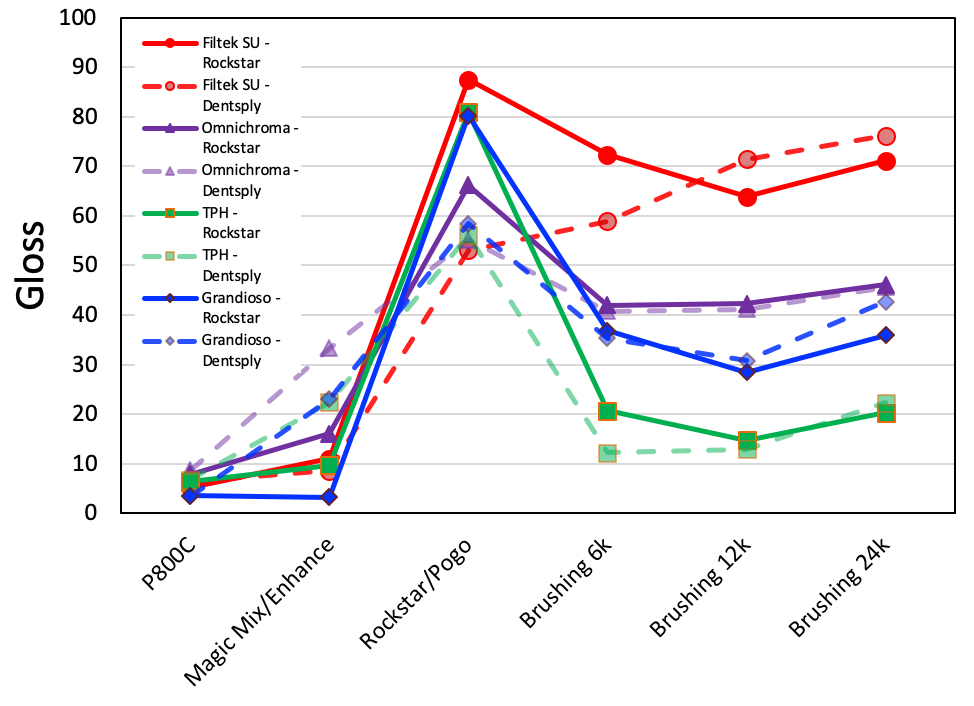
MagicMix produced a uniformly matt surface. When then polished with the Rockstar polishers, the surfaces of all the composites attained higher pre-brushing gloss values compared to when using POGO disks. Supreme Ultra achieved the highest gloss (88 GU). TPH was next at 81, followed by Grandioso at 80 GU. Omnichroma achieved 66 GU (Table 1).
The surface gloss of all samples decreased after toothbrushing. The final gloss values were almost identical irrespective of the polishing method. However, there were significant differences between the composites (p<0.05). After 24,000 brushing cycles, Supreme Ultra maintained the highest gloss value of 76 GU, Omnichroma achieved 46 GU, Grandioso achieved 43 GU and TPH 22 GU. After toothbrushing, all mean roughness values were less than 77 nm (Table 1). The average roughness of Omnichroma was slightly lower than Supreme Ultra, both were less than Grandioso or TPH (p<0.05). SEM images supported these results.
Conclusions:
The MagicMix/Rockstar polishing technique produced a higher gloss than the Enhance/POGO method. This difference disappeared after toothbrushing. Filtek Supreme Ultra was affected the least and TPH Spectra was affected the most by toothbrushing.
To evaluate the effect of two polishing methods followed by 24,000 toothbrushing cycles on the surface gloss and average roughness (Ra) of four composites.
Methods:
Disks of four composites: Filtek Supreme Ultra A2 (3M), Omnichroma (Tokuyama), TPH Spectra High Viscosity A2 (Dentsply) and Grandioso A2 (VOCO) were made and light-cured for 20s using the Elipar DeepCure-S (3M). The disks were sanded to a uniform gloss using 800 grit SiC paper. Specimens were randomly assigned to be polished with either MagicMix and Rockstar polishers (BIOCLEAR), or Enhance and POGO (DENTSPLY) polishers using a standardized polishing protocol (pressure, RPM and time). Their gloss was measured (Novo-Curve, Rhopoint Instruments) after each step. The specimens were then brushed for 24,000 cycles (48,000 strokes) using Crest Regular toothpaste and Sunstar 495 PC toothbrushes. The surface roughness was then measured with an atomic force microscope (nGauge, ICSPI). Selected SEM images at 5,000x were taken of the surfaces that represented the average roughness. Results were subjected to ANOVA and Fisher’s PLSD tests (alpha=0.05).
Results:
MagicMix produced a uniformly matt surface. When then polished with the Rockstar polishers, the surfaces of all the composites attained higher pre-brushing gloss values compared to when using POGO disks. Supreme Ultra achieved the highest gloss (88 GU). TPH was next at 81, followed by Grandioso at 80 GU. Omnichroma achieved 66 GU (Table 1).
The surface gloss of all samples decreased after toothbrushing. The final gloss values were almost identical irrespective of the polishing method. However, there were significant differences between the composites (p<0.05). After 24,000 brushing cycles, Supreme Ultra maintained the highest gloss value of 76 GU, Omnichroma achieved 46 GU, Grandioso achieved 43 GU and TPH 22 GU. After toothbrushing, all mean roughness values were less than 77 nm (Table 1). The average roughness of Omnichroma was slightly lower than Supreme Ultra, both were less than Grandioso or TPH (p<0.05). SEM images supported these results.
Conclusions:
The MagicMix/Rockstar polishing technique produced a higher gloss than the Enhance/POGO method. This difference disappeared after toothbrushing. Filtek Supreme Ultra was affected the least and TPH Spectra was affected the most by toothbrushing.
IMAGES
3320898_File000000.jpg
3320898_File000000.jpg