IADR Abstract Archives
Evaluation of a Novel Laser-induced Reversible Resin-based Cement
Objectives: This in vitro study was to evaluate the dislodging force of interim crowns cemented with a novel resin-based cement.
Methods:
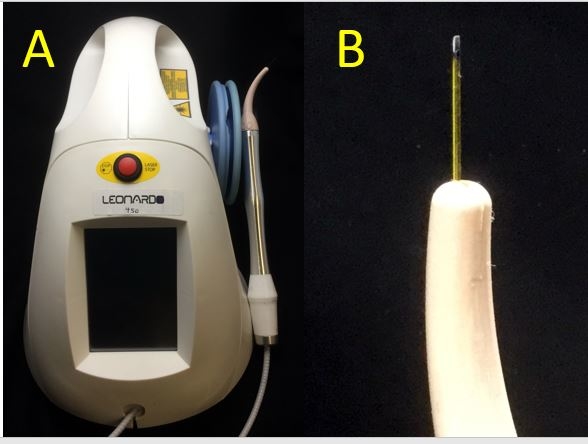
Thirty-six mandibular right first molar resin dies (Columbia Dentoform) were used to fabricate interim crowns with bis-acrylic composite (ProTemp Plus). Group RRC included 12 interim crowns cemented with an experimental resin-based cement; group RCL, 12 interim crowns cemented with the resin-based cement that activated by a diode laser (Figure 1)wavelength (450-nm) for 120 sec at 1.0 W to trigger rapidly a chemical cascading reaction before dislodging test; and group TBC (Figure 2), 12 interim crowns cemented with a temporary cement (Temp-Bond NE) as controls. All interim crowns were bench set for 10 minutes and stored at 37°C water bath for 7 days before testing. Dislodging device was attached on the occlusal portion of the interim crowns using dental adhesive (Scotchbond Universal Adhesive), a stainless steel rod, and resin (Triad Gel) to facilitate to dislodge the interim crowns in an occlusal direction during testing. After cementation and preparation, each specimen was mounted by embedding the root portion of the assembly with Orthodontic resin (Dentsply Sirona) to form a base with dimension 25mm × 15mm × 15mm for dislodging force measurement. The specimens were tested using a universal testing machine in tensile mode with a customized jig at a crosshead speed of 5 mm/min (Figure 3). Peak load-to-dislodgement was measured and data were statistically analyzed (ANOVA, Tukey’s, α=0.05).
Results:
The results are listed in Table. The laser activated group RCL is statistically significant weaker than the unlased resin group (p< .01) indicating that chemical degradation occurred after laser treatment.
Conclusions: A novel reversible cement has been developed and allowed the interim crowns to be removed easily with minimal or no damage to the tooth surface after laser activation.
Methods:
Thirty-six mandibular right first molar resin dies (Columbia Dentoform) were used to fabricate interim crowns with bis-acrylic composite (ProTemp Plus). Group RRC included 12 interim crowns cemented with an experimental resin-based cement; group RCL, 12 interim crowns cemented with the resin-based cement that activated by a diode laser (Figure 1)wavelength (450-nm) for 120 sec at 1.0 W to trigger rapidly a chemical cascading reaction before dislodging test; and group TBC (Figure 2), 12 interim crowns cemented with a temporary cement (Temp-Bond NE) as controls. All interim crowns were bench set for 10 minutes and stored at 37°C water bath for 7 days before testing. Dislodging device was attached on the occlusal portion of the interim crowns using dental adhesive (Scotchbond Universal Adhesive), a stainless steel rod, and resin (Triad Gel) to facilitate to dislodge the interim crowns in an occlusal direction during testing. After cementation and preparation, each specimen was mounted by embedding the root portion of the assembly with Orthodontic resin (Dentsply Sirona) to form a base with dimension 25mm × 15mm × 15mm for dislodging force measurement. The specimens were tested using a universal testing machine in tensile mode with a customized jig at a crosshead speed of 5 mm/min (Figure 3). Peak load-to-dislodgement was measured and data were statistically analyzed (ANOVA, Tukey’s, α=0.05).
Results:
The results are listed in Table. The laser activated group RCL is statistically significant weaker than the unlased resin group (p< .01) indicating that chemical degradation occurred after laser treatment.
Conclusions: A novel reversible cement has been developed and allowed the interim crowns to be removed easily with minimal or no damage to the tooth surface after laser activation.
IMAGES
3320650_File000000.JPG

3320650_File000001.JPG

3320650_File000002.JPG
3320650_File000000.JPG
3320650_File000001.JPG
3320650_File000002.JPG