IADR Abstract Archives
Early Flexural Strength and Hardness Study of Provisional Temporary Composites
Objectives: The development of provisional materials with improved handling, mechanical properties and lower water sorption has eased the fabrication of chairside provisional restorations. The aim of this study was to evaluate mechanical properties of provisional temporary crown and bridge materials at the early fabrication stage.
Methods: A newly developed provisional temporary composite, TurboTemp EZ (TTEZ, Zest Dental Solutions) and four leading commercial ones, including Luxatemp Ultra (LXTU, DMG), Protemp Plus (PTP, 3M-ESPE), Temphase (TP, Kerr) and Access Crown (AC, Centrix), were tested for Flexural Strength (FS) and Shore D Hardness (SDH). FS specimens (2×2×25mm, n=10) were prepared and tested according to ISO 4049 (2009). The disks (ø12.5mm×3.2mm, n=10) for SDH were prepared and tested via ASTM D2240-00. FS was determined after 10 min and SDH was determined after 5 min of fabrication at room temperature. Both FS and SDH specimens were also determined after 24 hours storage in water bath at 37°C. The results of each measurement were compared by ANOVA and Tukey Tests (p≤0.05).
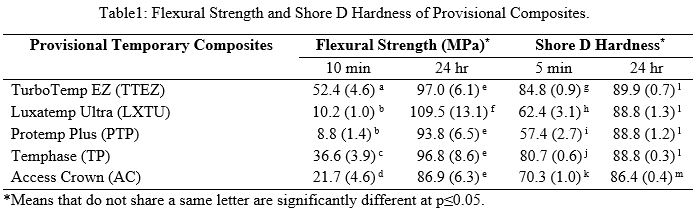
Results: The flexural strength of TTEZ at 10 min (52.4±4.6 MPa) and its hardness at 5 min (84.8±0.9) were significantly higher than other four provisional composites (p<0.05). The lowest flexural strength at 10 min was found from both LXTU (10.2±1.0MPa) and PTP (8.8±1.4MPa). Their hardness at 5 min was also significantly lower than other three provisional composites. At 24 hours, LXTU showed significant higher flexural strength whereas AC showed significant lower hardness in five groups.
Conclusions: At the early fabrication stage, TurboTemp EZ was significantly higher in flexural strength and hardness against the other provisional composites. Although all provisional composites studied here demonstrated greater flexural strength than ISO 10477:2004 requirements (>50MPa for polymer-based crown bridge materials), high flexural strength and hardness at the early stage might be beneficial to patients with early loading and avoiding early fracture.
Methods: A newly developed provisional temporary composite, TurboTemp EZ (TTEZ, Zest Dental Solutions) and four leading commercial ones, including Luxatemp Ultra (LXTU, DMG), Protemp Plus (PTP, 3M-ESPE), Temphase (TP, Kerr) and Access Crown (AC, Centrix), were tested for Flexural Strength (FS) and Shore D Hardness (SDH). FS specimens (2×2×25mm, n=10) were prepared and tested according to ISO 4049 (2009). The disks (ø12.5mm×3.2mm, n=10) for SDH were prepared and tested via ASTM D2240-00. FS was determined after 10 min and SDH was determined after 5 min of fabrication at room temperature. Both FS and SDH specimens were also determined after 24 hours storage in water bath at 37°C. The results of each measurement were compared by ANOVA and Tukey Tests (p≤0.05).
Results: The flexural strength of TTEZ at 10 min (52.4±4.6 MPa) and its hardness at 5 min (84.8±0.9) were significantly higher than other four provisional composites (p<0.05). The lowest flexural strength at 10 min was found from both LXTU (10.2±1.0MPa) and PTP (8.8±1.4MPa). Their hardness at 5 min was also significantly lower than other three provisional composites. At 24 hours, LXTU showed significant higher flexural strength whereas AC showed significant lower hardness in five groups.
Conclusions: At the early fabrication stage, TurboTemp EZ was significantly higher in flexural strength and hardness against the other provisional composites. Although all provisional composites studied here demonstrated greater flexural strength than ISO 10477:2004 requirements (>50MPa for polymer-based crown bridge materials), high flexural strength and hardness at the early stage might be beneficial to patients with early loading and avoiding early fracture.
IMAGES
3320441_File000000.JPG
3320441_File000000.JPG