IADR Abstract Archives
Mechanical and Physical Properties of Machinable and Pressable Glass Ceramics
Objectives: To investigate the effect of various finishing procedures and repeated firings on color stability and translucency of different glass ceramics. Also, to examine the differences in biaxial flexural strength after various finishing procedures.
Methods: Three glass-ceramics were investigated; IPS E.max CAD, E.max press and CELTRA Duo. 51 disk-shape specimens, 2 mm in thickness and 12 mm in diameter, for each material were fabricated. Specimens were divided into 3 groups (n=17) as control/no treatment, polishing and glazing group. Five samples from each group were subjected to 1, 3, and 5 simulated “stain” firings using a ceramic furnace according to the manufacturer’s instructions. Color coordinates were recorded in CIE L*a*b* system using an X-rite Ci7600 spectrophotometer and Vita Easy Shade. Color differences relative to the control (ΔE) and translucency by contrast ratio (CR) were recorded. The 3-point flexural strength test was performed using an Instron universal testing machine at across head speed of 0.5 mm/min. with n=12. Data were analyzed using multiple ANOVA (α=0.05).
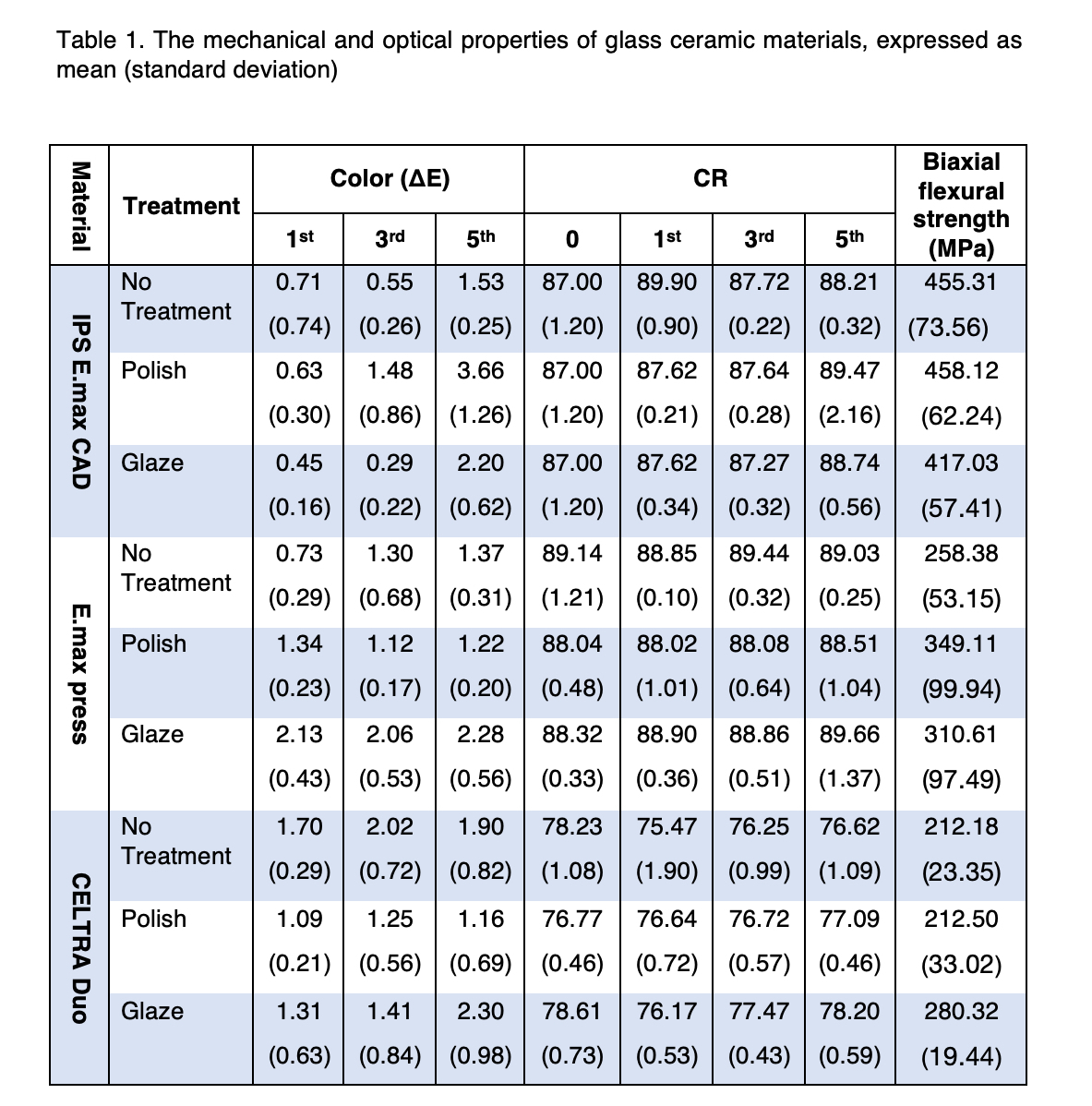
Results: The average and standard deviation of color changes to the green body, contrast ratio and biaxial flexural strength of different glass ceramic materials is shown in Table 1.
Contrast ratio of CELTRA Duo is significantly lower than IPS E.max CAD and E.max Press (p <0.0001). Contrast ratio after repeated firings increases for IPS E.max CAD and E.max press, but decreases for CELTRA Duo.
Treatment, Material type, and firing cycle has no significant effect on color change measured with the spectrophotometer (p >0.05). However, repeated firings produce significantly higher color change than one firing cycle as measured with Easyshade (p<0.001).
After glazing, E.max press has the highest color change, E.max CAD shows the lowest. E.max CAD has significantly higher flexural strength than E.max press and CELTRA Duo. Polished and glazed materials show higher (not statistically significant) flexural strength than no treatment groups.
Conclusions: Type of material, treatment and firing cycle have significant effect on translucency, but their effect on color changes are not clinically perceptible. Polishing and glazing can improve the flexural strength of the glass ceramic materials.
Methods: Three glass-ceramics were investigated; IPS E.max CAD, E.max press and CELTRA Duo. 51 disk-shape specimens, 2 mm in thickness and 12 mm in diameter, for each material were fabricated. Specimens were divided into 3 groups (n=17) as control/no treatment, polishing and glazing group. Five samples from each group were subjected to 1, 3, and 5 simulated “stain” firings using a ceramic furnace according to the manufacturer’s instructions. Color coordinates were recorded in CIE L*a*b* system using an X-rite Ci7600 spectrophotometer and Vita Easy Shade. Color differences relative to the control (ΔE) and translucency by contrast ratio (CR) were recorded. The 3-point flexural strength test was performed using an Instron universal testing machine at across head speed of 0.5 mm/min. with n=12. Data were analyzed using multiple ANOVA (α=0.05).
Results: The average and standard deviation of color changes to the green body, contrast ratio and biaxial flexural strength of different glass ceramic materials is shown in Table 1.
Contrast ratio of CELTRA Duo is significantly lower than IPS E.max CAD and E.max Press (p <0.0001). Contrast ratio after repeated firings increases for IPS E.max CAD and E.max press, but decreases for CELTRA Duo.
Treatment, Material type, and firing cycle has no significant effect on color change measured with the spectrophotometer (p >0.05). However, repeated firings produce significantly higher color change than one firing cycle as measured with Easyshade (p<0.001).
After glazing, E.max press has the highest color change, E.max CAD shows the lowest. E.max CAD has significantly higher flexural strength than E.max press and CELTRA Duo. Polished and glazed materials show higher (not statistically significant) flexural strength than no treatment groups.
Conclusions: Type of material, treatment and firing cycle have significant effect on translucency, but their effect on color changes are not clinically perceptible. Polishing and glazing can improve the flexural strength of the glass ceramic materials.
IMAGES
3319647_File000000.jpg
3319647_File000000.jpg