IADR Abstract Archives
Shear Bond Strength of a Novel Resin Cement to Zirconia
Objectives: Measure shear bond strength(SBS) of a novel resin cement to zirconia in self-cure(sc) and light-cure(lc) modes.
Methods: Two self-adhesive-resin-cements, 1-Experimental Cement(3M) and 2-Calibra Universal(Dentsply); two adhesive-resin-cements, 3-Experimental Cement(3M)+Experimental adhesive(3M) & 4-Panavia V5(Kuraray)+Clearfil Ceramic Primer Plus(Kuraray), were used according to manufacturer’s instructions. A total of 48 zirconia(Lava Esthetic-3M) samples were separated into 8groups(n=6). Samples were sandblasted, rinsed with ethanol and dried with air. Stainless-steel rods measuring 4mm in diameter were sandpapered, sandblasted, silanized and cemented under pressure(20g/mm2). Excess cement was removed immediately, then 1-for self-cure mode, a glycerine gel(Airblock™-Dentsply) was applied around the specimens before storage(10min) under pressure at 36°C; 2-for light-cure mode, a LED-curing unit(Elipar Deep Cure-3M) was used to polymerize(10s) specimens from 4 different angles. After initial treatment, pressure was relieved and specimens were washed off with distilled water. All specimens were stored at 36°C in 100% relative humidity for 24h before testing. SBS was performed in a universal testing machine(Zwick Z010) at crosshead speed of 0.75mm/min. Results were analyzed with ANOVA followed by Tukey HSD test(α=0.05).
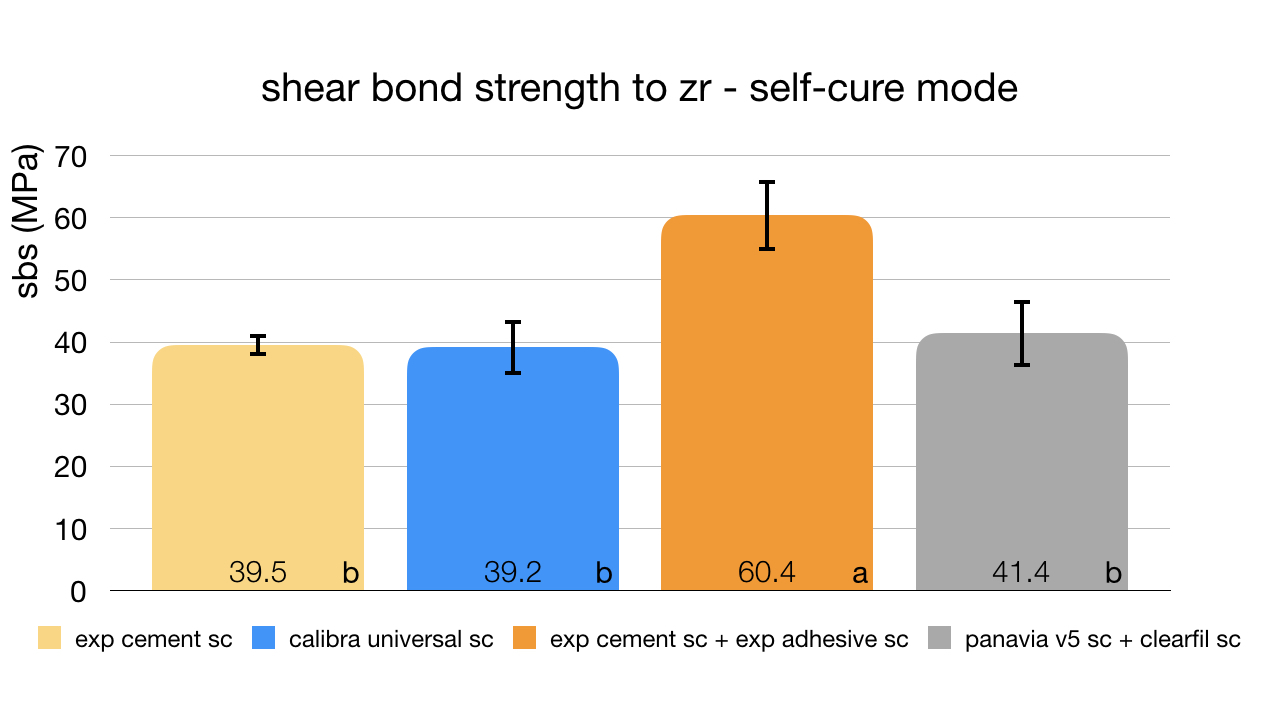
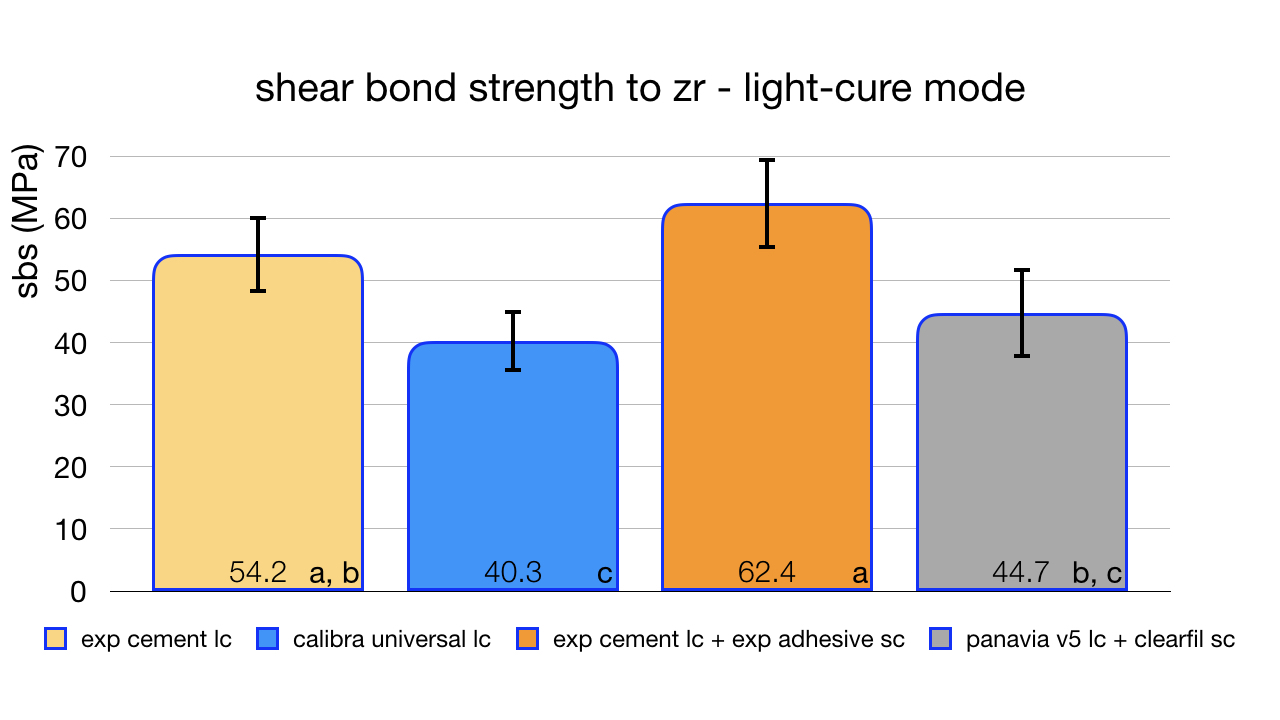
Results: Means and standard deviations of SBS are shown in Figures and Tables. Statistically significant differences in SBS values were found. Subgroups are identified with letters in Figures and Tables. Group3 in self-cure mode presented statistically significantly higher (p<0.05) SBS values than all other groups. In light-cure mode although group3 presented higher SBS values, there was no statistically significant difference (p>0.05) to group1.
Conclusions: Under limitations of this study, it can be concluded that in self-cure mode the Experimental Cement+Experimental adhesive presented SBS values statistically significantly higher. In self-cure mode there was no difference between the Experimental Cement in self-adhesive mode, Calibra Universal and Panavia V5+Clearfil Ceramic Primer Plus. In light-cure, the Experimental Cement+Experimental adhesive presented higher SBS values although there was no statistically significantly difference to the Experimental Cement in self-adhesive mode.
Methods: Two self-adhesive-resin-cements, 1-Experimental Cement(3M) and 2-Calibra Universal(Dentsply); two adhesive-resin-cements, 3-Experimental Cement(3M)+Experimental adhesive(3M) & 4-Panavia V5(Kuraray)+Clearfil Ceramic Primer Plus(Kuraray), were used according to manufacturer’s instructions. A total of 48 zirconia(Lava Esthetic-3M) samples were separated into 8groups(n=6). Samples were sandblasted, rinsed with ethanol and dried with air. Stainless-steel rods measuring 4mm in diameter were sandpapered, sandblasted, silanized and cemented under pressure(20g/mm2). Excess cement was removed immediately, then 1-for self-cure mode, a glycerine gel(Airblock™-Dentsply) was applied around the specimens before storage(10min) under pressure at 36°C; 2-for light-cure mode, a LED-curing unit(Elipar Deep Cure-3M) was used to polymerize(10s) specimens from 4 different angles. After initial treatment, pressure was relieved and specimens were washed off with distilled water. All specimens were stored at 36°C in 100% relative humidity for 24h before testing. SBS was performed in a universal testing machine(Zwick Z010) at crosshead speed of 0.75mm/min. Results were analyzed with ANOVA followed by Tukey HSD test(α=0.05).
Results: Means and standard deviations of SBS are shown in Figures and Tables. Statistically significant differences in SBS values were found. Subgroups are identified with letters in Figures and Tables. Group3 in self-cure mode presented statistically significantly higher (p<0.05) SBS values than all other groups. In light-cure mode although group3 presented higher SBS values, there was no statistically significant difference (p>0.05) to group1.
Conclusions: Under limitations of this study, it can be concluded that in self-cure mode the Experimental Cement+Experimental adhesive presented SBS values statistically significantly higher. In self-cure mode there was no difference between the Experimental Cement in self-adhesive mode, Calibra Universal and Panavia V5+Clearfil Ceramic Primer Plus. In light-cure, the Experimental Cement+Experimental adhesive presented higher SBS values although there was no statistically significantly difference to the Experimental Cement in self-adhesive mode.
IMAGES
3318653_File000000.jpg
3318653_File000001.jpg
3318653_File000000.jpg
3318653_File000001.jpg