IADR Abstract Archives
Microgap Infiltration of Pit & Fissure Sealants
Objectives: Characterize the ability of pit & fissure sealants to infiltrate microgaps. A test was developed that simulates the microgaps presented by deep fissures in molars.
Methods: The gaps presented by deep fissures in molars were simulated by two glass slides with a gap created by a pair of shims. 3M™ Clear Packing Tape and Parafilm™ Liner Paper are used to create 77 and 33 micron gaps, respectively. Two marks 10 mm apart were made along each slide edge. The sealant material were applied on the edge between the marks and allowed to infiltrate for 10 sec, then cured 10 sec with an LED dental curing light (3M™ Elipar™ S10 Light) held 1-2 mm from the glass. Six edge samples were prepared and measured for each material (n=6). Infiltration depth was measured in a Leica™ M165C Stereoscope at eight points along the edge, starting 1 mm from an edge, and spaced 1 mm apart.
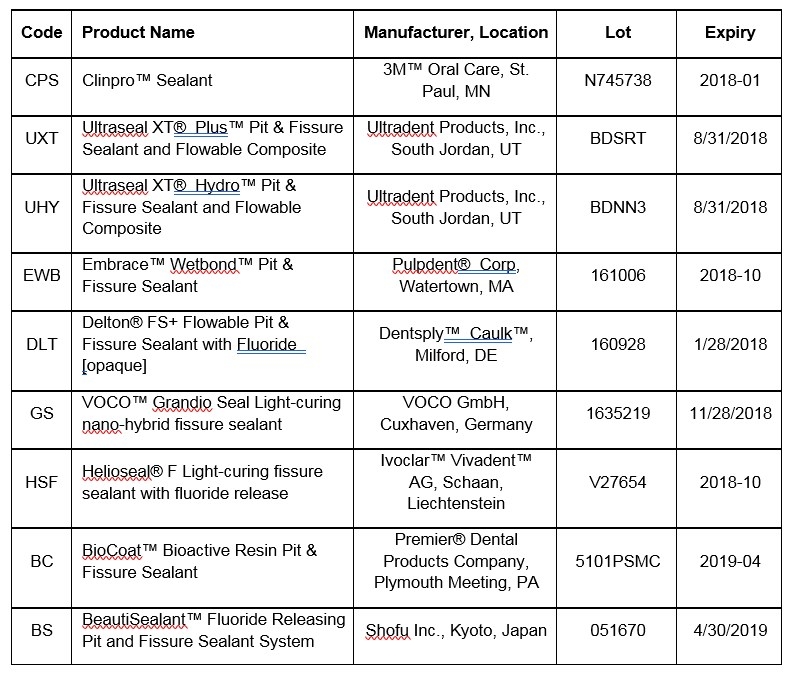
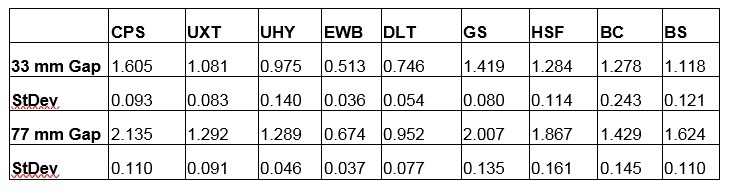
Results: Materials shown in Table 1; microgap infiltration results in Table 2; statistical comparisons in Table 3.
Conclusions: All sealants exhibited at least 500 or 600 microns of infiltration into microgaps of 33 or 77 microns, respectively. Statistically significant differences in microgap penetration were found amongst the sealants. CPS exhibited statistically significantly greater microgap infiltration depth than UXT, UHY, EWB, DLT, HSF, BS, and BC.
Methods: The gaps presented by deep fissures in molars were simulated by two glass slides with a gap created by a pair of shims. 3M™ Clear Packing Tape and Parafilm™ Liner Paper are used to create 77 and 33 micron gaps, respectively. Two marks 10 mm apart were made along each slide edge. The sealant material were applied on the edge between the marks and allowed to infiltrate for 10 sec, then cured 10 sec with an LED dental curing light (3M™ Elipar™ S10 Light) held 1-2 mm from the glass. Six edge samples were prepared and measured for each material (n=6). Infiltration depth was measured in a Leica™ M165C Stereoscope at eight points along the edge, starting 1 mm from an edge, and spaced 1 mm apart.
Results: Materials shown in Table 1; microgap infiltration results in Table 2; statistical comparisons in Table 3.
Conclusions: All sealants exhibited at least 500 or 600 microns of infiltration into microgaps of 33 or 77 microns, respectively. Statistically significant differences in microgap penetration were found amongst the sealants. CPS exhibited statistically significantly greater microgap infiltration depth than UXT, UHY, EWB, DLT, HSF, BS, and BC.
IMAGES
3317336_File000000.jpg
3317336_File000001.jpg

3317336_File000002.jpg
3317336_File000000.jpg
3317336_File000001.jpg
3317336_File000002.jpg