IADR Abstract Archives
Density Changes Induced by Ion-releasing Polyalkenoate Cements after Caries Removal
Objectives: To compare the caries removal ability of different techniques and mineral density changes induced by ion releasing polyalkenoate cements.
Methods: Five standardized dentin cavities were cut at flat occlusal surfaces of 10 extracted human sound third molars. The specimens were submitted to a microbial challenge using a pool of S.mutans (ATCC 25175), S.Sanguis (20556), S.Salivarius (7073) and L.Casei (431) to induce artificial dentin caries formation. They were then scanned by micro-CT in three periods: baseline caries, after excavation and after restoration. Each carious cavity was excavated with different techniques: low speed round bur, hand excavator and two papain-based agents, Papacárie (Fórmula e Ação) and Brix3000 (Brix Medical Science). The central cavity was left unexcavated. Half of the specimens (5) were restored with zinc polycarboxylate cement (Poly Zinc, Prevest) and half with glass ionomer (Ketac Molar, 3M ESPE) and stored in PBS for 45 days under simulated pulpal pressure. The micro-CT stacks (baseline, excavated and restored) were registered, gray values were normalized, a fixed threshold was chosen (40) and applied in baseline and excavated stacks to calculate cavity volumes (mm3). After, density values were calculated from a 3D VOI around the cavity. The specimens were imbedded and prepared for SEM interface evaluation. ANOVA repeated measures was used for statistical analysis.
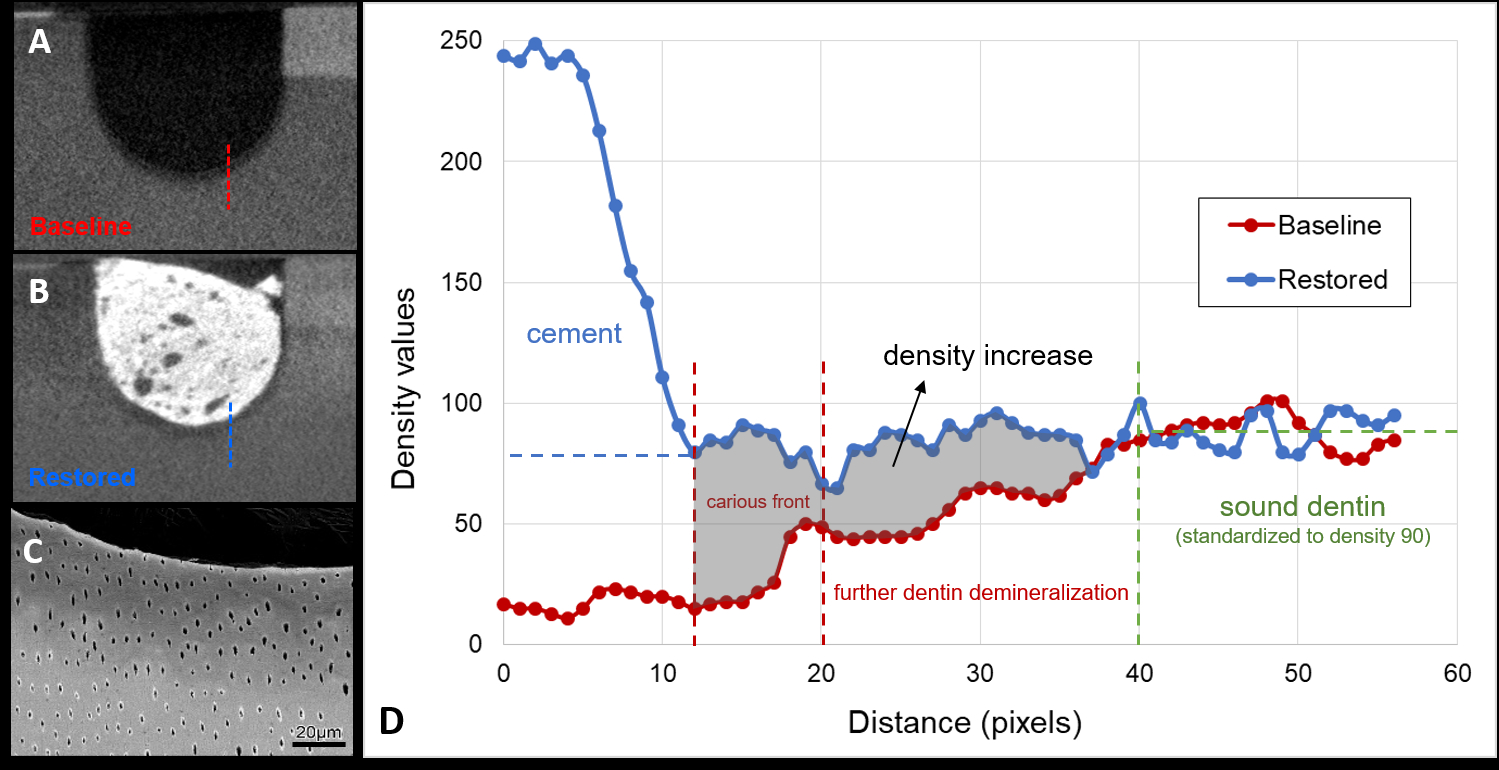
Results: Baseline caries formation (density values), were similar among each excavation group as well as the % cavity volume increase after caries removal (Table 1). A significant interaction was seen when density values were compared between baseline and restored specimens (p<0.01) while zinc polycarboxylate cement resulted in higher density values than glass ionomer (p>0.01) (Table 2). SEM analysis revealed that chemo-mechanical caries removal resulted in a smoother dentin surface compared to bur and hand excavation. Fig. 1 shows density values distribution between carious and restored cavities. In control cavities, the complete demineralization depth was still visible, as well as a brighter surface layer (Fig. 1C).
Conclusions: Caries removal techniques have improved to a minimally invasive removal of carious dentin while zinc polycarboxylate cement is a promising material for increasing density of carious dentin.
Methods: Five standardized dentin cavities were cut at flat occlusal surfaces of 10 extracted human sound third molars. The specimens were submitted to a microbial challenge using a pool of S.mutans (ATCC 25175), S.Sanguis (20556), S.Salivarius (7073) and L.Casei (431) to induce artificial dentin caries formation. They were then scanned by micro-CT in three periods: baseline caries, after excavation and after restoration. Each carious cavity was excavated with different techniques: low speed round bur, hand excavator and two papain-based agents, Papacárie (Fórmula e Ação) and Brix3000 (Brix Medical Science). The central cavity was left unexcavated. Half of the specimens (5) were restored with zinc polycarboxylate cement (Poly Zinc, Prevest) and half with glass ionomer (Ketac Molar, 3M ESPE) and stored in PBS for 45 days under simulated pulpal pressure. The micro-CT stacks (baseline, excavated and restored) were registered, gray values were normalized, a fixed threshold was chosen (40) and applied in baseline and excavated stacks to calculate cavity volumes (mm3). After, density values were calculated from a 3D VOI around the cavity. The specimens were imbedded and prepared for SEM interface evaluation. ANOVA repeated measures was used for statistical analysis.
Results: Baseline caries formation (density values), were similar among each excavation group as well as the % cavity volume increase after caries removal (Table 1). A significant interaction was seen when density values were compared between baseline and restored specimens (p<0.01) while zinc polycarboxylate cement resulted in higher density values than glass ionomer (p>0.01) (Table 2). SEM analysis revealed that chemo-mechanical caries removal resulted in a smoother dentin surface compared to bur and hand excavation. Fig. 1 shows density values distribution between carious and restored cavities. In control cavities, the complete demineralization depth was still visible, as well as a brighter surface layer (Fig. 1C).
Conclusions: Caries removal techniques have improved to a minimally invasive removal of carious dentin while zinc polycarboxylate cement is a promising material for increasing density of carious dentin.
IMAGES
3316739_File000000.jpg
3316739_File000000.jpg