IADR Abstract Archives
Hardness Behavior in Dental Tissues Among Different Species
Objectives: The indentation size effect (ISE) is when the calculated hardness value decreases as the indentation load increases until the hardness-indentation load curve reaches a hardness plateau. Since there is a wide range of loads used for hardness characterization and an absence of evaluation of ISE effects that precludes comparisons in these studies, the aim here is to determine the indentation loads suitable to characterize the hardness of different dental tissues.
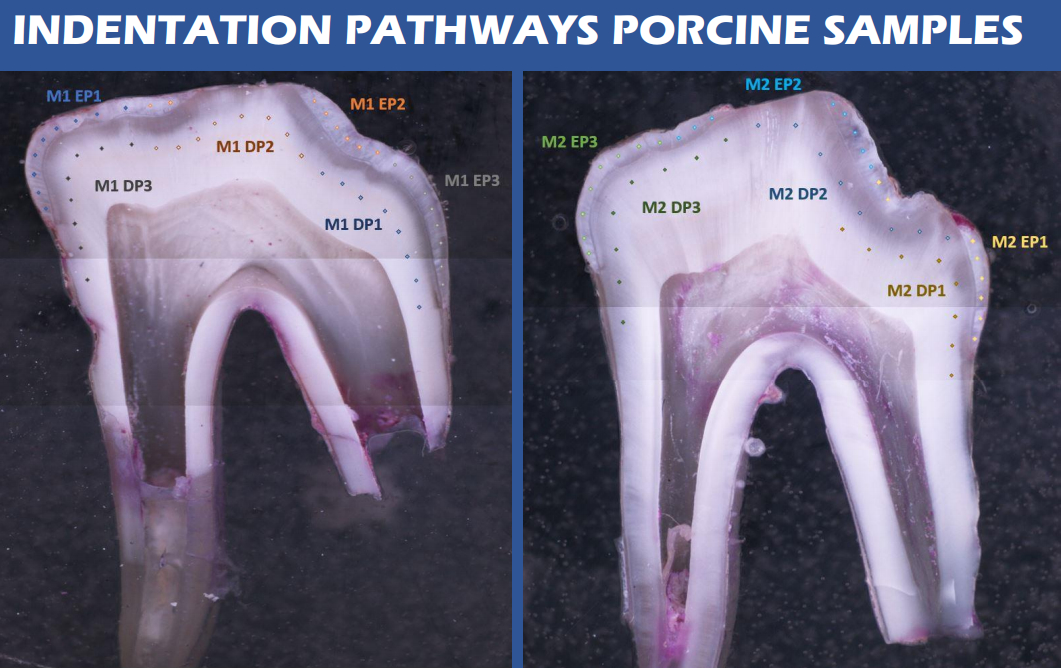
Methods: Two porcine premolars (Sus scrofa domestica), two crocodile teeth (Caiman crocodylus), and two human molars were evaluated with a Vickers micro indentation hardness tester at 8 different loads ranging from 10gf to 1000gf. Several indentation pathways were used for the evaluation of each tooth layer, enamel for the human and porcine samples and dentin for all the specimens, for the construction of the hardness-indentation load curve and subsequent identification of the hardness plateau to determine the appropriate indentation load. A total of 288 successful micro indentations were performed, 24 for each tooth layer.
Results: The enamel exhibited a noticeably decreasing trend where the hardness plateau was reached at different indentation loads for each tissue, being 300 gf for porcine enamel, 500 gf for human enamel, 50 gf for porcine and human dentin, and 500 gf for alligator dentin.
Conclusions: It was concluded that the adequate micro indentation load for hardness characterization in dental tissues stored under hydrated conditions varied among species and layers, demonstrating that a complete hardness-indentation load trend must always be evaluated to determine the adequate micro indentation load to characterize mechanical behavior.
Methods: Two porcine premolars (Sus scrofa domestica), two crocodile teeth (Caiman crocodylus), and two human molars were evaluated with a Vickers micro indentation hardness tester at 8 different loads ranging from 10gf to 1000gf. Several indentation pathways were used for the evaluation of each tooth layer, enamel for the human and porcine samples and dentin for all the specimens, for the construction of the hardness-indentation load curve and subsequent identification of the hardness plateau to determine the appropriate indentation load. A total of 288 successful micro indentations were performed, 24 for each tooth layer.
Results: The enamel exhibited a noticeably decreasing trend where the hardness plateau was reached at different indentation loads for each tissue, being 300 gf for porcine enamel, 500 gf for human enamel, 50 gf for porcine and human dentin, and 500 gf for alligator dentin.
Conclusions: It was concluded that the adequate micro indentation load for hardness characterization in dental tissues stored under hydrated conditions varied among species and layers, demonstrating that a complete hardness-indentation load trend must always be evaluated to determine the adequate micro indentation load to characterize mechanical behavior.
IMAGES
3316731_File000000.jpg

3316731_File000001.jpg

3316731_File000002.jpg
3316731_File000000.jpg
3316731_File000001.jpg
3316731_File000002.jpg