IADR Abstract Archives
Needle-free Dental Anesthesia Technology: From Laboratory to Dental clinic
Objectives: Many patients experience pain and anxiety from conventional dental anesthesia with needles and thus may avoid necessary dental treatments. This problem could be solved by needle-free injections(NFI). The NFI system has been developed for more than 60 years, works by creating a micro-thin, high-speed liquid jet to penetrate the skin and disperse in the soft tissue. The NFI system has many advantages like eliminating needle phobia and injection pain, however, it is rarely used in the dental anesthesia field. The way of NFI system and needle work differently. Previous clinical trials showed the NFI system wasn’t capable of dental anesthesia because of poorly achieved anesthesia effects. Until now, there is no guideline for needle-free dental anesthesia.
The objective of this study is to develop an optimal guideline for needle-free dental anesthesia using a series of in-vitro and in situ experiments and validate the techniques by in vivo clinical trials.
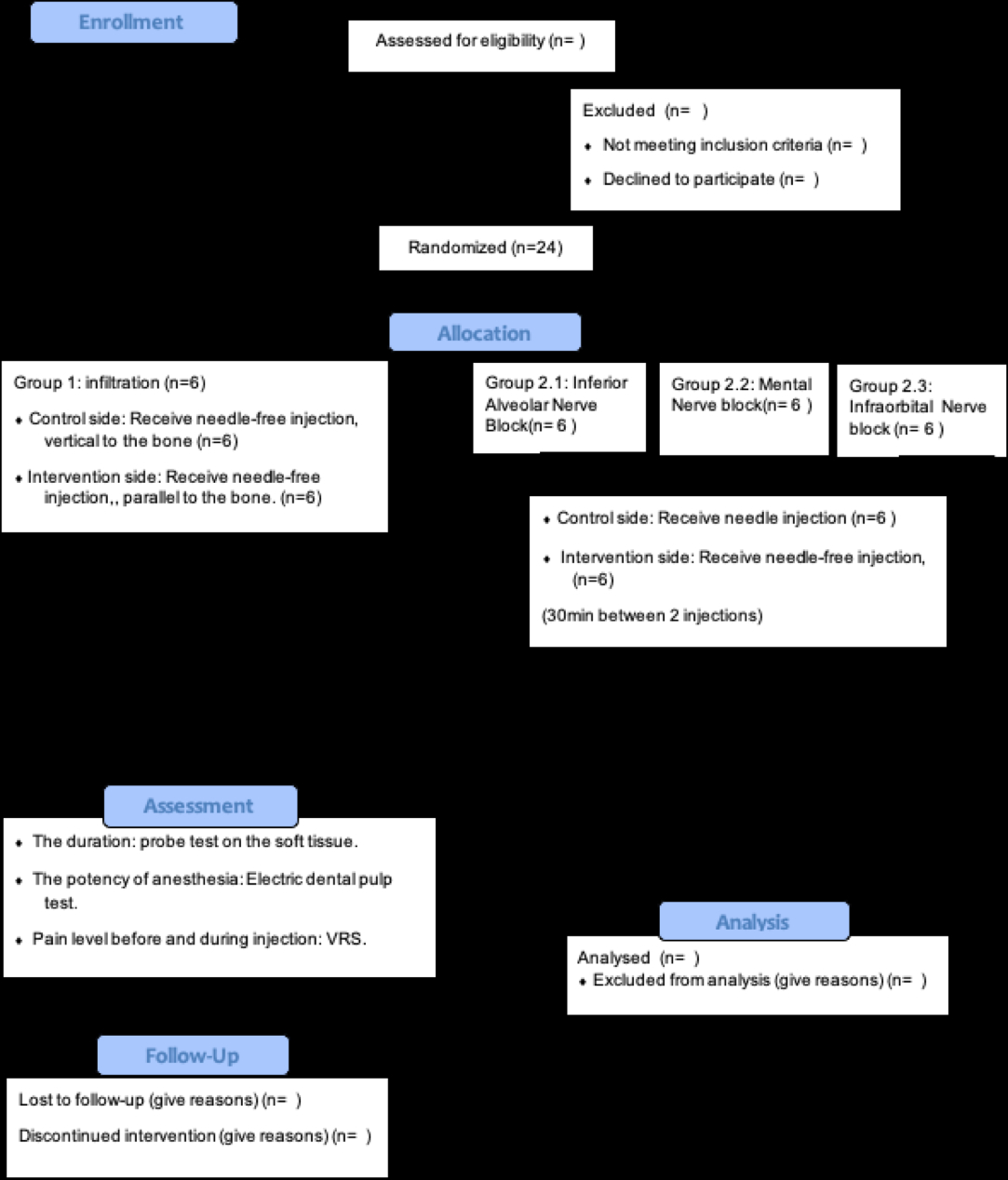
Methods: Needle-free injection tests were first performed on phantom materials mimicking human tissue, to optimize injection effect. After which a series of cadaver experiments were executed to test whether the optimal needle-free anesthesia techniques work on body donors. Finally, a randomized split-mouth clinical trial is designed to test the clinical efficacy by comparing the needle-free anesthesia technique with needle anesthesia.
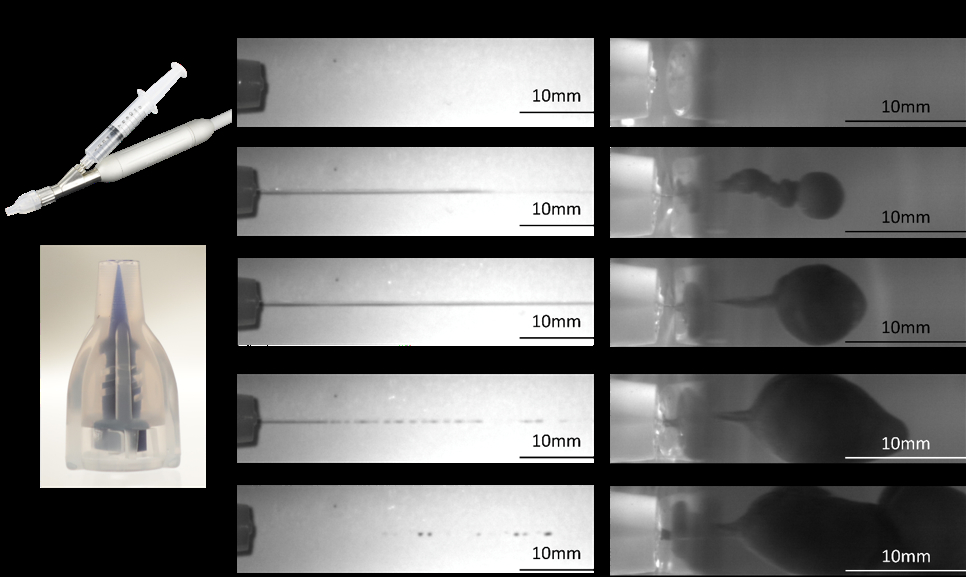
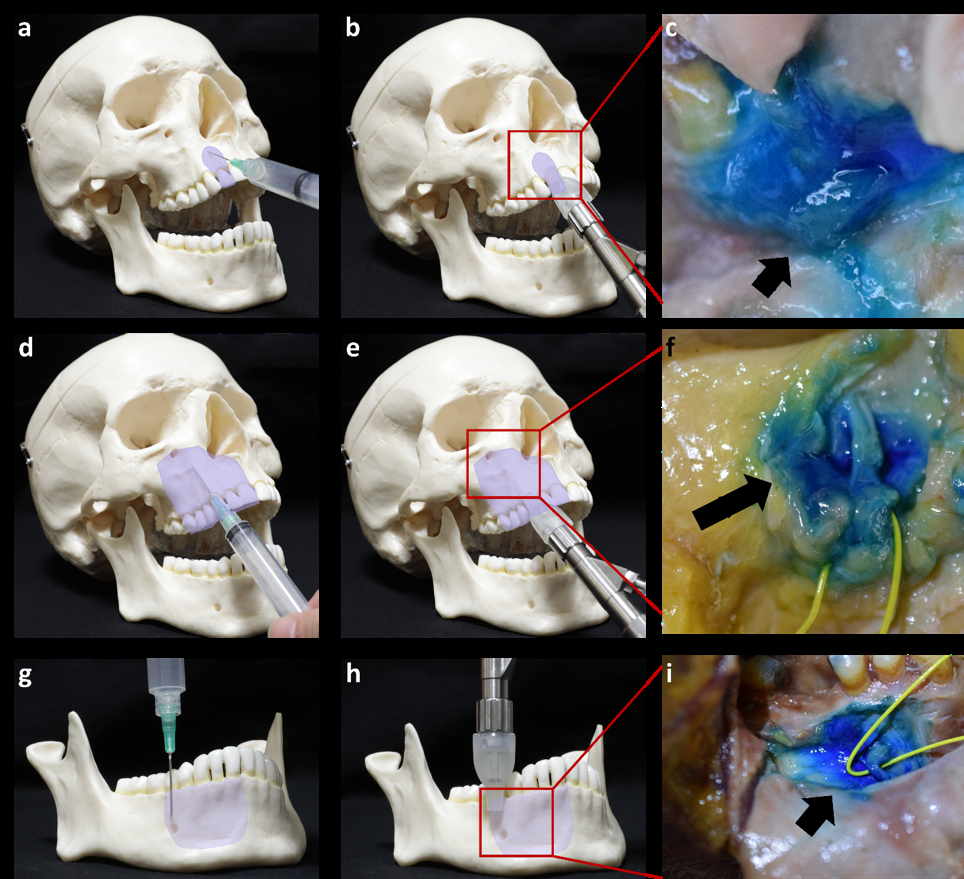
Results: The in vitro experiment shows that needle-free devices could provide sufficient injection depth of 1-3 cm. The injection is predictable based on injection setup. In situ experiment on cadaver shows that the mental, palatine, infraorbital and mandibular inferior alveolar nerve could be successfully blocked with the optimal techniques. Finally, the clinical trial confirmed the anesthesia efficacy and effect of NFI system are similar to needle injection.
Conclusions: This study sets the basis for how to use the needle-free device in the dental clinic in the future, to benefit both patients and clinicians.
The objective of this study is to develop an optimal guideline for needle-free dental anesthesia using a series of in-vitro and in situ experiments and validate the techniques by in vivo clinical trials.
Methods: Needle-free injection tests were first performed on phantom materials mimicking human tissue, to optimize injection effect. After which a series of cadaver experiments were executed to test whether the optimal needle-free anesthesia techniques work on body donors. Finally, a randomized split-mouth clinical trial is designed to test the clinical efficacy by comparing the needle-free anesthesia technique with needle anesthesia.
Results: The in vitro experiment shows that needle-free devices could provide sufficient injection depth of 1-3 cm. The injection is predictable based on injection setup. In situ experiment on cadaver shows that the mental, palatine, infraorbital and mandibular inferior alveolar nerve could be successfully blocked with the optimal techniques. Finally, the clinical trial confirmed the anesthesia efficacy and effect of NFI system are similar to needle injection.
Conclusions: This study sets the basis for how to use the needle-free device in the dental clinic in the future, to benefit both patients and clinicians.
IMAGES
3316412_File000000.jpg
3316412_File000003.jpg
3316412_File000005.jpg
3316412_File000000.jpg
3316412_File000003.jpg
3316412_File000005.jpg