IADR Abstract Archives
Modeling Dental Caries Trajectory Over Life-course Using Machine Learning Technique
Objectives: Unsupervised learning is a machine learning technique that uses algorithms to define hidden patterns or structures and draw inferences from unspecified or unlabeled data and it is novel analytical tool for longitudinal population-based studies in dentistry. Our objective was to model changes in caries patterns from childhood to adulthood using machine learning.
Methods: This is a longitudinal study of caries trajectory over a lif course using data from the Iowa Fluoride Study. A total of 1,382 newborns were recruited at birth and dental exams were conducted at age 5, 9,13,17 and 23. This study focused on permanent dentition at age 9, 13,17 and 23. The data was analyzed using the machine learning algorithm known as the K-means for Longitudinal Data (KmL) which is a k-means based R package specifically designed for analyzing longitudinal data. The algorithm determines the cluster membership by assessing the distance of the individual trajectory from the centroid. Calinsky & Harabatz, Ray & Turi and Davies & Bouldin criteria were used to determine the “best” partitions to explain the data set. The base code and assumptions used was – Kml (Ebtraj,nbClusters = 3:6, nbRedrawing =5, toPlot="both").
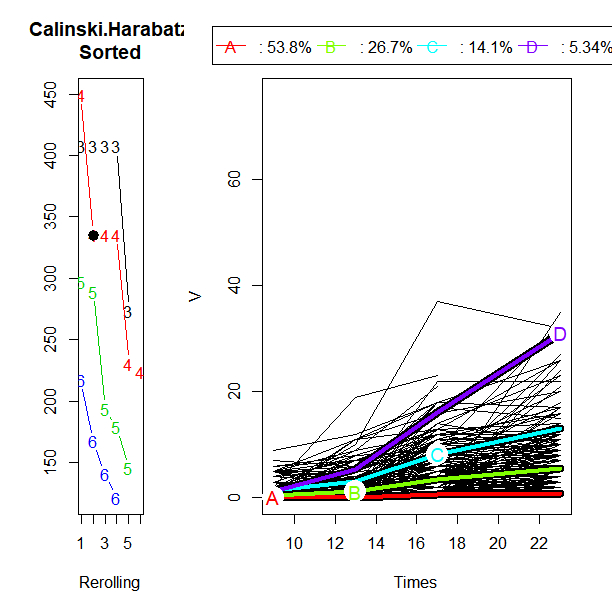
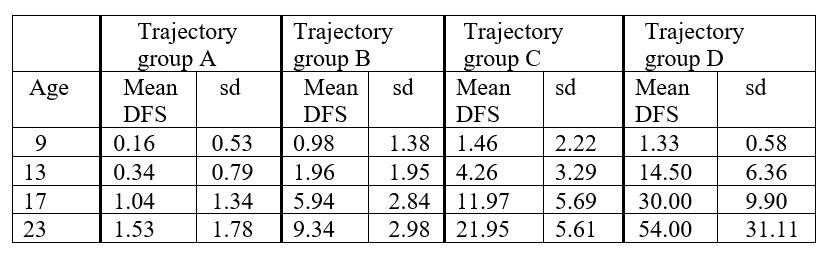
Results: The algorithm identified four trajectory groups as the optimal number of trajectories based on the concordance of the partition criteria. The trajectories group A (low caries group) contained 53.8% of all individual trajectories (n=312). The trajectory group B (medium caries group) had 26.7% of all individual trajectories (n=155). The trajectory group C (high caries group) contained 14.1% of all individual trajectories (n=82). The trajectory group D (very high caries group) contained 5.3% of all individual trajectories (n=31). The mean DFS was found to be significantly different across the trajectory groups (p <0.001). There was a sharp increase in all 4 trajectory slopes from ages 13 to 17.
Conclusions: Machine learning is a viable option for defining caries trajectories because it reduces error in trajectory selection by varying the initiation condition and multiple iteration. Future research should ascertain factors that predict group membership using supervised machine learning techniques.
Methods: This is a longitudinal study of caries trajectory over a lif course using data from the Iowa Fluoride Study. A total of 1,382 newborns were recruited at birth and dental exams were conducted at age 5, 9,13,17 and 23. This study focused on permanent dentition at age 9, 13,17 and 23. The data was analyzed using the machine learning algorithm known as the K-means for Longitudinal Data (KmL) which is a k-means based R package specifically designed for analyzing longitudinal data. The algorithm determines the cluster membership by assessing the distance of the individual trajectory from the centroid. Calinsky & Harabatz, Ray & Turi and Davies & Bouldin criteria were used to determine the “best” partitions to explain the data set. The base code and assumptions used was – Kml (Ebtraj,nbClusters = 3:6, nbRedrawing =5, toPlot="both").
Results: The algorithm identified four trajectory groups as the optimal number of trajectories based on the concordance of the partition criteria. The trajectories group A (low caries group) contained 53.8% of all individual trajectories (n=312). The trajectory group B (medium caries group) had 26.7% of all individual trajectories (n=155). The trajectory group C (high caries group) contained 14.1% of all individual trajectories (n=82). The trajectory group D (very high caries group) contained 5.3% of all individual trajectories (n=31). The mean DFS was found to be significantly different across the trajectory groups (p <0.001). There was a sharp increase in all 4 trajectory slopes from ages 13 to 17.
Conclusions: Machine learning is a viable option for defining caries trajectories because it reduces error in trajectory selection by varying the initiation condition and multiple iteration. Future research should ascertain factors that predict group membership using supervised machine learning techniques.
IMAGES
3315724_File000000.jpg
3315724_File000001.jpg
3315724_File000000.jpg
3315724_File000001.jpg