IADR Abstract Archives
Photodynamic Nanoadditves towards ‘Smart’ Dental Adhesives
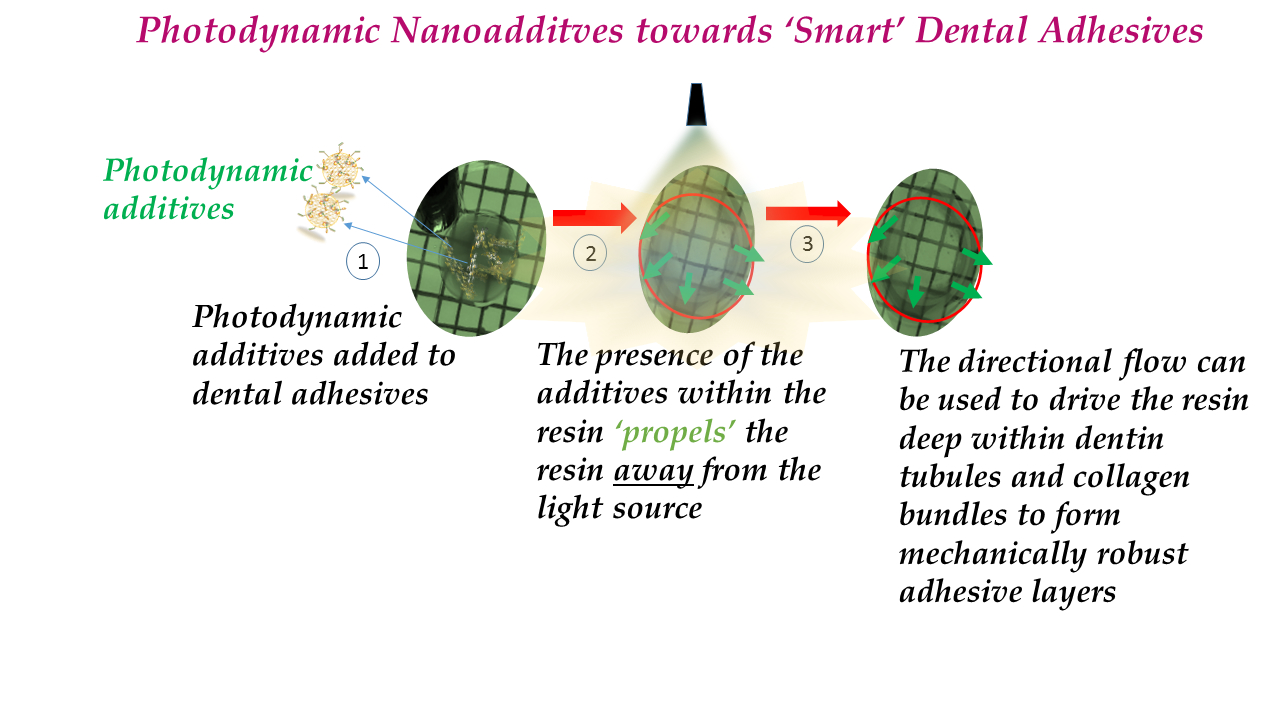
Objectives: The lack of micromechanical retention of the restoration is generally due to failure of the resin-dentin interface, which in turn leads to marginal gap formation, secondary caries, and eventually the replacement of degraded fillings. By incorporation of cytocompatible, 'smart' photodynamic nanoadditives (PDN) within traditional adhesive formulations, we propose to formulate and characterize smart adhesive resins that can undergo directional ‘flow’ away from the light source, to drive the resin deep within dentin tubules and collagen bundles to form mechanically robust adhesive layers
Methods: Tailored nanoscale additives were synthesized, characterized and incorporated within BisGMA/HEMA adhesives to study the fluid movement as a function of 430-480 nm light exposure, which is also utilized to achieve polymerization of the adhesive. Biocompatibility of the molecules were ascertained (ISO-10993) and the growth of Streptococcus mutans biofilms (presence and absence of 1wt% sucrose in BHI) on BisGMA/HEMA adhesive resins was evaluated. Microtensile tests were used to characterize the dentin-adhesive interface while formulations without the nanoadditives were synthesized as controls. The ability of the nanoadditives to compatibilize adhesive resins to form homogenous crosslinked networks in the presence of varied moisture contents was also evaluated.
Results: Photodynamic Nanoadditives (PDN) were synthesized and characterized via GPC (Mw = 12 kDA, Rh = 1.74 nm) and maintained the ability to respond to 430-480 nm light exposure. The μTS Bond Strength tests in permanent molar teeth with the addition of the PDN to BisGMA/HEMA adhesive formulation significantly enhanced the dry bond strength of adhesive formulations (41 ± 9 MPa with PDN vs 20 ± 4 MPa control formulation).
Conclusions: Photodynamic Nanoadditives (PDN) can be incorporated within conventional adhesive networks to generate smart, visible-light propelled adhesives that can penetrate the hybrid layer and reliably anchor restorations while compatibilizing the heterogeneous adhesive resin mixtures to form homogenous crosslinked networks.
Methods: Tailored nanoscale additives were synthesized, characterized and incorporated within BisGMA/HEMA adhesives to study the fluid movement as a function of 430-480 nm light exposure, which is also utilized to achieve polymerization of the adhesive. Biocompatibility of the molecules were ascertained (ISO-10993) and the growth of Streptococcus mutans biofilms (presence and absence of 1wt% sucrose in BHI) on BisGMA/HEMA adhesive resins was evaluated. Microtensile tests were used to characterize the dentin-adhesive interface while formulations without the nanoadditives were synthesized as controls. The ability of the nanoadditives to compatibilize adhesive resins to form homogenous crosslinked networks in the presence of varied moisture contents was also evaluated.
Results: Photodynamic Nanoadditives (PDN) were synthesized and characterized via GPC (Mw = 12 kDA, Rh = 1.74 nm) and maintained the ability to respond to 430-480 nm light exposure. The μTS Bond Strength tests in permanent molar teeth with the addition of the PDN to BisGMA/HEMA adhesive formulation significantly enhanced the dry bond strength of adhesive formulations (41 ± 9 MPa with PDN vs 20 ± 4 MPa control formulation).
Conclusions: Photodynamic Nanoadditives (PDN) can be incorporated within conventional adhesive networks to generate smart, visible-light propelled adhesives that can penetrate the hybrid layer and reliably anchor restorations while compatibilizing the heterogeneous adhesive resin mixtures to form homogenous crosslinked networks.
IMAGES
3314183_File000001.jpg
3314183_File000001.jpg