IADR Abstract Archives
Antibacterial Properties of Four Root-end Filling Materials Against Enterococcus Faecalis
Objectives: Periradicular surgery, followed by placement of a root-end filling material is often the last resort to maintain an endodontically treated tooth with a persistent periapical lesion.The extension of an intraradicular infection may give rise to real extraradicular biofilms on the external root surface and upon the root-end filling materials, also known as biomaterial-centered infection. The main purpose of a root-end filling is to establish a seal between the root canal space and the periradicular tissues. However, the potential extraradicular bacterial colonization indicates a need for antimicrobial efficacy. The aim of the present study was to evaluate the antibacterial properties of four root-end filling materials against both planktonic bacteria and biofilms of Enterococcus faecalis in vitro.
Methods: Biodentine, Totalfill BC RRM, MTA-Angelus and IRM were investigated as freshly mixed, 24 hours and 7 days-set materials. Planktonic bacteria in direct contact with materials’ surfaces and bacteria in 48-hour biofilms against 24-hour materials’ leachates were tested. The experiments were performed in triplicates and analyzed by using one-way analysis of variance.
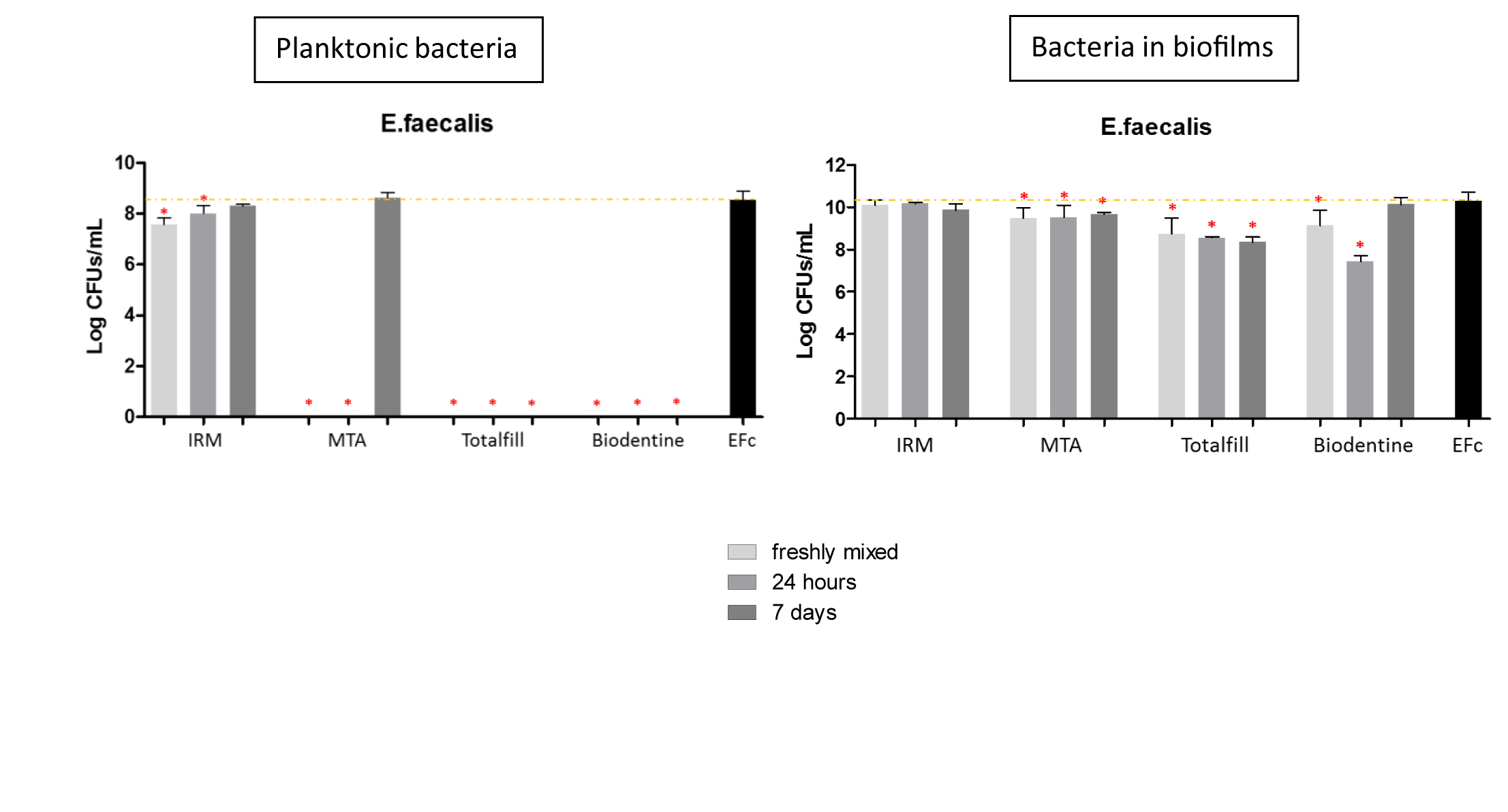
Results: For samples of Totalfill BC RRM and Biodentine, no surviving planktonic bacteria were recovered in all conditions tested. Freshly mixed and 24-hours set IRM reduced the number of bacteria (p<0.05), whilst 7-days set material had no antibacterial effect (p>0.05). MTA-Angelus eliminated the planktonic bacteria in freshly mixed and 24-hours set conditions, while after 7 days lost its antibacterial efficacy (p>0.05). In biofilms, MTA-Angelus, Totalfill and Biodentine were antibacterial in all setting times (p<0.05), except for Biodentine after 7 days (p>0.05). IRM did not exhibit any antibacterial properties against biofilms (p>0.05).
Conclusions: Biodentine, Totalfill BC RRM and MTA-Angelus showed a higher antibacterial efficacy, especially against Enterococcus faecalis in biofilms compared to IRM. Further studies assessing the antibacterial efficacy in more complex environments should be performed by using multispecies biofilms and tooth models.
Methods: Biodentine, Totalfill BC RRM, MTA-Angelus and IRM were investigated as freshly mixed, 24 hours and 7 days-set materials. Planktonic bacteria in direct contact with materials’ surfaces and bacteria in 48-hour biofilms against 24-hour materials’ leachates were tested. The experiments were performed in triplicates and analyzed by using one-way analysis of variance.
Results: For samples of Totalfill BC RRM and Biodentine, no surviving planktonic bacteria were recovered in all conditions tested. Freshly mixed and 24-hours set IRM reduced the number of bacteria (p<0.05), whilst 7-days set material had no antibacterial effect (p>0.05). MTA-Angelus eliminated the planktonic bacteria in freshly mixed and 24-hours set conditions, while after 7 days lost its antibacterial efficacy (p>0.05). In biofilms, MTA-Angelus, Totalfill and Biodentine were antibacterial in all setting times (p<0.05), except for Biodentine after 7 days (p>0.05). IRM did not exhibit any antibacterial properties against biofilms (p>0.05).
Conclusions: Biodentine, Totalfill BC RRM and MTA-Angelus showed a higher antibacterial efficacy, especially against Enterococcus faecalis in biofilms compared to IRM. Further studies assessing the antibacterial efficacy in more complex environments should be performed by using multispecies biofilms and tooth models.
IMAGES
3313506_File000000.jpg
3313506_File000000.jpg