IADR Abstract Archives
3-Dimensional Evaluation of Airway Volumes Among Patients with Ectodermal Dysplasia
Objectives: Ectodermal dysplasias (ED) are a group of inherited congenital disorders characterized by abnormalities of 2 or more ectodermal structures such as the skin, hair, nails, teeth and sweat glands. ED has an incidence rate of about 1 in every 100,000 live births. Individuals with ED often exhibit maxillary hypoplasia, reduced vertical dimension and midfacial retrusion. Previous studies using 2D lateral cephalograms found smaller airway dimensions for patients with ED in comparison to controls. The aim of this study is to compare pharyngeal airway volumes and areas of maximum constriction (MC) in patients with ED to controls (CON) using cone-beam computed tomography (CBCT).
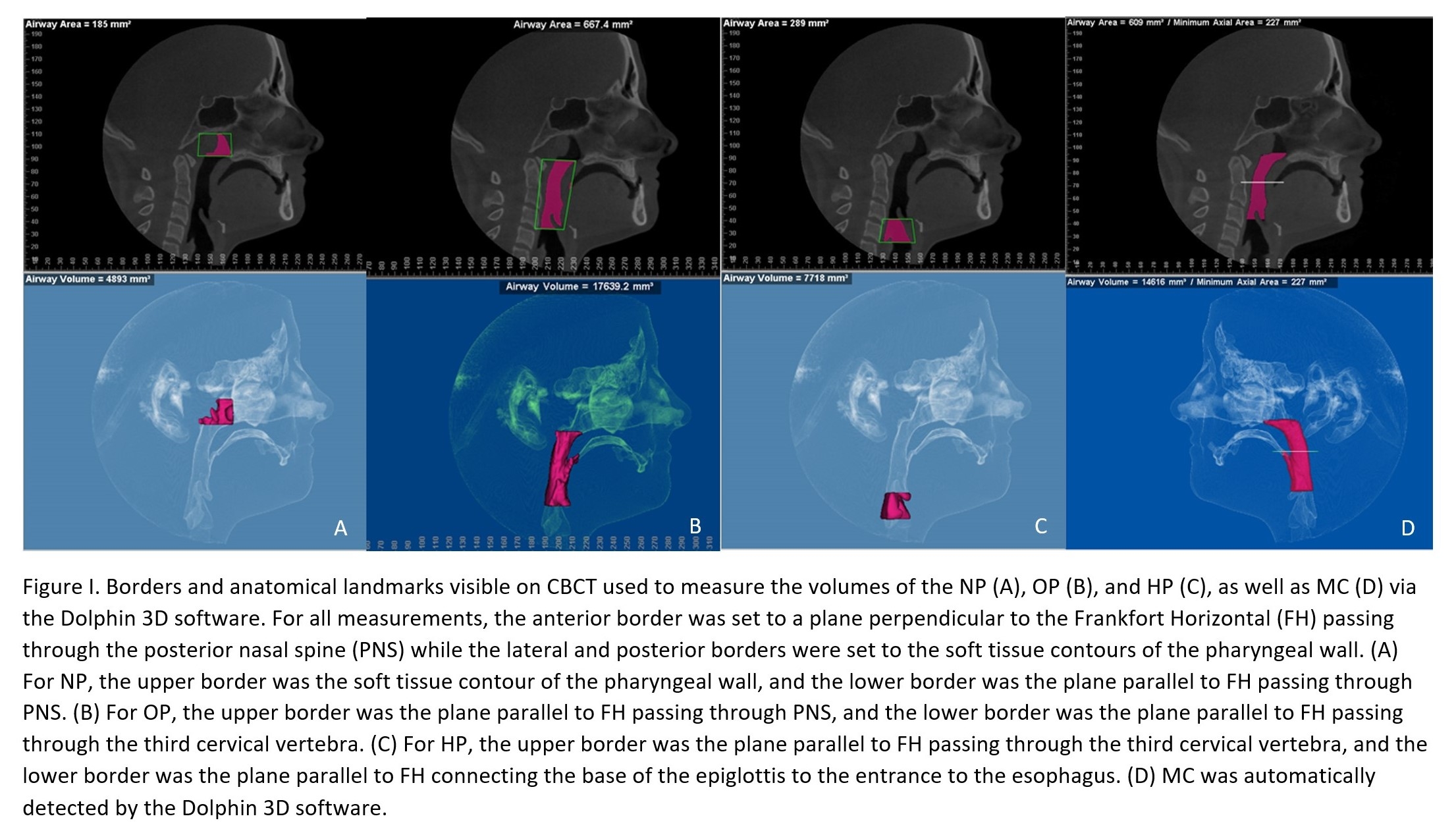
Methods: Our sample included 9 patients with ED and 61 CON. We only included controls with Class 1 occlusion and no skeletal discrepancies in any dimension and excluded those with any associated craniofacial conditions. Pre-treatment CBCT volumes were imported into Dolphin 3D software, which was used to measure the volume of the Nasopharynx (NP), Oropharynx (OP), Hypopharynx (HP), and MC using boundaries outlined by Figure 1. A second investigator re-measured 10 subjects for reliability analysis.
Results: No significant differences were found for the age or gender distributions between ED (mean age=12.8±3.5; 66.7% females) and CON (mean age=13.2±2.0; 44.3% females). All measurements showed normal distribution except HP. Intraclass correlation showed excellent inter-rater reliability (p<.001). Independent t-test showed no significant differences for NP (ED=4032±2305, CON=4314±1674; p=.73), OP (ED=9592±4270, CON=11104±4575; p=.35), HP (ED=4966±1872, CON=5235±2642; p=.74), or MC (ED=125±68, CON=138±61; p=.61) (Table 1).
Conclusions: Despite the maxillary hypoplasia and midface retrusion among patients with ED, the pharyngeal airway volumes among affected individuals do not seem to be significantly different from those of healthy controls. Future studies with larger sample sizes may be needed to confirm our findings.
Methods: Our sample included 9 patients with ED and 61 CON. We only included controls with Class 1 occlusion and no skeletal discrepancies in any dimension and excluded those with any associated craniofacial conditions. Pre-treatment CBCT volumes were imported into Dolphin 3D software, which was used to measure the volume of the Nasopharynx (NP), Oropharynx (OP), Hypopharynx (HP), and MC using boundaries outlined by Figure 1. A second investigator re-measured 10 subjects for reliability analysis.
Results: No significant differences were found for the age or gender distributions between ED (mean age=12.8±3.5; 66.7% females) and CON (mean age=13.2±2.0; 44.3% females). All measurements showed normal distribution except HP. Intraclass correlation showed excellent inter-rater reliability (p<.001). Independent t-test showed no significant differences for NP (ED=4032±2305, CON=4314±1674; p=.73), OP (ED=9592±4270, CON=11104±4575; p=.35), HP (ED=4966±1872, CON=5235±2642; p=.74), or MC (ED=125±68, CON=138±61; p=.61) (Table 1).
Conclusions: Despite the maxillary hypoplasia and midface retrusion among patients with ED, the pharyngeal airway volumes among affected individuals do not seem to be significantly different from those of healthy controls. Future studies with larger sample sizes may be needed to confirm our findings.
IMAGES
3307396_File000000.jpg
3307396_File000000.jpg