IADR Abstract Archives
Biomechanic Effect of Irrigants on Dentine. Systematic Review and Meta-analysis
Objectives: To quantify the effect of irrigants on biomechanical properties of dentine, as reported in available literature.
Methods: A literature review(Publication date:2009-2019) was conducted on different databases. Two researchers identified in vitro studies on permanent teeth root dentine that reported control group, featured non-mechanical preparation and sample size≥10. In case of non-consensus, a third reviewer was consulted. Initial selection process focused on sequential title analysis, abstract evaluation and removal of duplicates. Short-listed papers were subjected to full text reading and qualitative evaluation. An instrument was designed for bias assessment with three categories(High-Uncertain-Low), applying 17 criteria.
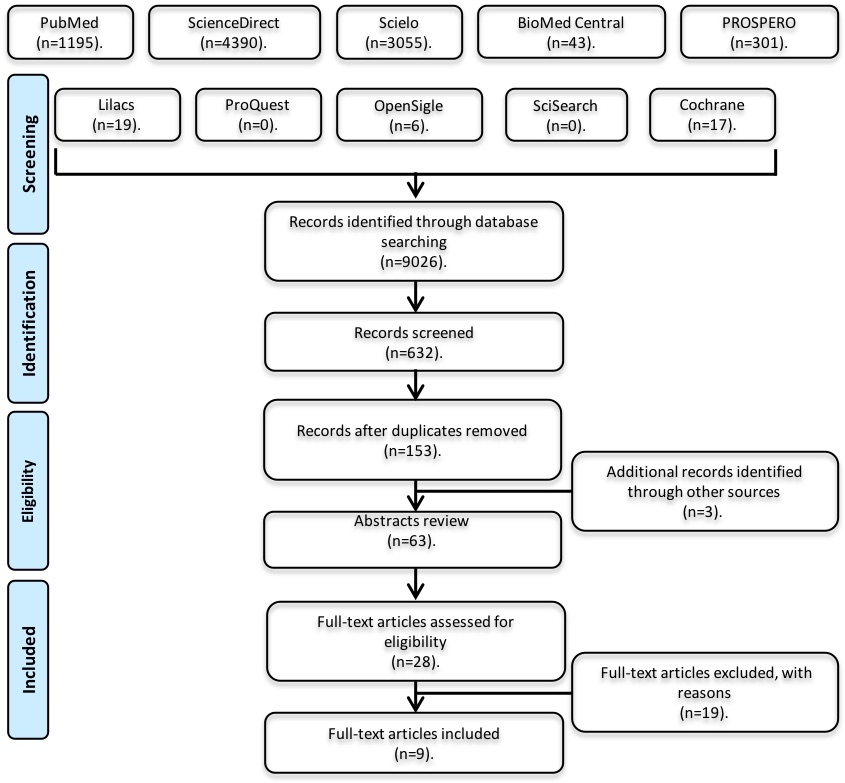
Results: Using the PRISMA tool, an electronic search found 9026 titles. From these, 153 were selected following removal of duplicated. Afterwards, 63 were named for abstract reading. Of these, 28 were subjected to full text analysis. 9 were chosen for further evaluation and qualitative analysis(8:Uncertain bias-1:Low bias).
It was identified that chelating led to a decrease in micro-hardness and stiffness. It was also inferred that proteolytic reduce the modulus of elasticity and flexural resistance.
Finally, 6 of these articles were quantitatively evaluated with RevMan5.3.5(Free software,Copenhagen:TheNordicCochraneCenter,2014). Under the heterogenicity analysis a value I2:92% for microhardness and I2:81% for roughness, reveals high heterogenicity, reason for a careful interpretation. The fixed effect model identified with 95% confidence that NaOCl and EDTA significantly decrease microhardness:-2.21[-2.55,-1.87]; EDTA17%-15min being on average the lowest value:-6.66[-8.32,-5.00]. For the roughness, all the proposed solutions increased significantly:2.23[1.93,2.53]; the highest, 3.94[2.84,5.04], is recorded by NaOCl2.5%-15min. NaOCl and EDTA, are directly proportional to the time of use(10min:1.29-1.97)(15min:3.36-3.94). On the contrary, CLX registered a higher value:3.33[1.88,4.77], depending on its concentration.
Conclusions: Biomechanical properties of dentine are dependent on the integrity of its organic-inorganic components, which are altered by irrigants.
Papers included in this review describe experimental approaches that don’t reflect clinical protocols.
Methods: A literature review(Publication date:2009-2019) was conducted on different databases. Two researchers identified in vitro studies on permanent teeth root dentine that reported control group, featured non-mechanical preparation and sample size≥10. In case of non-consensus, a third reviewer was consulted. Initial selection process focused on sequential title analysis, abstract evaluation and removal of duplicates. Short-listed papers were subjected to full text reading and qualitative evaluation. An instrument was designed for bias assessment with three categories(High-Uncertain-Low), applying 17 criteria.
Results: Using the PRISMA tool, an electronic search found 9026 titles. From these, 153 were selected following removal of duplicated. Afterwards, 63 were named for abstract reading. Of these, 28 were subjected to full text analysis. 9 were chosen for further evaluation and qualitative analysis(8:Uncertain bias-1:Low bias).
It was identified that chelating led to a decrease in micro-hardness and stiffness. It was also inferred that proteolytic reduce the modulus of elasticity and flexural resistance.
Finally, 6 of these articles were quantitatively evaluated with RevMan5.3.5(Free software,Copenhagen:TheNordicCochraneCenter,2014). Under the heterogenicity analysis a value I2:92% for microhardness and I2:81% for roughness, reveals high heterogenicity, reason for a careful interpretation. The fixed effect model identified with 95% confidence that NaOCl and EDTA significantly decrease microhardness:-2.21[-2.55,-1.87]; EDTA17%-15min being on average the lowest value:-6.66[-8.32,-5.00]. For the roughness, all the proposed solutions increased significantly:2.23[1.93,2.53]; the highest, 3.94[2.84,5.04], is recorded by NaOCl2.5%-15min. NaOCl and EDTA, are directly proportional to the time of use(10min:1.29-1.97)(15min:3.36-3.94). On the contrary, CLX registered a higher value:3.33[1.88,4.77], depending on its concentration.
Conclusions: Biomechanical properties of dentine are dependent on the integrity of its organic-inorganic components, which are altered by irrigants.
Papers included in this review describe experimental approaches that don’t reflect clinical protocols.
IMAGES
3306844_File000001.jpg
3306844_File000001.jpg