IADR Abstract Archives
The Theory-based Psychological Predictors of Dental Anxiety Among Adolescents
Objectives: The aim of the present study was to evaluate the efficiency of the Health Belief Model (HBM) in predicting dental anxiety among adolescents.
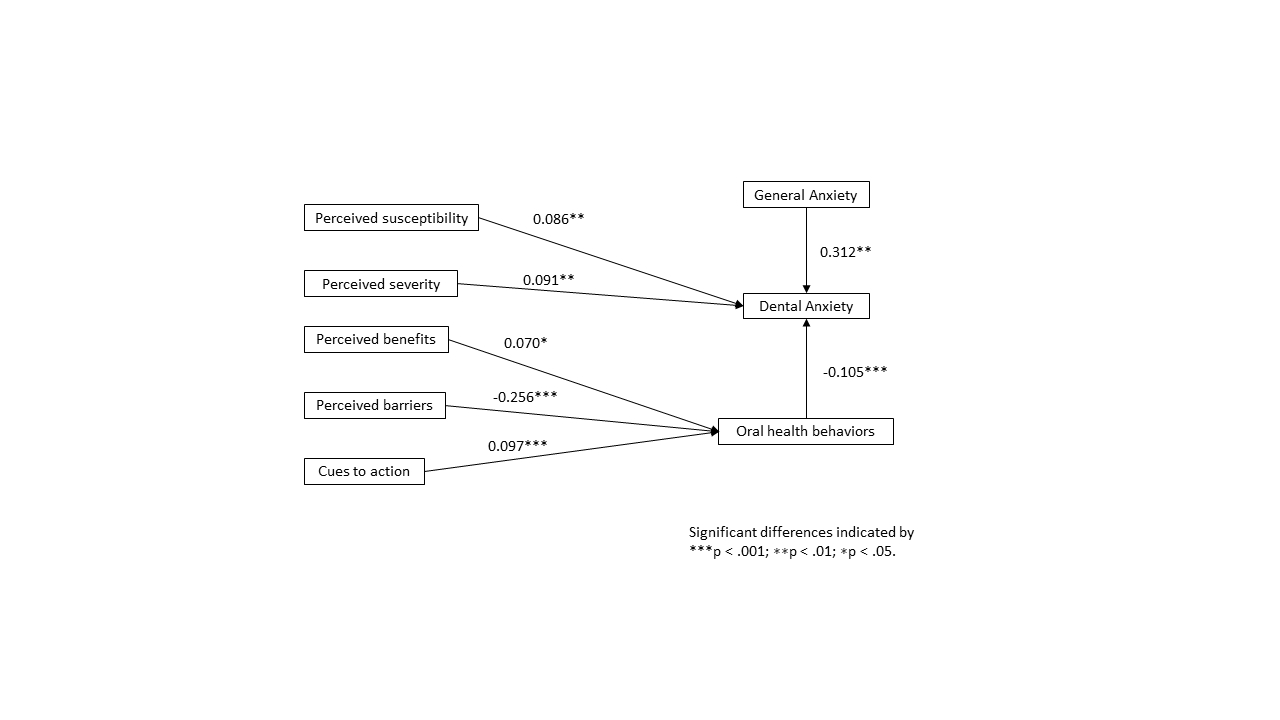
Methods: The study had a cross-sectional design and included 1207 S2 students of 12 secondary schools which were randomly selected from Hong Kong. Data were collected through clinical dental examinations (DMFT) and the questionnaire regarding constructs of health belief model, individual socioeconomic status, oral health behaviors and dental anxiety. Hierarchical regression analyses and structure equation modeling were applied to analyze data. Structural equation modeling was used to test the hypothesized model: pathways to predict dental anxiety based on HBM both directly and via oral health behaviors.
Results: The final model of hierarchical regression analyses showed that girls had higher dental anxiety levels than boys (β=0.096, p<0.01); adolescents who flossed weekly had lower dental anxiety (β=-0.064, p<0.05); and general anxiety (β=0.261, p<0.001), perceived susceptibility (β=0.077, p<0.05) and perceived severity (β=0.094, p<0.01) were all positively associated with dental anxiety levels. The revised final model of path analysis showed a good fit to the model (TLI=0.977; CFI=0.996; RMSEA=0.021; χ2=10.735; df=7; p=0.151). Perceived susceptibility and perceived severity both had a direct effect on dental anxiety.
Conclusions: Our reports support that HBM can predict dental anxiety among adolescents both directly and via oral health-related behaviors.
Methods: The study had a cross-sectional design and included 1207 S2 students of 12 secondary schools which were randomly selected from Hong Kong. Data were collected through clinical dental examinations (DMFT) and the questionnaire regarding constructs of health belief model, individual socioeconomic status, oral health behaviors and dental anxiety. Hierarchical regression analyses and structure equation modeling were applied to analyze data. Structural equation modeling was used to test the hypothesized model: pathways to predict dental anxiety based on HBM both directly and via oral health behaviors.
Results: The final model of hierarchical regression analyses showed that girls had higher dental anxiety levels than boys (β=0.096, p<0.01); adolescents who flossed weekly had lower dental anxiety (β=-0.064, p<0.05); and general anxiety (β=0.261, p<0.001), perceived susceptibility (β=0.077, p<0.05) and perceived severity (β=0.094, p<0.01) were all positively associated with dental anxiety levels. The revised final model of path analysis showed a good fit to the model (TLI=0.977; CFI=0.996; RMSEA=0.021; χ2=10.735; df=7; p=0.151). Perceived susceptibility and perceived severity both had a direct effect on dental anxiety.
Conclusions: Our reports support that HBM can predict dental anxiety among adolescents both directly and via oral health-related behaviors.
IMAGES
3304549_File000000.jpg
3304549_File000000.jpg