IADR Abstract Archives
In vitro Comparison of the Effect of Three Different Polishing Methods
Objectives: The purpose of this in-vitro study was to assess the effect of three different polishing protocols; pumice-flour (PF), prophy-paste (PP) and air-abrasion (AA) on the surface roughness (Ra) and color change (C) of the enamel and compare the results with the enamel specimens exposed to oral beverages.
Methods: Seventy-two enamel specimens prepared from bovine anterior teeth were used for this study. Pre-polishing Ra and tooth color were assessed using a surface profilometer (Perthometer, Germany) and digital spectrophotometer (VITA EasyShade, Germany), respectively. The specimens were randomly divided into Group A: only polishing and Group B: immersion in coffee solution and polishing. Groups were then subdivided into: polishing 15s with PF, PP, or AA. All measurements were performed at baseline, after immersion and after 15s prophylaxis. C was determined by the CIE L*a*b* system. SEM analysis were also performed. Statistical analyses were performed by GraphPad software. In addition, to descriptive analysis multiple comparisons between-groups and in-groups were performed using Kruskal-Wallis and Friedman tests, respectively.
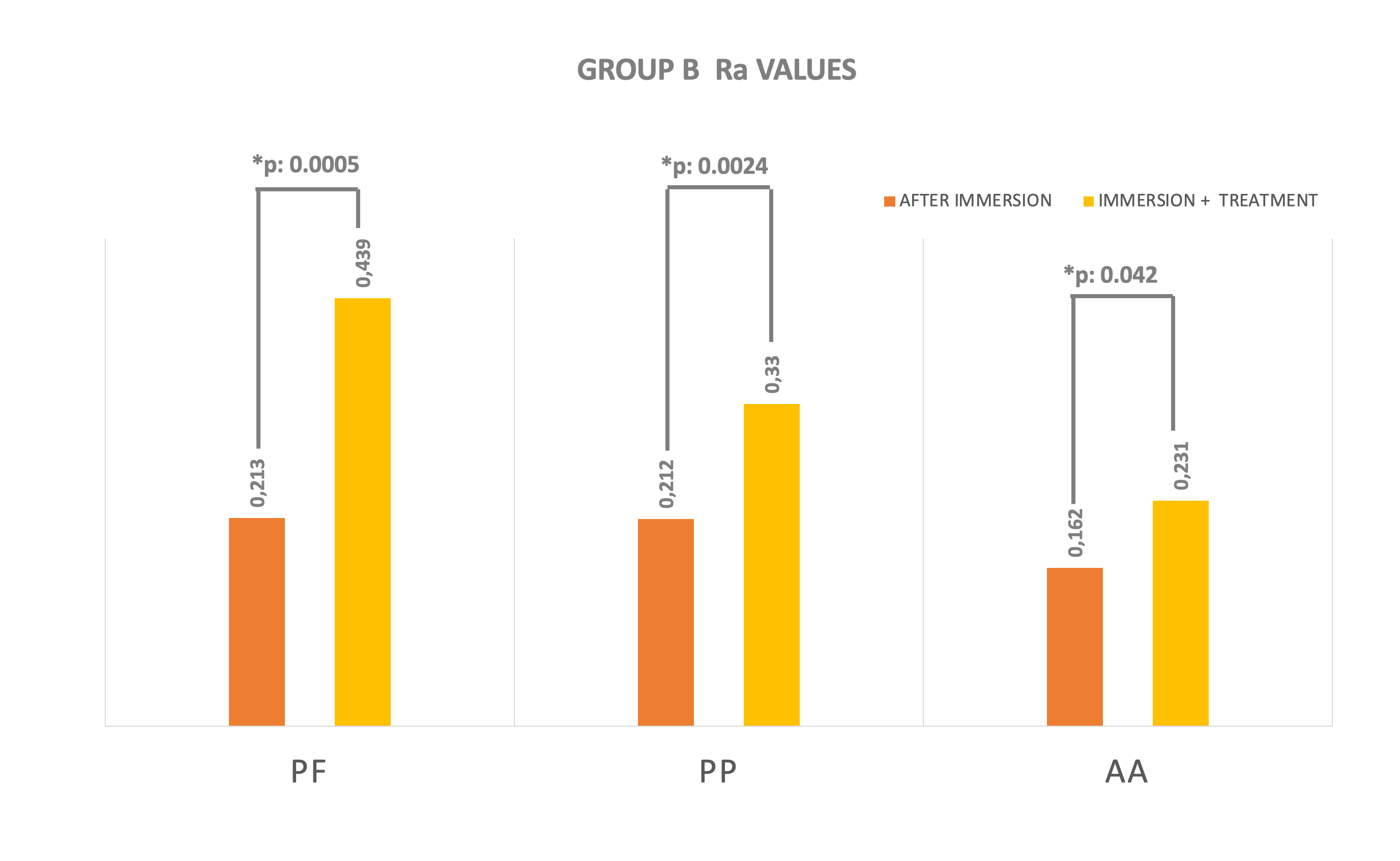
Results: In Group A, Ra values decreased in all protocols; only significant difference was detected in PF subgroup (p:0.016,Fig1). In Group B, Ra values were significantly increased in all subgroups (p<0.05,Fig2). All ΔE values were higher than 3.7 demonstrating clinical success of polishing. In Group A, no statistically significant difference was detected between PF, PP and AA in terms of C (p:0.09). In Group B, the highest ΔE value was detected in PP group.
Conclusions: According to the present study, the smoothest surface was achieved after polishing with PF for 15s. However after coffee immersion, teeth surfaces were more prone to erosion and become rough in all protocols. In all study groups visible clinical success was achieved in terms of color; therefore dental clinicians should prefer PP in clinical practice due to the less abrasive and sufficient color properties.
Methods: Seventy-two enamel specimens prepared from bovine anterior teeth were used for this study. Pre-polishing Ra and tooth color were assessed using a surface profilometer (Perthometer, Germany) and digital spectrophotometer (VITA EasyShade, Germany), respectively. The specimens were randomly divided into Group A: only polishing and Group B: immersion in coffee solution and polishing. Groups were then subdivided into: polishing 15s with PF, PP, or AA. All measurements were performed at baseline, after immersion and after 15s prophylaxis. C was determined by the CIE L*a*b* system. SEM analysis were also performed. Statistical analyses were performed by GraphPad software. In addition, to descriptive analysis multiple comparisons between-groups and in-groups were performed using Kruskal-Wallis and Friedman tests, respectively.
Results: In Group A, Ra values decreased in all protocols; only significant difference was detected in PF subgroup (p:0.016,Fig1). In Group B, Ra values were significantly increased in all subgroups (p<0.05,Fig2). All ΔE values were higher than 3.7 demonstrating clinical success of polishing. In Group A, no statistically significant difference was detected between PF, PP and AA in terms of C (p:0.09). In Group B, the highest ΔE value was detected in PP group.
Conclusions: According to the present study, the smoothest surface was achieved after polishing with PF for 15s. However after coffee immersion, teeth surfaces were more prone to erosion and become rough in all protocols. In all study groups visible clinical success was achieved in terms of color; therefore dental clinicians should prefer PP in clinical practice due to the less abrasive and sufficient color properties.
IMAGES

3292234_File000002.jpg
3292234_File000003.jpg
3292234_File000002.jpg
3292234_File000003.jpg