IADR Abstract Archives
Association Between Plaque Scores and Brushing Behavior in Young Children
Objectives: To determine if plaque scores reflect brushing behaviors in young children, we tested associations between plaque scores and multiple brushing behavior and tested if plaque scores varied by select demographic factors.
Methods: Data are from the baseline sample of trial NCT03397589 testing an oral health intervention for urban low-income young children. Child-caregiver dyads were recruited from social service agencies and primary care clinics in Cook County, IL. Research assistants collected data mainly in homes. Behaviors were self-reported and observed. Plaque score was captured by disclosing plaque and photographing primary maxillary incisors using methods previously tested for feasibility and reliability. Two calibrated examiners scored photographs using the Oral Hygiene Index Maxillary Incisor Simplified (OHI-MIS) scale to establish a plaque score ranging from 0-3 for each subject. Scores of 0.3-0.6 are considered good, 0.7-1.8 are fair, and 1.9-3.0 are poor. Bivariate statistics were analyzed using ANOVA and independent t-tests to explore for differences between plaque and covariates.
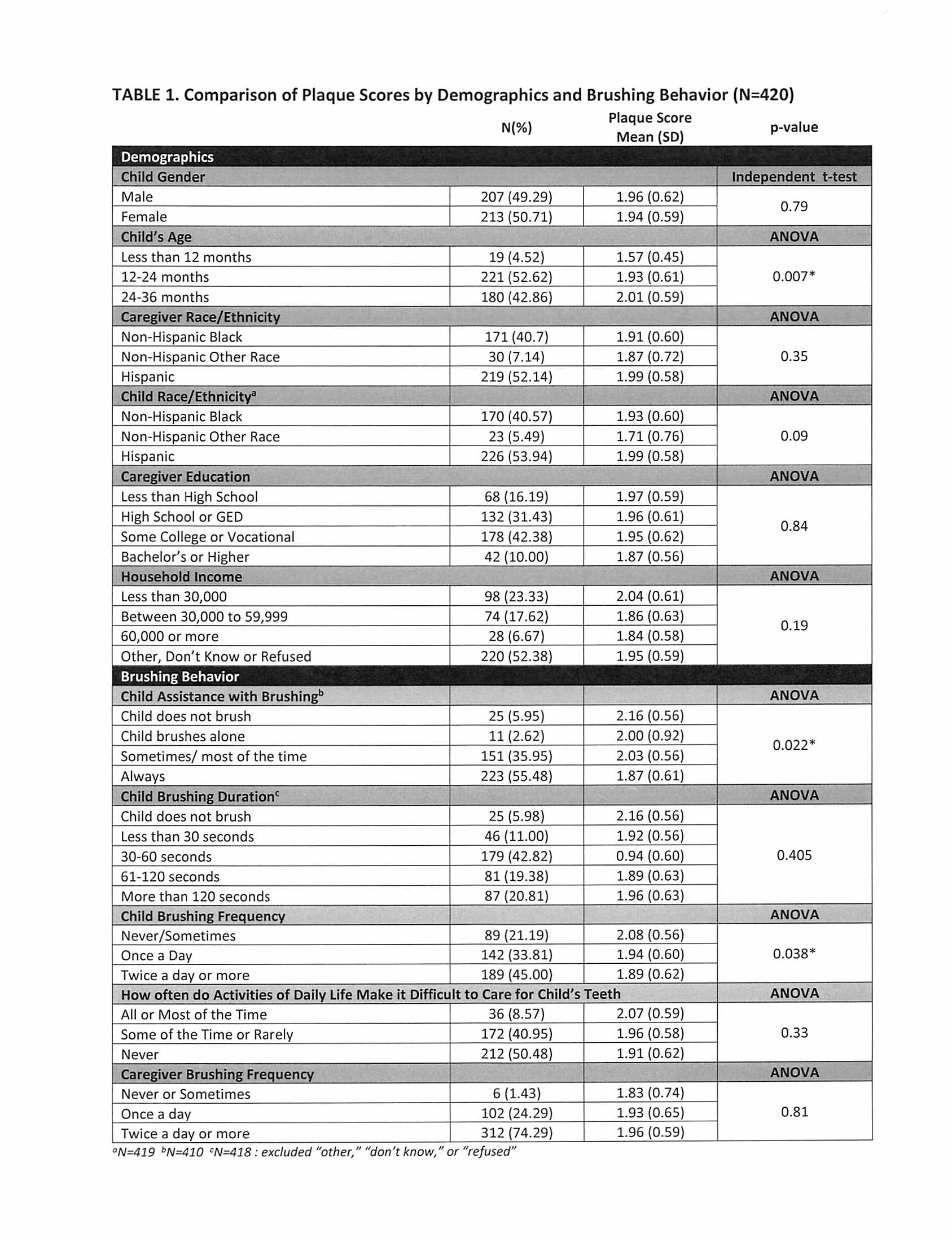
Results: Results: 420 caregiver-dyads participated; 213 (50.71%) children and 405 (96.43%) caregivers were female. Average child age was 21.52 months (SD 6.92), and average caregiver age was 29.60 years (SD 6.61). Nearly all children (90.4%) had dental coverage with Medicaid. Among child race/ethnicity, 226 (53.94%) identified as Hispanic, 170 (40.57%) identified as non-Hispanic black, and 23 (5.49%) identified as Non-Hispanic “Other.” Mean total plaque score was 1.95 (SD 0.60). Lower plaque scores were associated with younger child age (p=0.007), children who receive assistance with brushing (p=0.022), and children who brush more frequently (p=0.038).
Conclusions: Conclusions: These findings suggest that plaque score can be captured using non-clinicians in community environments. The OHI-MIS measure has variability and aligns well with brushing behaviors/age, suggesting it could capture brushing behaviors. Future research should explore if changes in plaque scores over time are associated with interventions that improve oral health behaviors.
Methods: Data are from the baseline sample of trial NCT03397589 testing an oral health intervention for urban low-income young children. Child-caregiver dyads were recruited from social service agencies and primary care clinics in Cook County, IL. Research assistants collected data mainly in homes. Behaviors were self-reported and observed. Plaque score was captured by disclosing plaque and photographing primary maxillary incisors using methods previously tested for feasibility and reliability. Two calibrated examiners scored photographs using the Oral Hygiene Index Maxillary Incisor Simplified (OHI-MIS) scale to establish a plaque score ranging from 0-3 for each subject. Scores of 0.3-0.6 are considered good, 0.7-1.8 are fair, and 1.9-3.0 are poor. Bivariate statistics were analyzed using ANOVA and independent t-tests to explore for differences between plaque and covariates.
Results: Results: 420 caregiver-dyads participated; 213 (50.71%) children and 405 (96.43%) caregivers were female. Average child age was 21.52 months (SD 6.92), and average caregiver age was 29.60 years (SD 6.61). Nearly all children (90.4%) had dental coverage with Medicaid. Among child race/ethnicity, 226 (53.94%) identified as Hispanic, 170 (40.57%) identified as non-Hispanic black, and 23 (5.49%) identified as Non-Hispanic “Other.” Mean total plaque score was 1.95 (SD 0.60). Lower plaque scores were associated with younger child age (p=0.007), children who receive assistance with brushing (p=0.022), and children who brush more frequently (p=0.038).
Conclusions: Conclusions: These findings suggest that plaque score can be captured using non-clinicians in community environments. The OHI-MIS measure has variability and aligns well with brushing behaviors/age, suggesting it could capture brushing behaviors. Future research should explore if changes in plaque scores over time are associated with interventions that improve oral health behaviors.
IMAGES
3289070_File000001.jpg
3289070_File000001.jpg