IADR Abstract Archives
Precision and Accuracy of the TRIOS® Intraoral scanner for Shade-matching
Objectives: Dentists rely on visual guidance for shade-matching even though numerous external factors can influence this determination. Technologies for electronic shade matching including spectrophotometers can be more accurate measures of tooth shade. This study aims to analyze the ability of the TRIOS® intraoral scanner (3shape) to provide precise and accurate shade matches compared to a spectrophotometer.
Methods: To compare the shades from the TRIOS and the spectrophotomer, each VITA shade value was assigned a numerical value based on the color value order from lightest to darkest on the VITA classical shade guide (B1,A1,B2,D2,A2,C1,C2,D4,A3,D3,B3,A3.5,B4,C3,A4,C4). Twenty human posterior teeth were evaluated. Samples were mounted in a typodont with adjacent typodont teeth of the same shade. Samples were scanned using the TRIOS scanner with 300 images per scan, per manufacturer instructions. The VITA color data was collected from the incisal, middle and cervical sections of the mid-buccal surface of each sample. Scans of three adjacent typodont teeth were taken each time to verify scan consistency between samples. Samples were scanned in triplicate to verify precision. Samples and typodont teeth were scanned with the Crystaleye spectrophotometer (Olympus) at the same three points. Intra-scanner reliability for the TRIOS scanner was assessed with intraclass correlation coefficient and interpretation was performed using Landis and Koch criteria. Agreement between the TRIOS scanner and spectrophotometer was compared using the Spearman rank correlation. P-values <0.05 were considered statistically significant.
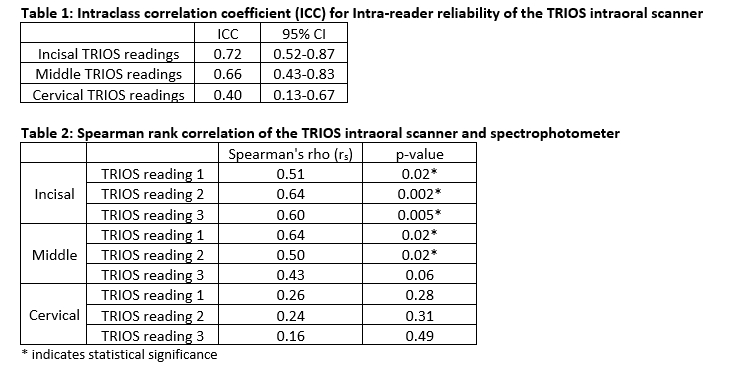
Results: There was substantial agreement in shade values at the incisal and middle thirds per Landis and Koch criteria (Table 1). There was a moderate positive correlation between TRIOS and spectrophotometer readings at the incisal and middle thirds (Table 2).
Conclusions: When using the TRIOS scanner for shade-matching, the cervical third of the tooth should be avoided in the determination of shade to ensure precision and accuracy of the shade match.
Methods: To compare the shades from the TRIOS and the spectrophotomer, each VITA shade value was assigned a numerical value based on the color value order from lightest to darkest on the VITA classical shade guide (B1,A1,B2,D2,A2,C1,C2,D4,A3,D3,B3,A3.5,B4,C3,A4,C4). Twenty human posterior teeth were evaluated. Samples were mounted in a typodont with adjacent typodont teeth of the same shade. Samples were scanned using the TRIOS scanner with 300 images per scan, per manufacturer instructions. The VITA color data was collected from the incisal, middle and cervical sections of the mid-buccal surface of each sample. Scans of three adjacent typodont teeth were taken each time to verify scan consistency between samples. Samples were scanned in triplicate to verify precision. Samples and typodont teeth were scanned with the Crystaleye spectrophotometer (Olympus) at the same three points. Intra-scanner reliability for the TRIOS scanner was assessed with intraclass correlation coefficient and interpretation was performed using Landis and Koch criteria. Agreement between the TRIOS scanner and spectrophotometer was compared using the Spearman rank correlation. P-values <0.05 were considered statistically significant.
Results: There was substantial agreement in shade values at the incisal and middle thirds per Landis and Koch criteria (Table 1). There was a moderate positive correlation between TRIOS and spectrophotometer readings at the incisal and middle thirds (Table 2).
Conclusions: When using the TRIOS scanner for shade-matching, the cervical third of the tooth should be avoided in the determination of shade to ensure precision and accuracy of the shade match.
IMAGES
3288515_File000000.jpg
3288515_File000000.jpg