IADR Abstract Archives
Short (SI) vs Standard Length (ST) Cone Morse Connection Implants: An in vitro Study in Low Density Polyurethane Foam
Objectives: Aim of the present study was to compare the insertion torque, pull-out torque and ISQ of Short Implants (SI) and Standard Length Implants (ST), inserted into polyurethane foam blocks.
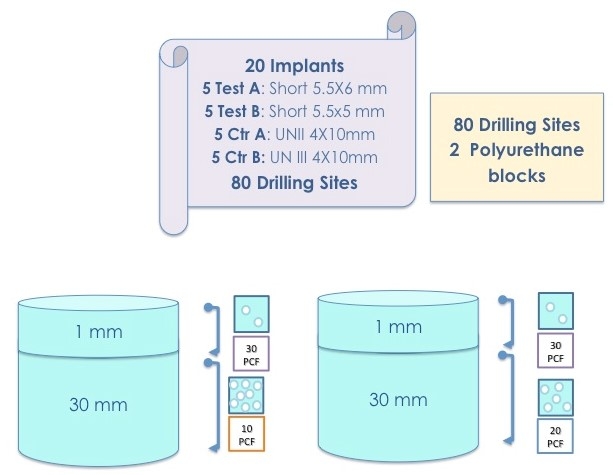
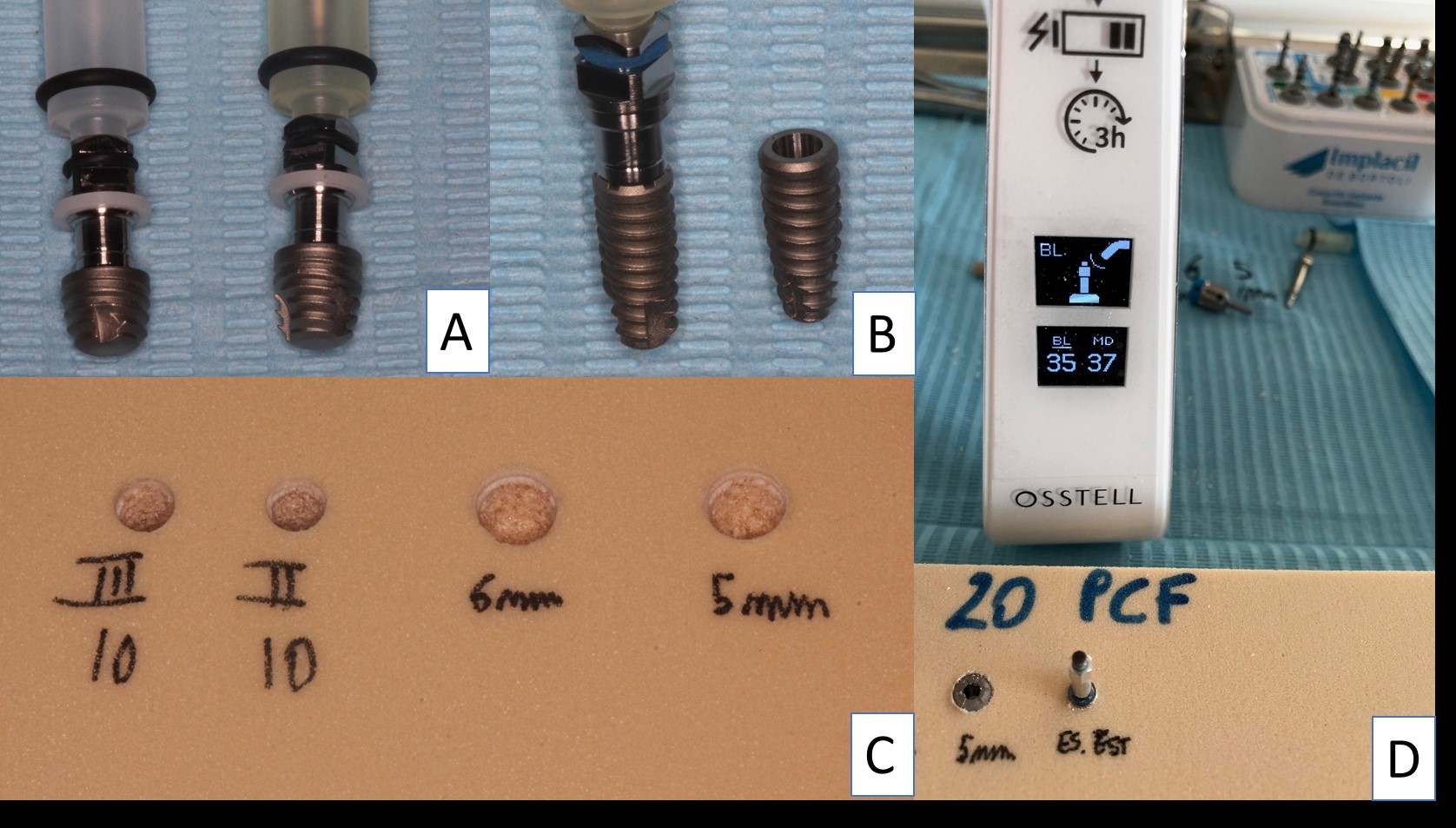
Methods: Short dental titanium implants with a Cone Morse connection and a conical shape (Test Implants: Test Implant A - diameter 5.5 mm and length 6 mm) (Test Implant B – diameter 5.5 mm and length 5 mm) were used for the present investigation. ST implants (4 mm diameter and 10 mm length, with a Cone Morse connection and a conical shape), were used as Control Implant A and B. These implants had a different macrodesign. A total of 20 implants (5 Test A, 5 Test B, 5 Control A and 5 Control B) were used.
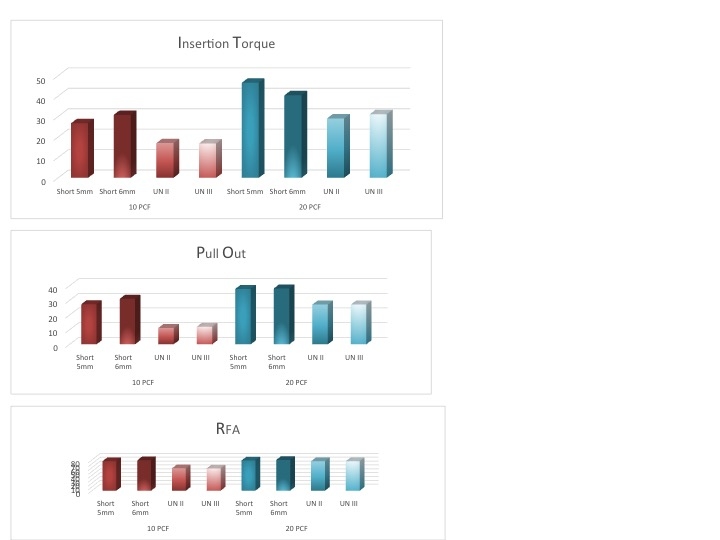
Results: The results were similar when comparing the Test A and B implants. Test implants had a very good stability in polyurethane 10-20 pcf density blocks. The insertion torque values were very high for both types of Test Implants (25-32 Ncm on 10 pcf blocks, and up to 45 Ncm in 20 pcf blocks). The pull-out test values were very similar to the insertion torque values. The ISQ values were significantly high with 75-80 in 10 pcf blocks, and 78-83 in 20 pcf blocks. No differences were found in the values of the Control A and Control B implants. In both these implants the insertion torque were quite low in the 10 pcf blocks. Better results were found in the 20 pcf blocks. The pull-out values for these Control Implants were slightly lower than the insertion torque values. High ISQ values were found in both Control Implants.
Conclusions: When comparing SI and ST implants, the SI had a similar if not better performance in low quality polyurethane foam blocks, corresponding to D3 and D4 bone.
Methods: Short dental titanium implants with a Cone Morse connection and a conical shape (Test Implants: Test Implant A - diameter 5.5 mm and length 6 mm) (Test Implant B – diameter 5.5 mm and length 5 mm) were used for the present investigation. ST implants (4 mm diameter and 10 mm length, with a Cone Morse connection and a conical shape), were used as Control Implant A and B. These implants had a different macrodesign. A total of 20 implants (5 Test A, 5 Test B, 5 Control A and 5 Control B) were used.
Results: The results were similar when comparing the Test A and B implants. Test implants had a very good stability in polyurethane 10-20 pcf density blocks. The insertion torque values were very high for both types of Test Implants (25-32 Ncm on 10 pcf blocks, and up to 45 Ncm in 20 pcf blocks). The pull-out test values were very similar to the insertion torque values. The ISQ values were significantly high with 75-80 in 10 pcf blocks, and 78-83 in 20 pcf blocks. No differences were found in the values of the Control A and Control B implants. In both these implants the insertion torque were quite low in the 10 pcf blocks. Better results were found in the 20 pcf blocks. The pull-out values for these Control Implants were slightly lower than the insertion torque values. High ISQ values were found in both Control Implants.
Conclusions: When comparing SI and ST implants, the SI had a similar if not better performance in low quality polyurethane foam blocks, corresponding to D3 and D4 bone.
IMAGES
3285733_File000000.jpg
3285733_File000001.jpg
3285733_File000002.jpg
3285733_File000000.jpg
3285733_File000001.jpg
3285733_File000002.jpg