IADR Abstract Archives
Intrinsically-disordered Proteins to Guide the Growth of Hierarchical Mineralised Structures
Objectives: There is growing evidence that intrinsically disordered proteins (IDPs) play a fundamental role in mineralisation. IDPs contribute in intermolecular interactions at the protein–mineral interface. Here we report a protein-mediated mineralisation process that takes advantage of disorder-order interplay using elastin-like recombinamers (ELRs) to program organic-inorganic interactions into hierarchically-ordered mineralised structures.
Methods: We exploited recombinant technologies to design a supramolecular matrix that is based on ELR molecules consisting of a main hydrophobic framework (VPGIG), a positively charged segment (VPGKG) with the amino acid lysine (K) for ELR cross-linking, and the highly-acidic statherin-derived analogue. In addition, collagen membranes, ELR-coated glass, and membranes made from similar ELR molecules without the statherin-derived peptide or with the cell adhesive RGDS were used as controls. Through FTIR deconvolution of the amide III spectral region, a quantitative analysis of the protein secondary structure can be established.
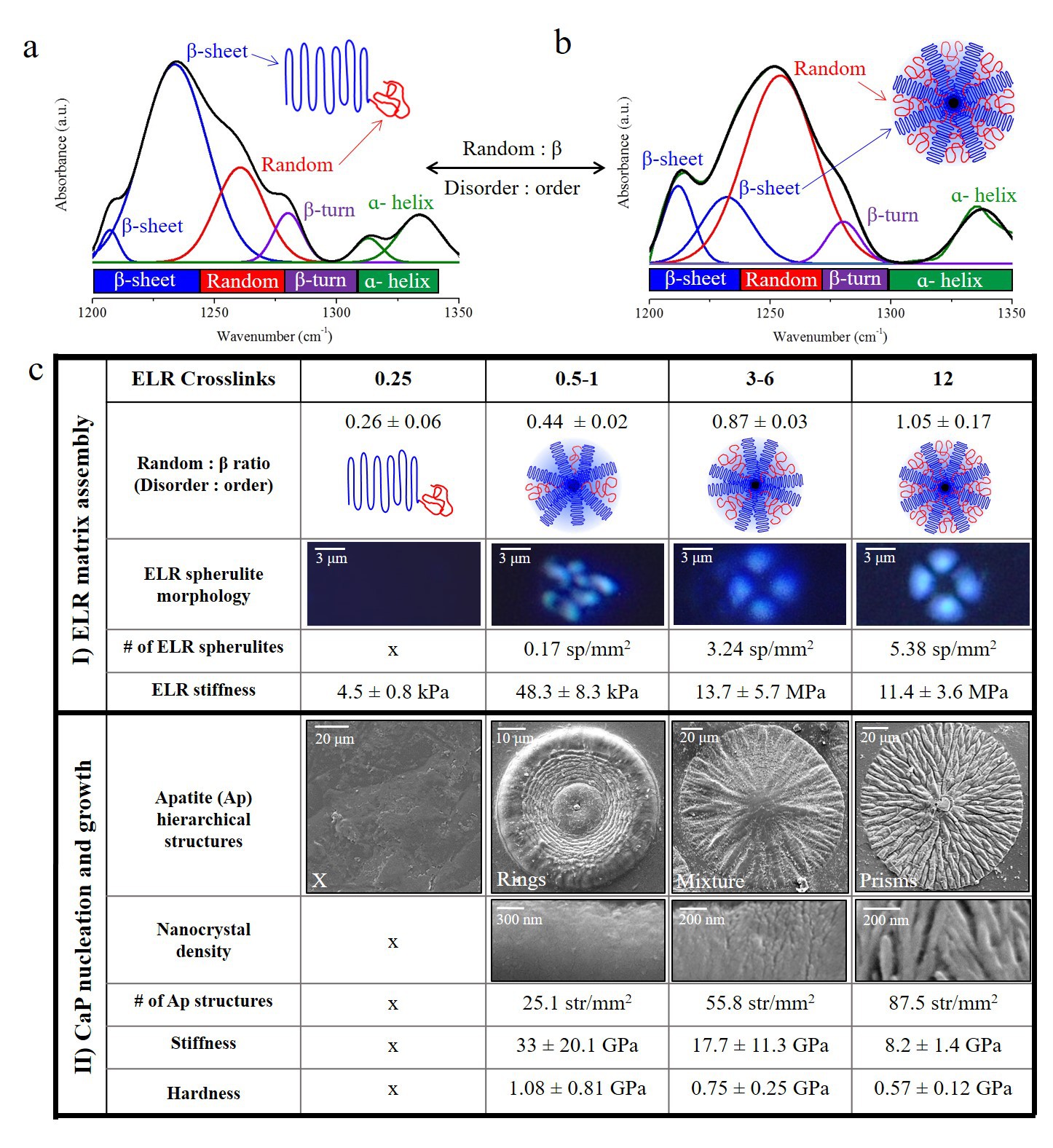
Results: During crosslinking/drying process, ELRs self-assemble into a dense network of b-amyloid-like fibrils and homogenously distributed three-dimensional (3D) ELR spherulites. Therefore, these organic supramolecular structures formed independently of the type of ELR used. We discovered that by systematically modifying the amount of cross-linker, it was possible to modulate the levels of ELR ordered b-sheet and disordered random coil conformation, while maintaining β-turn and α-helix nearly constant. Upon incubation in a solution supersaturated with respect to apatite, the materials comprise elongated apatite nanocrystals that are aligned and organised into microscopic prisms, which grow together into spherulite-like structures hundreds of microns in diameter.
Conclusions: The synthetic hierarchical structures can be grown over large uneven surfaces and native tissues as acid resistant membranes or coatings with tuneable hierarchy, and properties. Our study represents a potential strategy for complex materials design that may open opportunities for hard tissue repair and provide insights into the role of molecular disorder in human physiology and pathology.
Methods: We exploited recombinant technologies to design a supramolecular matrix that is based on ELR molecules consisting of a main hydrophobic framework (VPGIG), a positively charged segment (VPGKG) with the amino acid lysine (K) for ELR cross-linking, and the highly-acidic statherin-derived analogue. In addition, collagen membranes, ELR-coated glass, and membranes made from similar ELR molecules without the statherin-derived peptide or with the cell adhesive RGDS were used as controls. Through FTIR deconvolution of the amide III spectral region, a quantitative analysis of the protein secondary structure can be established.
Results: During crosslinking/drying process, ELRs self-assemble into a dense network of b-amyloid-like fibrils and homogenously distributed three-dimensional (3D) ELR spherulites. Therefore, these organic supramolecular structures formed independently of the type of ELR used. We discovered that by systematically modifying the amount of cross-linker, it was possible to modulate the levels of ELR ordered b-sheet and disordered random coil conformation, while maintaining β-turn and α-helix nearly constant. Upon incubation in a solution supersaturated with respect to apatite, the materials comprise elongated apatite nanocrystals that are aligned and organised into microscopic prisms, which grow together into spherulite-like structures hundreds of microns in diameter.
Conclusions: The synthetic hierarchical structures can be grown over large uneven surfaces and native tissues as acid resistant membranes or coatings with tuneable hierarchy, and properties. Our study represents a potential strategy for complex materials design that may open opportunities for hard tissue repair and provide insights into the role of molecular disorder in human physiology and pathology.
IMAGES
2961429_File000000.jpg
2961429_File000000.jpg