IADR Abstract Archives
Long-term Clinical Outcome of Zirconia Ceramic Inlay-retained FDPs
Objectives: To evaluate the clinical outcome of inlay-retained fixed dental prostheses (IRFDPs) with a new design made from zirconia after an observation period of 8 years.
Methods: Thirty 3-unit IRFDPs were placed in thirty patients (18 females, 12 males, mean age 41.9 years). IRFDPs replaced 7 second premolars (4 in the maxilla, 3 in the mandible) and 23 first molars (15 in the maxilla, 8 in the mandible). Preparations were performed in accordance with general principles for ceramic inlay restorations and modified with a short retainer-wing bevel within enamel at the buccal and lingual sides, with the aim to improve stress distribution, and to increase the adhesive bonding surface. The frameworks were scanned and milled out of zirconia (Vita In-Ceram YZ, Vita Zahnfabrik, Bad Säckingen, Germany) using CAD/CAM technology, and the pontics were veneered with feldspathic ceramic. After alumina particle air-abrasion of the ceramic bonding surfaces, IRFDPs were luted adhesively with composite resin (Panavia 21, Kuraray, Osaka, Japan). Clinical follow-up examinations were performed annually. Statistical analysis was performed using descriptive statistics and Kaplan-Meier survival analysis.
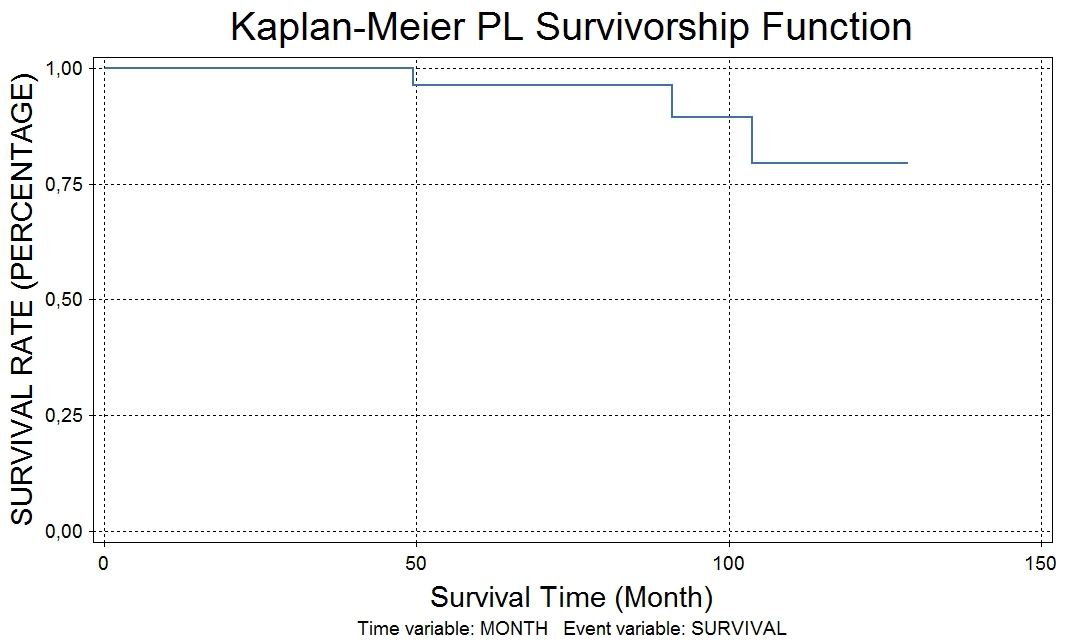
Results: The mean observation time was 86.2 ± 25.7 months. After 8 years, the cumulative survival rate was 79.5%, as three IRFDPs failed (one due to repeated debonding because of bruxismus, one due to caries, and one due to general progressive periodontitis). Subsequently, the technical survival rate was 96.3%. Debonding was reported for three IRFDPs, one of them failed finally after 49.4 months and two were rebonded again, reporting a cumulative debonding rate of 12.7%. Four patients were regarded as drop-out because they did not attend the recall program for more than 24 months. Chipping of the veneering ceramic was reported in three cases, which were repaired or polished intraorally (Chipping rate 10.2%). Twenty-three RBFDPs were free of any kind of complication reporting thus a cumulative success rate of 69.7%. Moreover, the technical success rate was 84.2%.
Conclusions: The clinical outcome of zirconia ceramic IRFDPs constructed in the modified design after 8 years is promising, so that this novel design could recommended as a treatment modality to replace a missing tooth in the posterior region.
Methods: Thirty 3-unit IRFDPs were placed in thirty patients (18 females, 12 males, mean age 41.9 years). IRFDPs replaced 7 second premolars (4 in the maxilla, 3 in the mandible) and 23 first molars (15 in the maxilla, 8 in the mandible). Preparations were performed in accordance with general principles for ceramic inlay restorations and modified with a short retainer-wing bevel within enamel at the buccal and lingual sides, with the aim to improve stress distribution, and to increase the adhesive bonding surface. The frameworks were scanned and milled out of zirconia (Vita In-Ceram YZ, Vita Zahnfabrik, Bad Säckingen, Germany) using CAD/CAM technology, and the pontics were veneered with feldspathic ceramic. After alumina particle air-abrasion of the ceramic bonding surfaces, IRFDPs were luted adhesively with composite resin (Panavia 21, Kuraray, Osaka, Japan). Clinical follow-up examinations were performed annually. Statistical analysis was performed using descriptive statistics and Kaplan-Meier survival analysis.
Results: The mean observation time was 86.2 ± 25.7 months. After 8 years, the cumulative survival rate was 79.5%, as three IRFDPs failed (one due to repeated debonding because of bruxismus, one due to caries, and one due to general progressive periodontitis). Subsequently, the technical survival rate was 96.3%. Debonding was reported for three IRFDPs, one of them failed finally after 49.4 months and two were rebonded again, reporting a cumulative debonding rate of 12.7%. Four patients were regarded as drop-out because they did not attend the recall program for more than 24 months. Chipping of the veneering ceramic was reported in three cases, which were repaired or polished intraorally (Chipping rate 10.2%). Twenty-three RBFDPs were free of any kind of complication reporting thus a cumulative success rate of 69.7%. Moreover, the technical success rate was 84.2%.
Conclusions: The clinical outcome of zirconia ceramic IRFDPs constructed in the modified design after 8 years is promising, so that this novel design could recommended as a treatment modality to replace a missing tooth in the posterior region.
IMAGES
2959419_File000000.jpg
2959419_File000000.jpg