IADR Abstract Archives
Simulation of Facial Soft Tissue Deformation Caused by Tooth Movement
Objectives: The prediction of facial appearance changes before and after orthodontic treatment provides an important tool for the improvement of orthodontic treatment planning and doctor-patient communication. This study aimed to develop a method to simulate facial soft tissue deformation caused by tooth movement for the prediction of facial appearance changes before and after orthodontic treatment using finite element method.
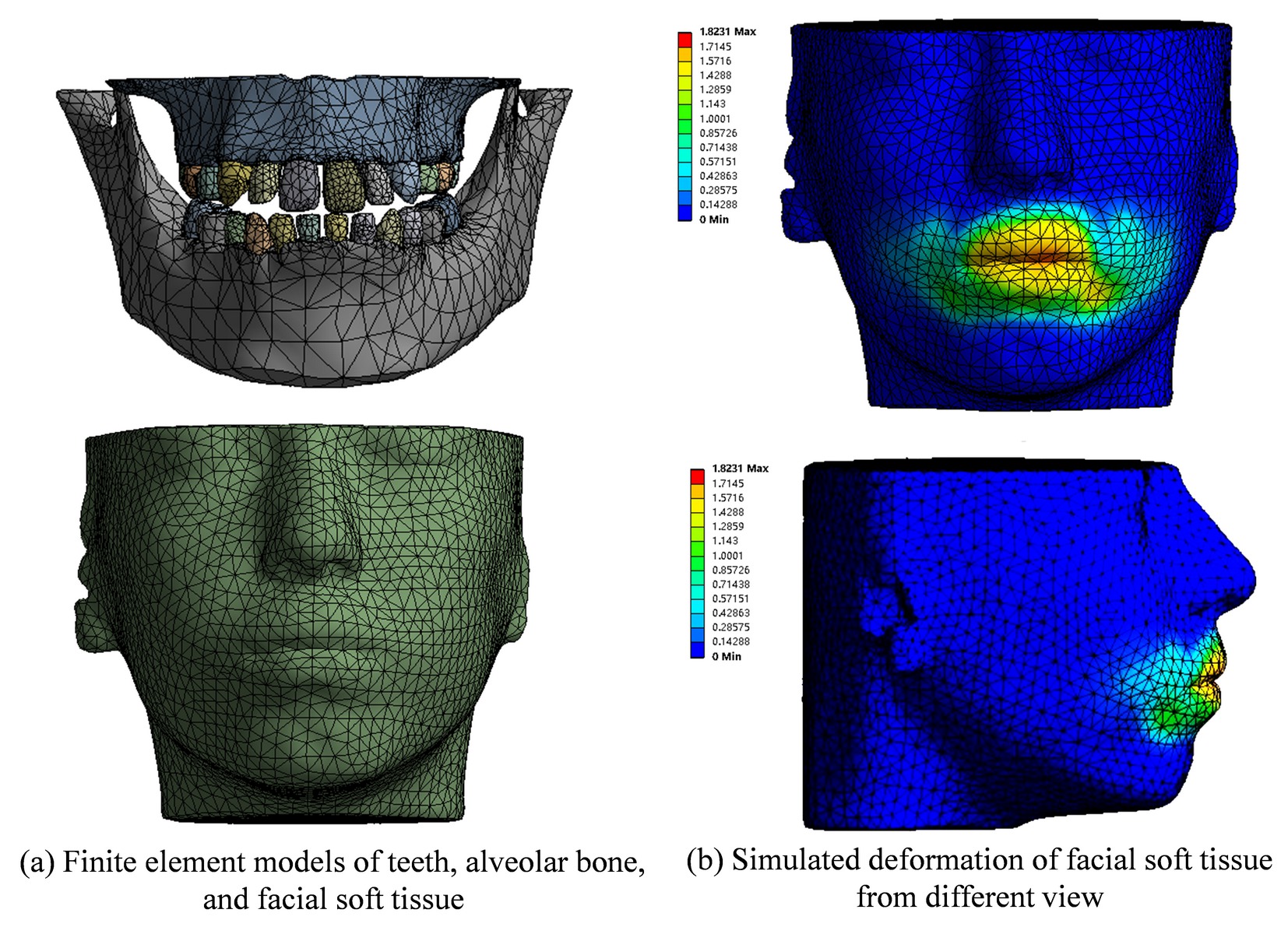
Methods: Finite element models of teeth, alveolar bone and soft tissue of one subject before orthodontic treatment was constructed from cone beam computed tomography images. All material properties were assigned to be homogeneous, isotropic, and linearly elastic, and the values of material properties were set based on previous studies. Bone and soft tissue were set to be bonded, and tooth and soft tissue were set to be no separation contact. Nodes of bone on surfaces near the temporomandibular joints were set to be fixed. Displacement loads were applied to teeth, and the amplitude and direction of the displacements were determined based on the planned tooth movement. The planned tooth movement mainly occurred in the anterior teeth, and the maximum tooth movement displacement was 2.26 mm.
Results: The deformation of facial soft tissue before and after tooth movement was calculated, and the facial appearance after tooth movement was obtained. The maximum deformation of the facial soft tissue was 1.82 mm.
Conclusions: The developed method for the simulation of facial soft tissue deformation can be used to predict the facial appearance changes caused by tooth movement of orthodontic treatment.
Methods: Finite element models of teeth, alveolar bone and soft tissue of one subject before orthodontic treatment was constructed from cone beam computed tomography images. All material properties were assigned to be homogeneous, isotropic, and linearly elastic, and the values of material properties were set based on previous studies. Bone and soft tissue were set to be bonded, and tooth and soft tissue were set to be no separation contact. Nodes of bone on surfaces near the temporomandibular joints were set to be fixed. Displacement loads were applied to teeth, and the amplitude and direction of the displacements were determined based on the planned tooth movement. The planned tooth movement mainly occurred in the anterior teeth, and the maximum tooth movement displacement was 2.26 mm.
Results: The deformation of facial soft tissue before and after tooth movement was calculated, and the facial appearance after tooth movement was obtained. The maximum deformation of the facial soft tissue was 1.82 mm.
Conclusions: The developed method for the simulation of facial soft tissue deformation can be used to predict the facial appearance changes caused by tooth movement of orthodontic treatment.
IMAGES
2959064_File000000.jpg
2959064_File000000.jpg