IADR Abstract Archives
Retention Durability of Metallic and Non-Metallic Telescopic Mandibular Overdentures
Objectives: To evaluate the change in retention of metallic and non-metallic combinations for telescopic mandibular overdentures.
Methods: Polyvinylchloride-cylindrical bases were used to insert four implants arranged in an arch, with 10mm inter-implant spacing anteriorly and 35mm posteriorly. Four groups (n=8 each) were tested: ZP (zirconia abutments/PEEK framework), PP (PEEK abutments/PEEK framework), TP (titanium abutments/PEEK framework), and a control group TG (titanium abutments/gold copings). The abutment retention height was 4mm with 1° convergence angle. The PEEK frameworks (BioHPP, Bredent, Germany) were manufactured by the injection technique. The gold copings were fabricated from electroformed pure gold with 0.25mm thickness.
The retention was measured in a wet condition using a chewing simulator initially, and. then at 100, 200, 500, 1,000, 2,000, 3,000, 5,000, 8,000, and 10,000 insertion-separation cycles, which simulates removing and inserting of an overdenture three times daily for 10 years. Subsequently, the specimens were subjected to thermo-mechanical dynamic load distally located in a chewing simulator for 1,200,000 loading cycles corresponding to 5-years clinical fatigue. A universal testing device was used to measure the retentive force before and after the chewing simulation.
Statistical analysis was performed using one-way ANOVA and paired T-test.
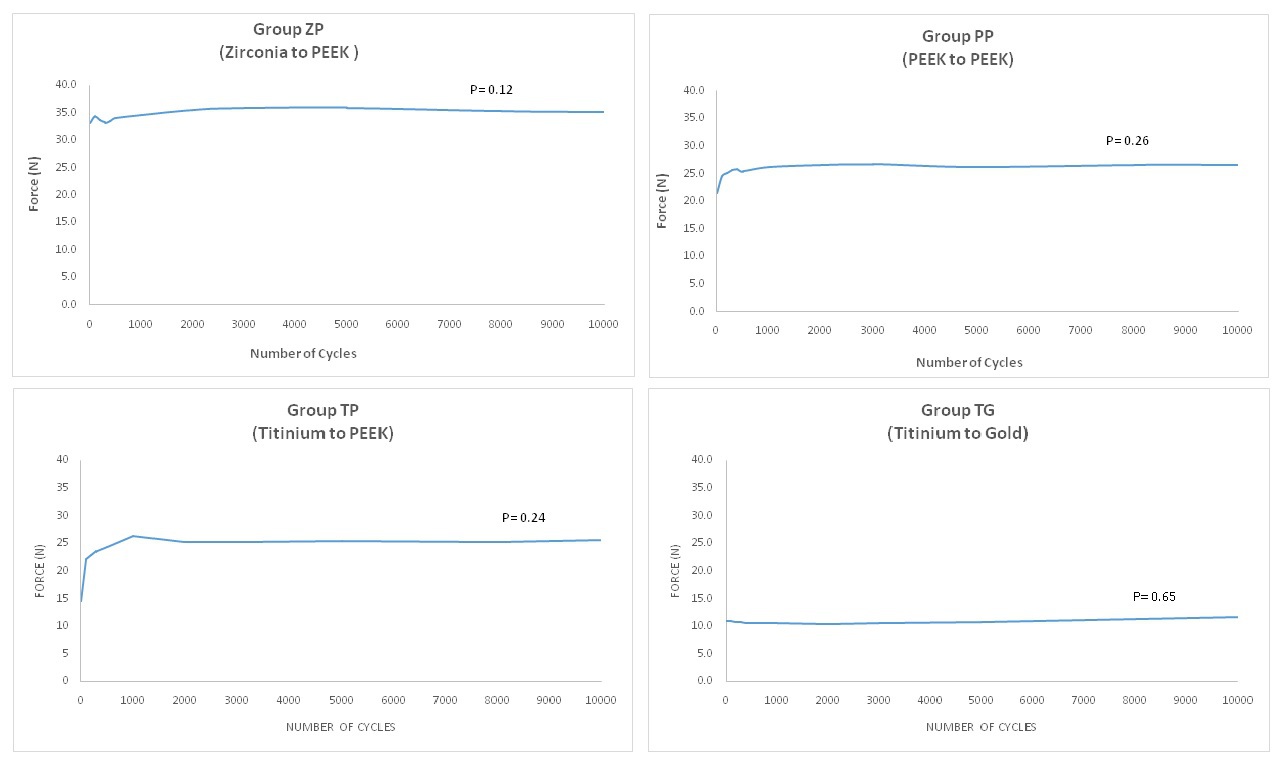
Results: The initial mean retention was 33.1N (±6.7), 21.5N (±4.1), 14.5N (±5.7), and 11N (±8.4) for group ZP, PP, TP, and TG, respectively. After 10,000 insertion-separation cycles, the mean retention was 35.2N (±6.1), 26.6N (±3.6), 25.5N (±5.9), and 11.6N (±9.6). There were no statistically significant changes in the retentive forces over time in the four test groups.
After the chewing simulation test, there was no statistically significant change in retention in groups PP and TG. However, in groups ZP and TP the retention changed significantly.
Conclusions: The use of metallic and non-metallic combinations in the construction of telescopic mandibular overdentures resulted in durable retention and might be suitable for clinical use.
Methods: Polyvinylchloride-cylindrical bases were used to insert four implants arranged in an arch, with 10mm inter-implant spacing anteriorly and 35mm posteriorly. Four groups (n=8 each) were tested: ZP (zirconia abutments/PEEK framework), PP (PEEK abutments/PEEK framework), TP (titanium abutments/PEEK framework), and a control group TG (titanium abutments/gold copings). The abutment retention height was 4mm with 1° convergence angle. The PEEK frameworks (BioHPP, Bredent, Germany) were manufactured by the injection technique. The gold copings were fabricated from electroformed pure gold with 0.25mm thickness.
The retention was measured in a wet condition using a chewing simulator initially, and. then at 100, 200, 500, 1,000, 2,000, 3,000, 5,000, 8,000, and 10,000 insertion-separation cycles, which simulates removing and inserting of an overdenture three times daily for 10 years. Subsequently, the specimens were subjected to thermo-mechanical dynamic load distally located in a chewing simulator for 1,200,000 loading cycles corresponding to 5-years clinical fatigue. A universal testing device was used to measure the retentive force before and after the chewing simulation.
Statistical analysis was performed using one-way ANOVA and paired T-test.
Results: The initial mean retention was 33.1N (±6.7), 21.5N (±4.1), 14.5N (±5.7), and 11N (±8.4) for group ZP, PP, TP, and TG, respectively. After 10,000 insertion-separation cycles, the mean retention was 35.2N (±6.1), 26.6N (±3.6), 25.5N (±5.9), and 11.6N (±9.6). There were no statistically significant changes in the retentive forces over time in the four test groups.
After the chewing simulation test, there was no statistically significant change in retention in groups PP and TG. However, in groups ZP and TP the retention changed significantly.
Conclusions: The use of metallic and non-metallic combinations in the construction of telescopic mandibular overdentures resulted in durable retention and might be suitable for clinical use.
IMAGES
2957334_File000000.jpg
2957334_File000000.jpg