IADR Abstract Archives
Validation of the DC/TMD Axis I for Children
Objectives: To adapt and validate the DC/TMD Axis I, for children 7 to 11 years old.
Methods: 189 children between 7-11 years old, participated in the study. The history and clinical instrument included in the DC/TMD Axis I, were adaptated and validated by a multidisciplinary group, conformed by psychologists and pediatric dentists, calibrated in the use of the instrument (Kappa:0.82). Data were analyzed using Cronbach's Alpha. A Receiver Operator Characteristic (ROC) curve was established for each diagnosis. The analysis of the ROC curves was performed, using optimal cut points with maximum sensitivity and specificity. Prevalence of TMD was assessed with the new instrument. Data was analyzed in STATA© version 13.0, which was also used to create the algorithm for the diagnosis tree. Sensitivity and specificity were considered acceptable when values were ≥ 70% and ≥ 95%, respectively.
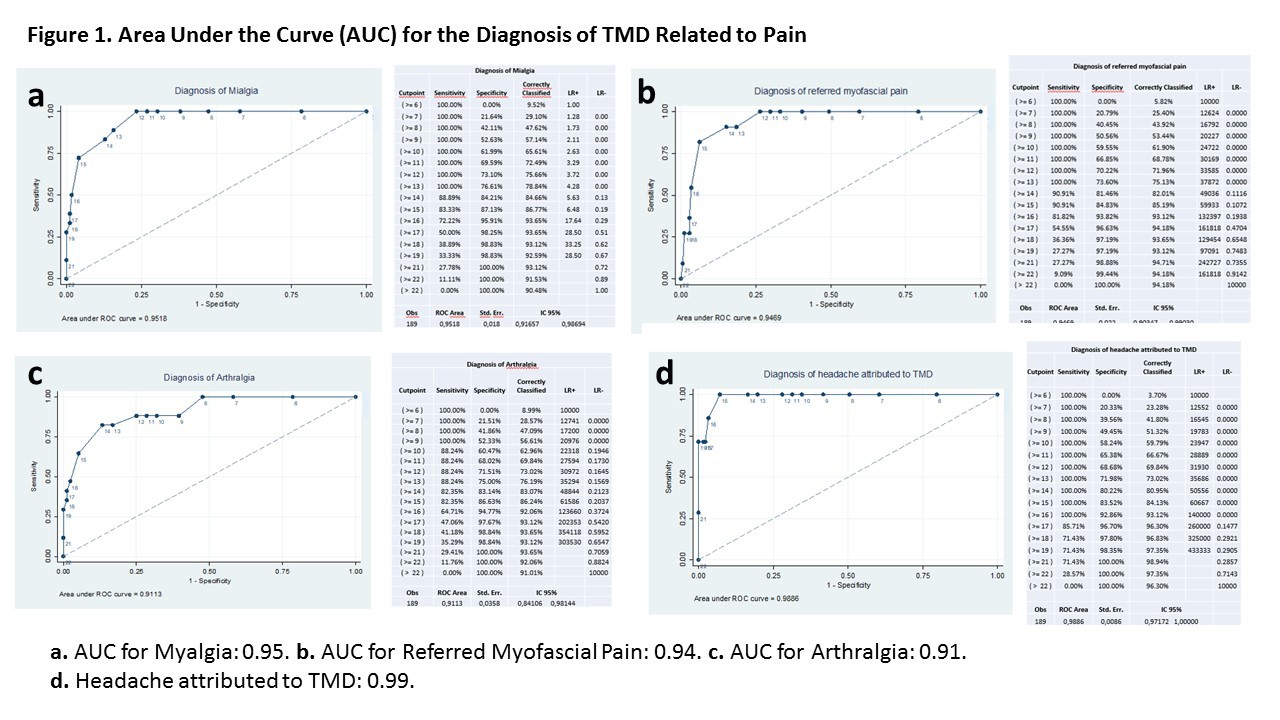
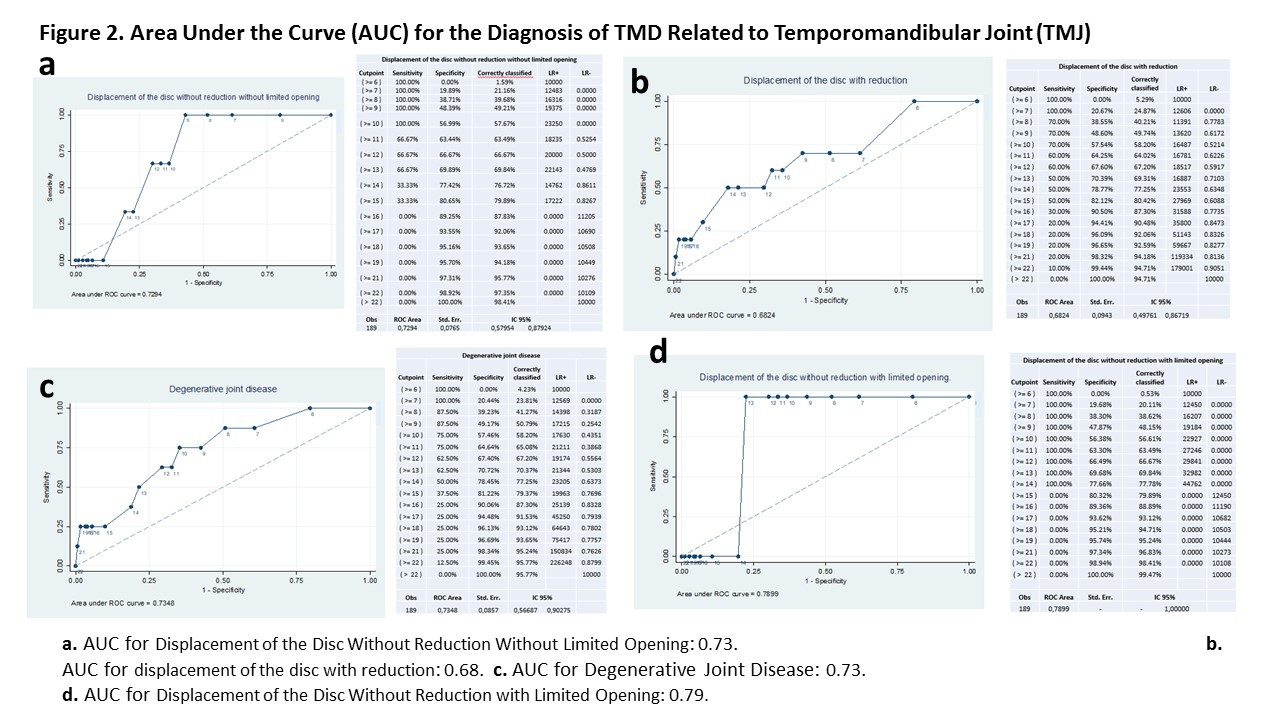
Results: Modifications to the DC/TMD Axis I, included changing the temporality of the questions dealing with experience of pain, from one month to two weeks; the adaptation of language to be better understood by children; and the use of a face scale to report pain. The diagnosis tree included the same diagnosis as the original DC/TMD for adults. The internal consistency of the instrument, was 0.9492 and between 0.72 and 0.93 for the constructs (Table 1). The Area Under the Curve (AUC) for the diagnoses dealing with pain, oscillated between 0.91 and 0.99 (Figure 1); and for the diagnoses dealing with temporomandibular joint (TMJ) between 0.68 and 0.79 (Figure 2). Pain diagnoses were more prevalent than disorders related to the TMJ.
Conclusions: The adapted DC/TMD Axis I for children, showed good sensitivity, specificity and internal consistency, thus it can be used, both in the clinic and for research purposes.
Methods: 189 children between 7-11 years old, participated in the study. The history and clinical instrument included in the DC/TMD Axis I, were adaptated and validated by a multidisciplinary group, conformed by psychologists and pediatric dentists, calibrated in the use of the instrument (Kappa:0.82). Data were analyzed using Cronbach's Alpha. A Receiver Operator Characteristic (ROC) curve was established for each diagnosis. The analysis of the ROC curves was performed, using optimal cut points with maximum sensitivity and specificity. Prevalence of TMD was assessed with the new instrument. Data was analyzed in STATA© version 13.0, which was also used to create the algorithm for the diagnosis tree. Sensitivity and specificity were considered acceptable when values were ≥ 70% and ≥ 95%, respectively.
Results: Modifications to the DC/TMD Axis I, included changing the temporality of the questions dealing with experience of pain, from one month to two weeks; the adaptation of language to be better understood by children; and the use of a face scale to report pain. The diagnosis tree included the same diagnosis as the original DC/TMD for adults. The internal consistency of the instrument, was 0.9492 and between 0.72 and 0.93 for the constructs (Table 1). The Area Under the Curve (AUC) for the diagnoses dealing with pain, oscillated between 0.91 and 0.99 (Figure 1); and for the diagnoses dealing with temporomandibular joint (TMJ) between 0.68 and 0.79 (Figure 2). Pain diagnoses were more prevalent than disorders related to the TMJ.
Conclusions: The adapted DC/TMD Axis I for children, showed good sensitivity, specificity and internal consistency, thus it can be used, both in the clinic and for research purposes.
IMAGES
2957274_File000000.jpg
2957274_File000001.jpg
2957274_File000000.jpg
2957274_File000001.jpg