IADR Abstract Archives
In-Vitro Cytotoxicity Evaluation of Three Low-Friction Abutment Coatings
Objectives: Plaque accumulation and mechanical wear are two main risk factors of implant-prosthetic failure. To reduce the occurrence of these complications, prototypical abutments ("Star Abutment”, PhD Course in Industrial and Environmental Engineering, Modena, Italy) were realised and the literature reviewed to identify eligible coatings for enhancing mechanical and chemical surface properties. Zirconium Nitride (ZrN), Diamond-Like Carbon (DLC), and Superlattice CrN/NbN (CrN/NbN) coated some abutments, and then Neutral Red Uptake Cytotoxicity Direct Contact Test was performed to primarily evaluate the biocompatibility of these surfaces.
Methods: Four specimens for each test group were sterilized, then each group placed in a plate directly contacting with Dulbecco’s modified Eagle's medium (DMEM) (Invitrogen, Karlshue, Germany) containing BALB/3T3 murine fibroblasts (Istituto Zooprofilattico, Brescia, Italy) at standard temperature (37°C±1°C), humidity (90%± 5%) and CO2 concentration (5%±1%). Two additional plates were used as positive (DMEM with 0.45% phenol solution) and negative (DMEM) control groups. Samples were analyzed at 24, 48 and 72 hours with optical microscope (Nikon, Japan) for cytomorphological evaluation and, after treatment with 0.2% Neutral Red, spectrophotometry analysis (HP 8452A Diode-Array, Hewlett-Packard, USA) was performed with λ set at 540nm to obtain fibroblasts survival rates for each test and control group: non-coated (NC), ZrN-coated, DLC-coated, CrN/NbN-coated, negative control (CTRL-) and positive control (CTRL+).
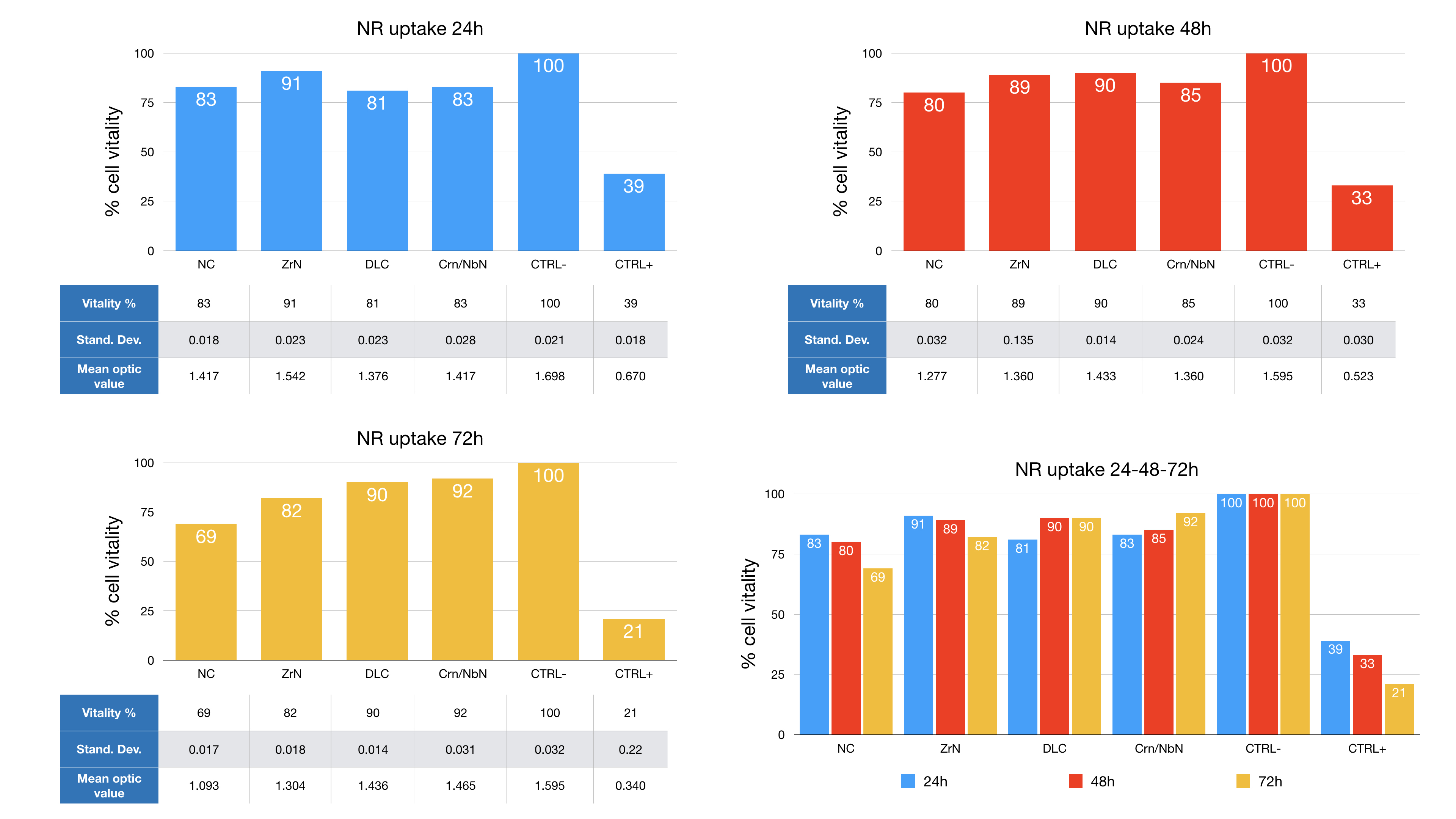
Results: Optical analysis showed no inhibition halo for each test specimens at 24, 48 and 72 hours. Spectrophotometry analysis showed no cytotoxicity for each test specimens at 24, 48 and 72 hours. Detailed results are reported in the attached graphics.
Conclusions: ZrN, DLC, and CrN/NbN coatings showed no cytotoxicity with BALB/3T3 murine fibroblasts after 24, 48 and 72 hours. These results encourage the research on Star Abutments. Up to January 2018, this seems to be the first application of a Superlattice CrN/NbN coating in dentistry.
Methods: Four specimens for each test group were sterilized, then each group placed in a plate directly contacting with Dulbecco’s modified Eagle's medium (DMEM) (Invitrogen, Karlshue, Germany) containing BALB/3T3 murine fibroblasts (Istituto Zooprofilattico, Brescia, Italy) at standard temperature (37°C±1°C), humidity (90%± 5%) and CO2 concentration (5%±1%). Two additional plates were used as positive (DMEM with 0.45% phenol solution) and negative (DMEM) control groups. Samples were analyzed at 24, 48 and 72 hours with optical microscope (Nikon, Japan) for cytomorphological evaluation and, after treatment with 0.2% Neutral Red, spectrophotometry analysis (HP 8452A Diode-Array, Hewlett-Packard, USA) was performed with λ set at 540nm to obtain fibroblasts survival rates for each test and control group: non-coated (NC), ZrN-coated, DLC-coated, CrN/NbN-coated, negative control (CTRL-) and positive control (CTRL+).
Results: Optical analysis showed no inhibition halo for each test specimens at 24, 48 and 72 hours. Spectrophotometry analysis showed no cytotoxicity for each test specimens at 24, 48 and 72 hours. Detailed results are reported in the attached graphics.
Conclusions: ZrN, DLC, and CrN/NbN coatings showed no cytotoxicity with BALB/3T3 murine fibroblasts after 24, 48 and 72 hours. These results encourage the research on Star Abutments. Up to January 2018, this seems to be the first application of a Superlattice CrN/NbN coating in dentistry.
IMAGES
2955697_File000002.jpg
2955697_File000002.jpg