IADR Abstract Archives
Biomechanical Condylar Regeneration in Early-stage Degenerative TMJ Diseases
Objectives: To determine the effect of biomechanical unloading on osseous condylar changes in adolescents / young adults with early-stage degenerative joint disease (DJD).
Methods: Six-nine patients diagnosed with early-stage TMJ DJD based on the DC/TMD and CBCT imaging were recruited and randomly allocated to two treatment groups: (a) conservative therapy plus biomechanical unloading with anterior repositioning splint (ARS) and (b) conservative therapy without ARS. Subjects with acute TMJ closed-lock had their displaced discs physically reduced by mandibular manipulation prior to ARS therapy. Clinical and CBCT data of 59 patients (86.4% females, mean age 17.97±4.53 years) comprising a total of 67 joints were attained pre- and at 6-12 months post-treatment. Osseous changes after treatment were subsequently categorized into (1) progressed, (2) unchanged, (3) repaired (remodeled without new bone formation), and (4) regenerated ( remodeled with new bone formation). Data was subjected to statistical analysis using Chi-square/Fisher’s exact test, independent samples t-test or Mann-Whitney U-test (p<0.05).
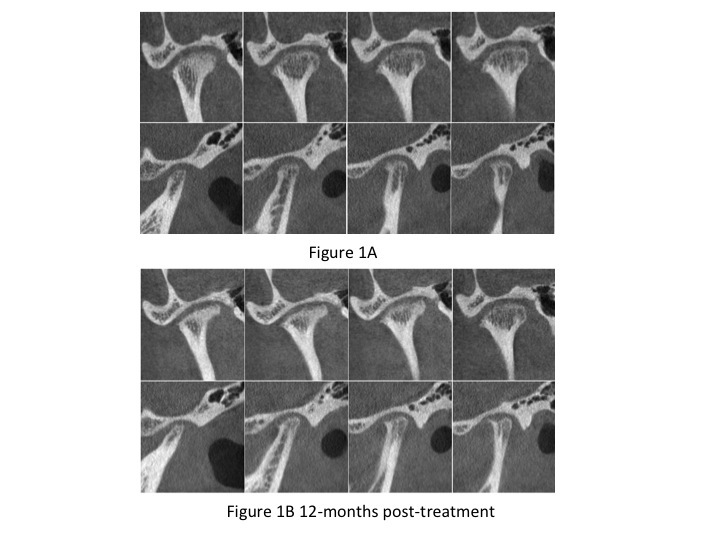
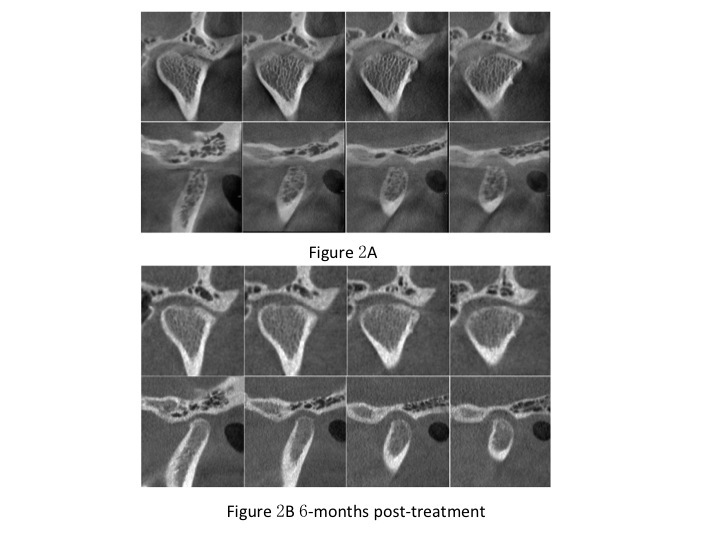
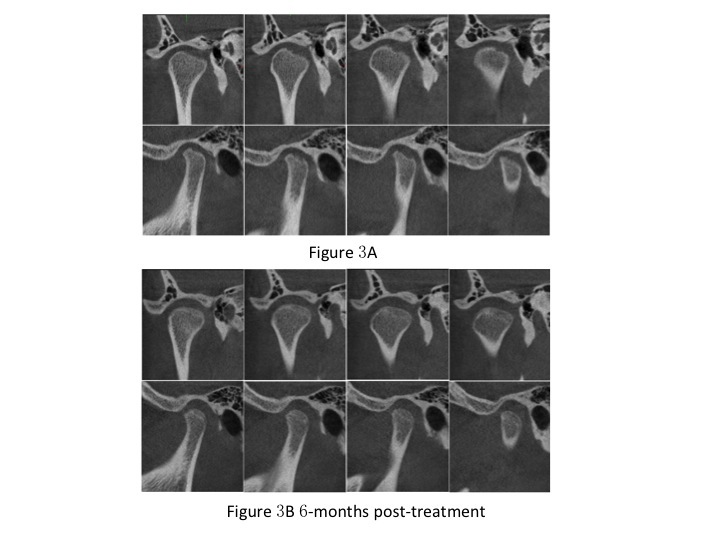
Results: The occurrence of condylar repair and regeneration was significantly higher with the splint treatment (78.1% [25/32] of joints) when compared to the control group (48.6% [17/35]). Significant new bone formation was found in 50%(16/32) in the splint group, while none in the control. The splint group (3.1%, [1/32]) also had significantly lower incidence of progressive TMJ degeneration than the control group (37.1% [13/35]).
Conclusions: Early-stage TMJ DJD in adolescents / young adults can be repaired and condylar regeneration is possible with conservative and splint therapy. Ideal spatial disc-condyle relationships appear important in condylar repair and regeneration. The possibility of restoring TMJ form / structure presents an attractive area of new basic science and clinical research.
Methods: Six-nine patients diagnosed with early-stage TMJ DJD based on the DC/TMD and CBCT imaging were recruited and randomly allocated to two treatment groups: (a) conservative therapy plus biomechanical unloading with anterior repositioning splint (ARS) and (b) conservative therapy without ARS. Subjects with acute TMJ closed-lock had their displaced discs physically reduced by mandibular manipulation prior to ARS therapy. Clinical and CBCT data of 59 patients (86.4% females, mean age 17.97±4.53 years) comprising a total of 67 joints were attained pre- and at 6-12 months post-treatment. Osseous changes after treatment were subsequently categorized into (1) progressed, (2) unchanged, (3) repaired (remodeled without new bone formation), and (4) regenerated ( remodeled with new bone formation). Data was subjected to statistical analysis using Chi-square/Fisher’s exact test, independent samples t-test or Mann-Whitney U-test (p<0.05).
Results: The occurrence of condylar repair and regeneration was significantly higher with the splint treatment (78.1% [25/32] of joints) when compared to the control group (48.6% [17/35]). Significant new bone formation was found in 50%(16/32) in the splint group, while none in the control. The splint group (3.1%, [1/32]) also had significantly lower incidence of progressive TMJ degeneration than the control group (37.1% [13/35]).
Conclusions: Early-stage TMJ DJD in adolescents / young adults can be repaired and condylar regeneration is possible with conservative and splint therapy. Ideal spatial disc-condyle relationships appear important in condylar repair and regeneration. The possibility of restoring TMJ form / structure presents an attractive area of new basic science and clinical research.
IMAGES
2955579_File000000.jpg
2955579_File000001.jpg
2955579_File000002.jpg
2955579_File000000.jpg
2955579_File000001.jpg
2955579_File000002.jpg