IADR Abstract Archives
Development of a Novel Radiopaque Infiltrant Resin
Objectives: To produce a radiopaque infiltrant resin incorporating contrasting Bromine-Methacrylate (BrM) and to assess the materials water absorption and desorption.
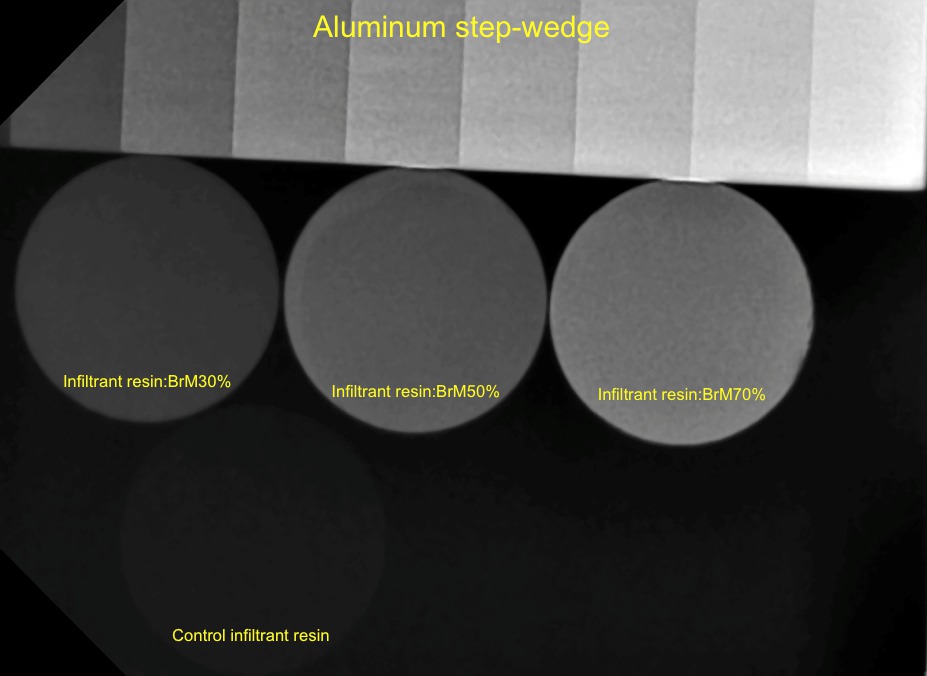
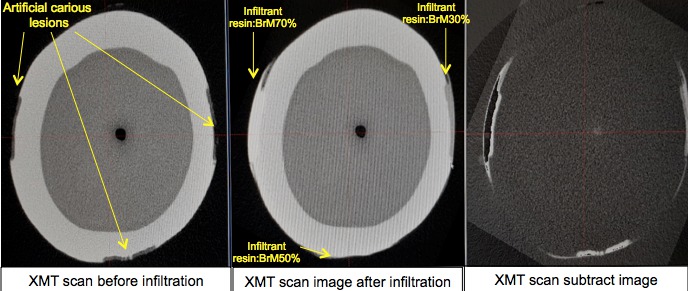
Methods: An experimental infiltrant resin mixture (control) was prepared based on urethane dimethacrylate, (similar to commercial infiltrant resin ICON). Additionally, three further compositions were prepared incorporating 30%, 50% and 70% BrM (2,3-dibromopropyl methacrylate, by weight) respectively. Six samples discs (10mm diameter x 1mm thickness) per 4 compositions underwent water absorption in deionized water (DW) at 37°C, for three months, and then the samples were desorbed (37°C) until they equilibrated (~2 weeks). Infiltration into extracted teeth with artificial carious lesions were assessed using a MuCat Scanner, X-ray MicroTomography (XMT). An aluminum step wedge was used to compare radiopacity.
Results: Water absorption of the experimental control was similar to the commercial resin, ICON (~4.5% at ~3 days). With the inclusion of BrM, the water absorption of these systems decreased and this was concentration dependent (e.g. 4.5%-control; 2.7%BrM30%; 2.1%BrM50%; 1.6%BrM70%, at three months). The samples equilibrated faster during the desorption process (e.g. within 1 day compared to ~2 weeks in water). Desorption values were less than water uptake values (e.g. 4.7%-control; 4.5%BrM30%; 3.7%BrM50%; 2.56%BrM70%), thus indicating a small loss of residuals. Both water absorption and desorption processes were diffusion controlled. XMT scanned images showed that the experimental resins incorporating BrM were able to sufficiently infiltrate artificial carious lesions in extracted teeth, which were detected both visually and using image subtraction. The equivalent Al thickness for 30%, 50%, and 70% BrM were 1, 2 and 3mm respectively.
Conclusions: Experimental infiltrant resins incorporating 50% and 70% BrM demonstrated sufficient radiopacity, were able to infiltrate lesions in artificial teeth, and had less water uptake than the controls.
Methods: An experimental infiltrant resin mixture (control) was prepared based on urethane dimethacrylate, (similar to commercial infiltrant resin ICON). Additionally, three further compositions were prepared incorporating 30%, 50% and 70% BrM (2,3-dibromopropyl methacrylate, by weight) respectively. Six samples discs (10mm diameter x 1mm thickness) per 4 compositions underwent water absorption in deionized water (DW) at 37°C, for three months, and then the samples were desorbed (37°C) until they equilibrated (~2 weeks). Infiltration into extracted teeth with artificial carious lesions were assessed using a MuCat Scanner, X-ray MicroTomography (XMT). An aluminum step wedge was used to compare radiopacity.
Results: Water absorption of the experimental control was similar to the commercial resin, ICON (~4.5% at ~3 days). With the inclusion of BrM, the water absorption of these systems decreased and this was concentration dependent (e.g. 4.5%-control; 2.7%BrM30%; 2.1%BrM50%; 1.6%BrM70%, at three months). The samples equilibrated faster during the desorption process (e.g. within 1 day compared to ~2 weeks in water). Desorption values were less than water uptake values (e.g. 4.7%-control; 4.5%BrM30%; 3.7%BrM50%; 2.56%BrM70%), thus indicating a small loss of residuals. Both water absorption and desorption processes were diffusion controlled. XMT scanned images showed that the experimental resins incorporating BrM were able to sufficiently infiltrate artificial carious lesions in extracted teeth, which were detected both visually and using image subtraction. The equivalent Al thickness for 30%, 50%, and 70% BrM were 1, 2 and 3mm respectively.
Conclusions: Experimental infiltrant resins incorporating 50% and 70% BrM demonstrated sufficient radiopacity, were able to infiltrate lesions in artificial teeth, and had less water uptake than the controls.
IMAGES
2953762_File000000.jpg
2953762_File000001.jpg
2953762_File000000.jpg
2953762_File000001.jpg