IADR Abstract Archives
Applying Newly Developed Multilayer Capsules on Exposed Dentinal Tubules
Objectives: Dental hypersensitivity (DH) is a very common oral situation in Taiwan. According to the statistics, over 30% Taiwanese suffered DH and most of them had problems in daily diet resulted in compromised life quality. However, the current therapy for DH mostly is to fill the exposed dentinal tubules with calcium phosphate minerals (CPM) mechanically, which cannot fit dentinal pores precisely and completely. Therefore, we aim to develop a novel multilayer capsule, which carrying Type I collagen, proteoglycans and hydroxyapatite, to solve this problem more entirely.
Methods: Capsules are prepared by ultrasonic-emulsion and measure the particle size with particle size analyzer. Drug retention ability is measured with ELISA assay and calculate the retention concentration. In animal model, we separated male Wistar rats randomly into 4 groups: “no-erosion teeth”, “erosion teeth”, “CPM treatment”, and “Capsules treatment”. Erosion was assessed by offering the rats an acid solution (Gatorade®, lemon flavor, pH 2.7) as drinking water for 30 or 45 days. The efficiency of damaged- surface smoothing and exposed dentinal tubule filling rate were observed by scanning electron microscope (SEM) and measured by Mercury Intrusion Porosimeter (MIP). Section-staining is used to confirm dentin regeneration. All data represented the mean±SD of every independent experiments (n>3), statistical significances were determined using Student’s t-test for comparison, and differences were considered significant when p<0.05.
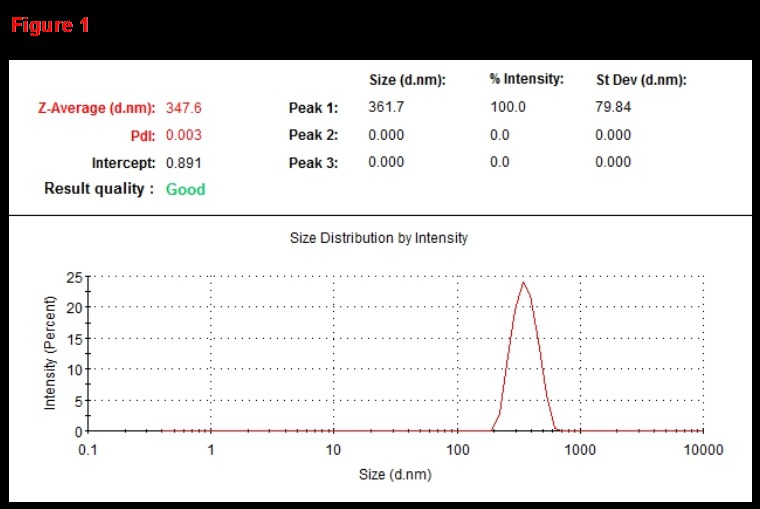
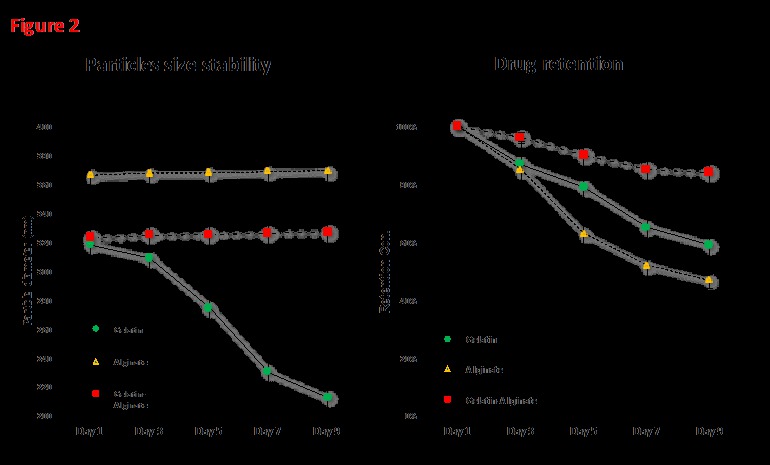
Results: The capsules prepared by ultrasonic-emulsion are approximately 350 nm (Fig. 1). The capsule stability and drug retention ability are measured as shown in Figure 2.
Conclusions: Our material not only can be ensured that the strong adhesion between capsules and dentinal pores but also might enhance the detinogenesis. The capsules filled in the pores would provide a special niche for secondary dentin repair to avoid outside stimulus. As the materials fabricated for these capsules were biodegradable, they would degrade gradually in dentinal pores during dentinogenesis and secondary dentin formation. Our newly developed multilayer capsules might provide a more comprehensive therapy for DH and further clinical trial is in progress.
Methods: Capsules are prepared by ultrasonic-emulsion and measure the particle size with particle size analyzer. Drug retention ability is measured with ELISA assay and calculate the retention concentration. In animal model, we separated male Wistar rats randomly into 4 groups: “no-erosion teeth”, “erosion teeth”, “CPM treatment”, and “Capsules treatment”. Erosion was assessed by offering the rats an acid solution (Gatorade®, lemon flavor, pH 2.7) as drinking water for 30 or 45 days. The efficiency of damaged- surface smoothing and exposed dentinal tubule filling rate were observed by scanning electron microscope (SEM) and measured by Mercury Intrusion Porosimeter (MIP). Section-staining is used to confirm dentin regeneration. All data represented the mean±SD of every independent experiments (n>3), statistical significances were determined using Student’s t-test for comparison, and differences were considered significant when p<0.05.
Results: The capsules prepared by ultrasonic-emulsion are approximately 350 nm (Fig. 1). The capsule stability and drug retention ability are measured as shown in Figure 2.
Conclusions: Our material not only can be ensured that the strong adhesion between capsules and dentinal pores but also might enhance the detinogenesis. The capsules filled in the pores would provide a special niche for secondary dentin repair to avoid outside stimulus. As the materials fabricated for these capsules were biodegradable, they would degrade gradually in dentinal pores during dentinogenesis and secondary dentin formation. Our newly developed multilayer capsules might provide a more comprehensive therapy for DH and further clinical trial is in progress.
IMAGES
2953240_File000000.jpg
2953240_File000001.jpg
2953240_File000000.jpg
2953240_File000001.jpg