IADR Abstract Archives
TM7x/XH001: Model System for Understanding Oral Candidate Phyla Radiation Bacteria
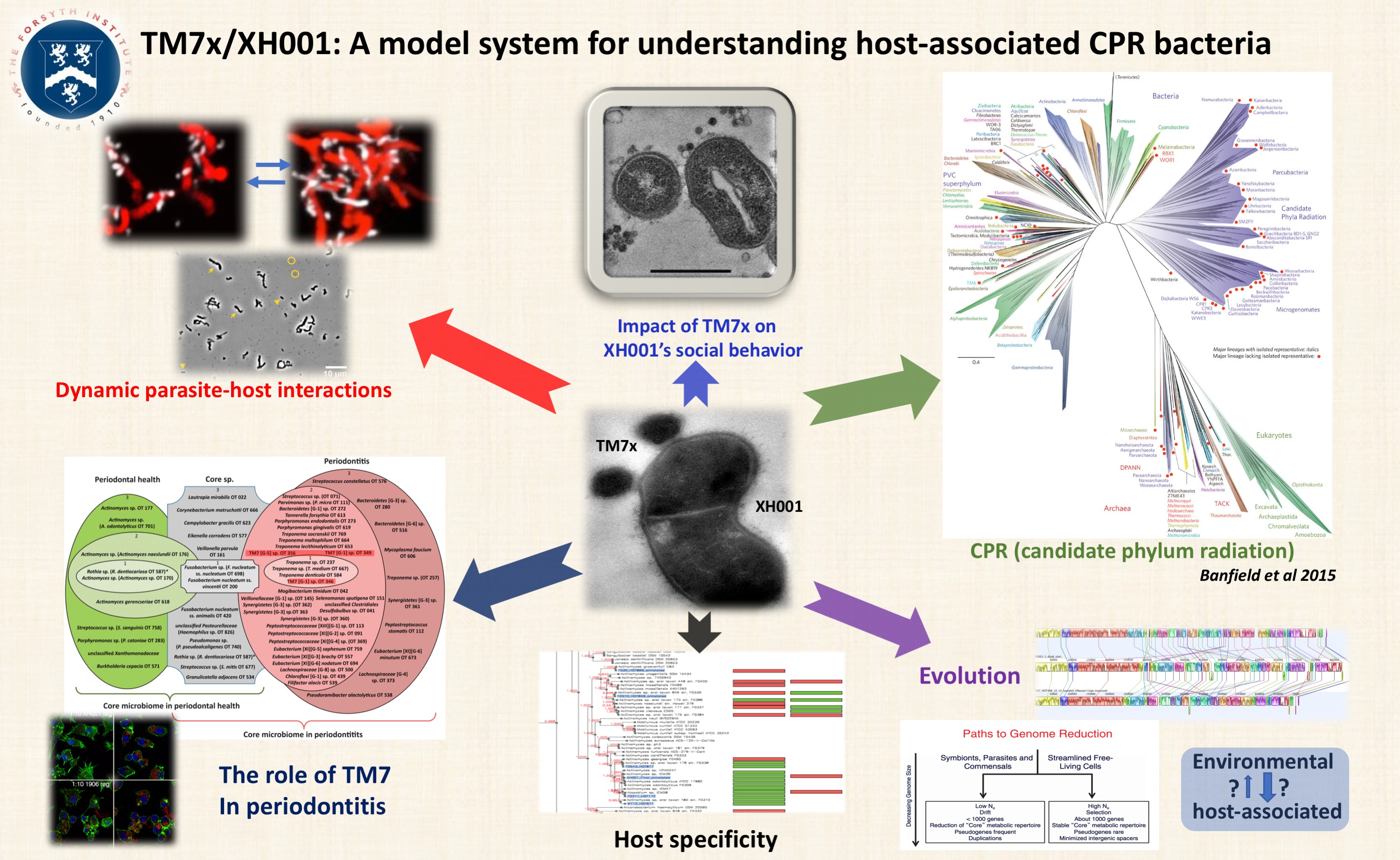
Objectives: Recently, we isolated TM7x, the first cultivated representative of TM7 phylum, together with its bacterial host XH001, an Actinomyces spp. from oral cavity. Initial work revealed a fascinating epiparasitic lifestyle of TM7x. Intriguingly, TM7 belongs to the recently described Candidate Phyla Radiation (CPR) group, which contributes > 15% of biodiversity in domain Bacteria, and TM7x is the ONLY characterized cultivated representative among CPR bacteira. Furthermore, increased abundance of TM7 has been observed in periodontal patients. Here, we use TM7x/XH001 as a model system to understand this intriguing epiparasitic lifestyle, likely common among CPR bacteria. We also aim to investigate the impact of epiparasitic relationship on bacterial physiology, microbial ecology and bacterial-host interaction.
Methods: Methods and assays were developed, including isolation of host-free TM7x; cross-infection assay to investigate TM7x’s host range; in vitro system for investigating the impact of epiparasitic relationship on bacterial host’s social behavior, and its response to lytic phage and the activity of host-associated prophage; and in vitro assay for investigating the interaction between TM7x and host immune cells.
Results: We provided intriguing findings, many of which have not been reported in human associated microbiome studies:
*TM7x and XH001 exhibit dynamic interaction during their establishment and maintenance of ectoparasitic relationship;
*TM7x exhibits distinct host range compared to BB001, another TM7 strain sharing >99% in identity at 16s level.
*TM7x has significant impact on the activity of XH001-associated prophage, as well as XH001’s sensitive to lytic phage infection. Furthermore, the interaction affects their social behavior, such as biofilm-formation ability, and interaction with immune cells.
* When separated from its host, TM7x adopts a spore-like existence, highly resistant to environmental stress, including antibiotics, and shows better survival within macrophage.
Conclusions: TM7x/XH001 could serve as a model to understand the newly described, particularly human associated CPR, whose physiology, their impact on microbial ecology and host health remain largely unknown.
Methods: Methods and assays were developed, including isolation of host-free TM7x; cross-infection assay to investigate TM7x’s host range; in vitro system for investigating the impact of epiparasitic relationship on bacterial host’s social behavior, and its response to lytic phage and the activity of host-associated prophage; and in vitro assay for investigating the interaction between TM7x and host immune cells.
Results: We provided intriguing findings, many of which have not been reported in human associated microbiome studies:
*TM7x and XH001 exhibit dynamic interaction during their establishment and maintenance of ectoparasitic relationship;
*TM7x exhibits distinct host range compared to BB001, another TM7 strain sharing >99% in identity at 16s level.
*TM7x has significant impact on the activity of XH001-associated prophage, as well as XH001’s sensitive to lytic phage infection. Furthermore, the interaction affects their social behavior, such as biofilm-formation ability, and interaction with immune cells.
* When separated from its host, TM7x adopts a spore-like existence, highly resistant to environmental stress, including antibiotics, and shows better survival within macrophage.
Conclusions: TM7x/XH001 could serve as a model to understand the newly described, particularly human associated CPR, whose physiology, their impact on microbial ecology and host health remain largely unknown.
IMAGES
2949963_File000000.jpg
2949963_File000000.jpg