IADR Abstract Archives
Removal of Temporary Crown Adhesive: Effect on Shear-bond Strength
Objectives: Clinicians are often challenged to remove “temporary” cement prior to cementing a final restoration. This project measured the shear bond strength of a self-etching resin cement to dentin after the tooth surface was “cleaned” of temporary cement by four methods.
Methods: 40 non-carious extracted human molars were randomly assigned to four groups. The teeth were de-coronated to provide a flat dentin surface. Teeth were embedded in acrylic and wet-polished through 600-grit with abrasive papers. Teeth had Temp-Bond NE cement (Kerr, Orange, CA) applied to the surface and cured. Samples were allowed to rest for 24 hours (37C & 100% humidity) and had the cement removed by one of four methods: 1) hand-instrumenting; 2) pumice/prophy cup (Preppies, WhipMix, Louisville, Kentucky) using a low-speed handpiece (2,000rpm); 3) air abrasion with aluminum oxide particles (Danville Materials, San Ramon, CA) (27um); and 4) air abrasion with bioactive glass (BAG) particles. Both air abrasions were performed with a Danville microetcher at 60 psi. BAG particles (65 mol%SiO2, 31mol%CaO, 4mol% P2O5) were synthesized in our laboratory, ground and micronized to obtain particles < 17 um.
After cleaning, samples were rinsed with water and air dried. Samples were placed into an Ultradent jig (Ultradent, South Jordan, UT) and RelyX™ Unicem 2 Self-Adhesive Resin Cement (3M ESPE, Minneapolis, MN) was added to the dentin surface to produce 2mm-high posts. Samples were self-cured for 2 minutes and light cured for 20 seconds. Posts underwent shear bond-strength testing with an Electropuls E-3000 (Instron, Norwood, MA) using a crosshead speed of 0.5mm/min. Data were compared using ANOVA (with post-hoc Tukey) with α=0.05.
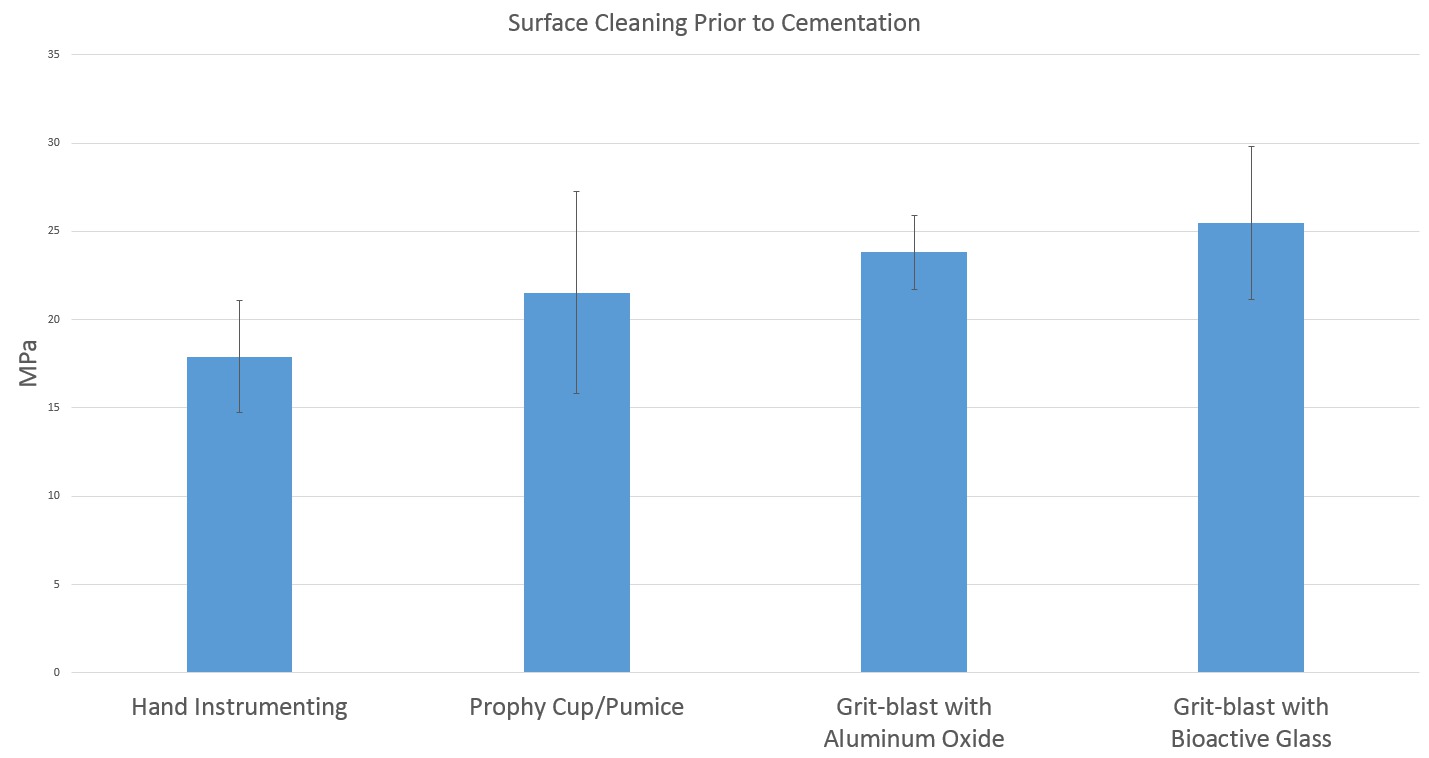
Results: Hand cleaning produced significantly lower bond strength compared to air abrasion with either material. All other comparisons were statistically equivalent.
Conclusions: For highest bond strength and durability when cementing indirect ceramic restorations, grit blast removal of temporary cement is recommended.
Methods: 40 non-carious extracted human molars were randomly assigned to four groups. The teeth were de-coronated to provide a flat dentin surface. Teeth were embedded in acrylic and wet-polished through 600-grit with abrasive papers. Teeth had Temp-Bond NE cement (Kerr, Orange, CA) applied to the surface and cured. Samples were allowed to rest for 24 hours (37C & 100% humidity) and had the cement removed by one of four methods: 1) hand-instrumenting; 2) pumice/prophy cup (Preppies, WhipMix, Louisville, Kentucky) using a low-speed handpiece (2,000rpm); 3) air abrasion with aluminum oxide particles (Danville Materials, San Ramon, CA) (27um); and 4) air abrasion with bioactive glass (BAG) particles. Both air abrasions were performed with a Danville microetcher at 60 psi. BAG particles (65 mol%SiO2, 31mol%CaO, 4mol% P2O5) were synthesized in our laboratory, ground and micronized to obtain particles < 17 um.
After cleaning, samples were rinsed with water and air dried. Samples were placed into an Ultradent jig (Ultradent, South Jordan, UT) and RelyX™ Unicem 2 Self-Adhesive Resin Cement (3M ESPE, Minneapolis, MN) was added to the dentin surface to produce 2mm-high posts. Samples were self-cured for 2 minutes and light cured for 20 seconds. Posts underwent shear bond-strength testing with an Electropuls E-3000 (Instron, Norwood, MA) using a crosshead speed of 0.5mm/min. Data were compared using ANOVA (with post-hoc Tukey) with α=0.05.
Results: Hand cleaning produced significantly lower bond strength compared to air abrasion with either material. All other comparisons were statistically equivalent.
Conclusions: For highest bond strength and durability when cementing indirect ceramic restorations, grit blast removal of temporary cement is recommended.
IMAGES
2640338_File000001.jpg
2640338_File000001.jpg