IADR Abstract Archives
MicroRNA-200c as a Novel Therapeutic Agent for the Treatment of Periodontitis-Associated Bone Loss
Objectives: Periodontitis is a destructive inflammatory disease of the tooth-supporting tissues, the periodontal ligament and the alveolar bone. It is highly prevalent and may result in aggravate microvascular complications. Conventional treatments for bacterial infection arrest the disease but does not recover the damaged bone or connective tissue. MicroRNAs (miRs) are short RNAs involved in post-transcriptional regulation of gene expression. Our recent studies revealed that miR-200c enhance osteogenic differentiation of bone marrow stem cells. The advantage of using miRs as therapeutic agent is the ability of a single miR to target multiple biological responses; which may improve the treatment response in patients with degenerative, inflammatory and infectious diseases.
The goal of this study is to evaluate the effect of miR-200c on inflammatory response of periodontal ligament fibroblasts (PDL), gingival fibroblasts (GF), and on the arrest of bone loss in an in vivo periodontitis model.
Methods: miR-200c was incorporated into polyethylenimine (PEI) to form nanoplexes (N/P=10:1). PDL and GF were treated with nanoplexes, and PEI-empty vector as control. After 4 hours of transfection, cells were cultured in DMEM supplemented with LPS (1μg/ml). Afterward, IL-6, IL-8, and CCL5 transcripts and protein levels were measured.
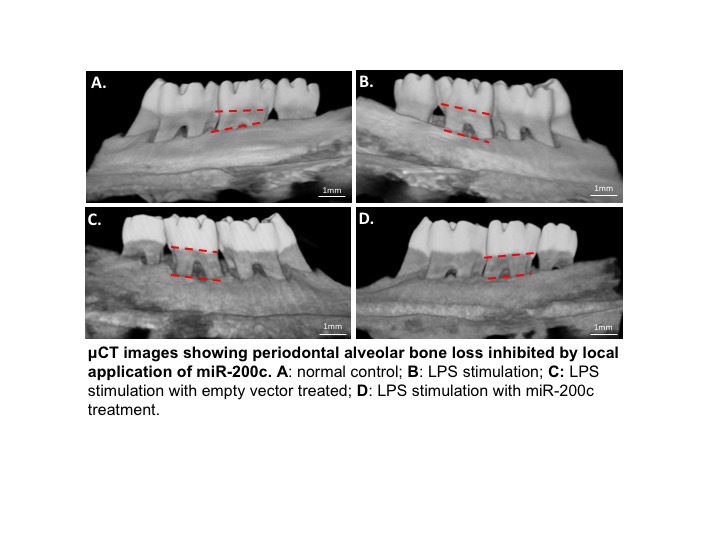
Rat model of periodontitis was developed by injecting nanoplexes into the palatal/interproximal gingiva around the maxilla of 2nd molars, followed by tying LPS-saturated ligature on the cervical region of tooth. Periodontal bone resorption was analyzed using micro-computed tomography and histology.
Results: The overexpression of miR-200c effectively represses multiple proinflammatory mediators in PDL and GF. Remarkably, the LPS-silk ligature with nanoplexe group showed significant difference in the arrest of alveolar bone loss compared to the non-treated groups (P<0.05).
Conclusions: These results substantiate the potential use of miR-200c for the treatment of periodontitis by modulating imbalance and dysregulation of proinflammatory mediators and by inhibiting bone loss and improving bone formation.
The goal of this study is to evaluate the effect of miR-200c on inflammatory response of periodontal ligament fibroblasts (PDL), gingival fibroblasts (GF), and on the arrest of bone loss in an in vivo periodontitis model.
Methods: miR-200c was incorporated into polyethylenimine (PEI) to form nanoplexes (N/P=10:1). PDL and GF were treated with nanoplexes, and PEI-empty vector as control. After 4 hours of transfection, cells were cultured in DMEM supplemented with LPS (1μg/ml). Afterward, IL-6, IL-8, and CCL5 transcripts and protein levels were measured.
Rat model of periodontitis was developed by injecting nanoplexes into the palatal/interproximal gingiva around the maxilla of 2nd molars, followed by tying LPS-saturated ligature on the cervical region of tooth. Periodontal bone resorption was analyzed using micro-computed tomography and histology.
Results: The overexpression of miR-200c effectively represses multiple proinflammatory mediators in PDL and GF. Remarkably, the LPS-silk ligature with nanoplexe group showed significant difference in the arrest of alveolar bone loss compared to the non-treated groups (P<0.05).
Conclusions: These results substantiate the potential use of miR-200c for the treatment of periodontitis by modulating imbalance and dysregulation of proinflammatory mediators and by inhibiting bone loss and improving bone formation.
IMAGES
2640033_File000000.jpg
2640033_File000000.jpg