IADR Abstract Archives
Microleakage Evaluation of Elevated Temperatures in Combined Adhesives and Restoratives
Objectives: To compare marginal microleakage after heating restoratives and adhesives before placement across three different restoratives: dental composite, bioactive restorative, and glass ionomer. The delivery and storage of materials exposed to prolonged high temperatures prior to application may compromise their restorative properties.
Methods: Ninety standard Class II slot preparations were performed on non-carious human posterior teeth with approximately 3mm depth at gingival floor and 4mm width bucco-lingually. Samples were randomly assigned into 9 groups (n=10). Three dental restoratives were tested: FiltekTM Supreme Ultra composite 3M ESPE (FS), ACTIVATM BioACTIVE-RestorativeTM Pulpdent (AB), and PhotacTM Fil Quick AplicapTM 3M ESPE (PT). ExciTE® F Ivoclar Vivadent was used as the adhesive. All materials were placed in incubator (Thermo ScientificTM, ELED265) and heated 120 hours at 24°C, 40°C, or 52°C. Materials were applied according to manufacturer’s instructions. Completed restorations were thermocycled for 6,000 cycles between 5°C and 55°C. Samples were immersed in 2% methylene blue dye for 8 hours. Samples were embedded in acrylic resin, sectioned mesio-distally, and evaluated under stereomicroscope (Olympus, SZX16). A dye-penetration-to-axial-wall (DP) score was used on gingival floor: 0=0% DP, 1=1-25% DP, 2=26-50% DP, 3=51-75% DP, and 4=76-100% DP. Counts and percentages were calculated, and statistical significance was assessed via generalized estimating equations (GEE) for separate comparisons of materials and temperatures.
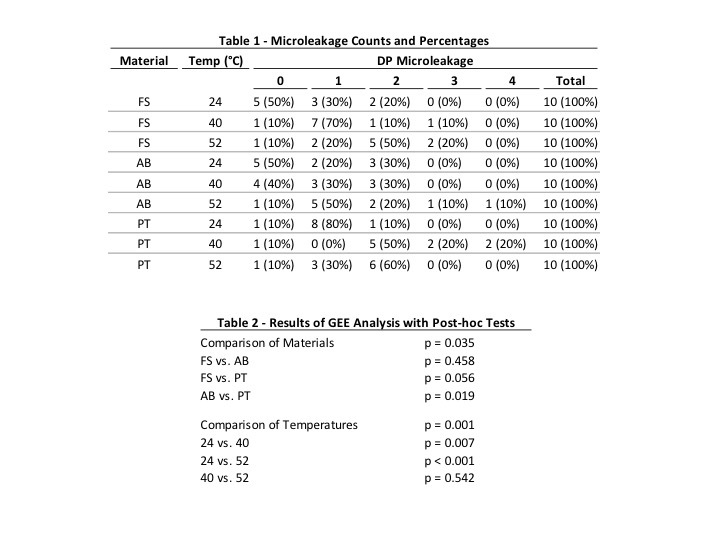
Results: Table 1 displays counts and percentages of microleakage scores. Table 2 displays GEE analysis with post-hoc tests using Bonferroni correction to adjust for multiple comparisons (p<0.0167).
Conclusions: Significant microleakage differences were seen in comparisons between materials and temperatures. Materials heated at 24°C showed least microleakage, as compared to 40°C and 52°C, which had higher DP scores. Compared to previous years’ study, the effect of heating the adhesive with the restorative did not affect microleakage outcome.
Methods: Ninety standard Class II slot preparations were performed on non-carious human posterior teeth with approximately 3mm depth at gingival floor and 4mm width bucco-lingually. Samples were randomly assigned into 9 groups (n=10). Three dental restoratives were tested: FiltekTM Supreme Ultra composite 3M ESPE (FS), ACTIVATM BioACTIVE-RestorativeTM Pulpdent (AB), and PhotacTM Fil Quick AplicapTM 3M ESPE (PT). ExciTE® F Ivoclar Vivadent was used as the adhesive. All materials were placed in incubator (Thermo ScientificTM, ELED265) and heated 120 hours at 24°C, 40°C, or 52°C. Materials were applied according to manufacturer’s instructions. Completed restorations were thermocycled for 6,000 cycles between 5°C and 55°C. Samples were immersed in 2% methylene blue dye for 8 hours. Samples were embedded in acrylic resin, sectioned mesio-distally, and evaluated under stereomicroscope (Olympus, SZX16). A dye-penetration-to-axial-wall (DP) score was used on gingival floor: 0=0% DP, 1=1-25% DP, 2=26-50% DP, 3=51-75% DP, and 4=76-100% DP. Counts and percentages were calculated, and statistical significance was assessed via generalized estimating equations (GEE) for separate comparisons of materials and temperatures.
Results: Table 1 displays counts and percentages of microleakage scores. Table 2 displays GEE analysis with post-hoc tests using Bonferroni correction to adjust for multiple comparisons (p<0.0167).
Conclusions: Significant microleakage differences were seen in comparisons between materials and temperatures. Materials heated at 24°C showed least microleakage, as compared to 40°C and 52°C, which had higher DP scores. Compared to previous years’ study, the effect of heating the adhesive with the restorative did not affect microleakage outcome.
IMAGES
2636689_File000000.jpg
2636689_File000000.jpg