IADR Abstract Archives
Pro-Angiogenic Factors Released by Porous Silicon Biomaterials During Osteogenesis
Objectives: Angiogenesis is a key factor for bone tissues engineering. We developed a synthetic non-toxic porous resorbable material (pSi) with nanotopographic features promoting cell adhesion and osteodifferentiation. PSi degrades into silicic acid which is a natural compound excreted in urine. Recently, we have also shown the pro-angiogenic properties of monosaccharides derived from mannose-6-phosphate in chorio-allantoide model and in aortic explant culture.
The aim of this study was to explore the capacities of pSi loaded with mannose-6-phosphanate (M6Pn) for osteogenesis and angiogenesis.
Methods: In vitro experiments were conducted with human DPSC incubated on pSi particles loaded with M6Pn. DPSC proliferation and osteodifferentiation were followed by optical and electron microscopy. Particles resorption and M6Pn release were assessed by Induced Coupled Plasma Mass Spectrometry. For in vivo experiments, critical sized defects were drilled in rat tail vertebrae, and filled with pSi-M6Pn, with or without rat DPSC. Bone regeneration was assessed by µCT and histological evaluation.
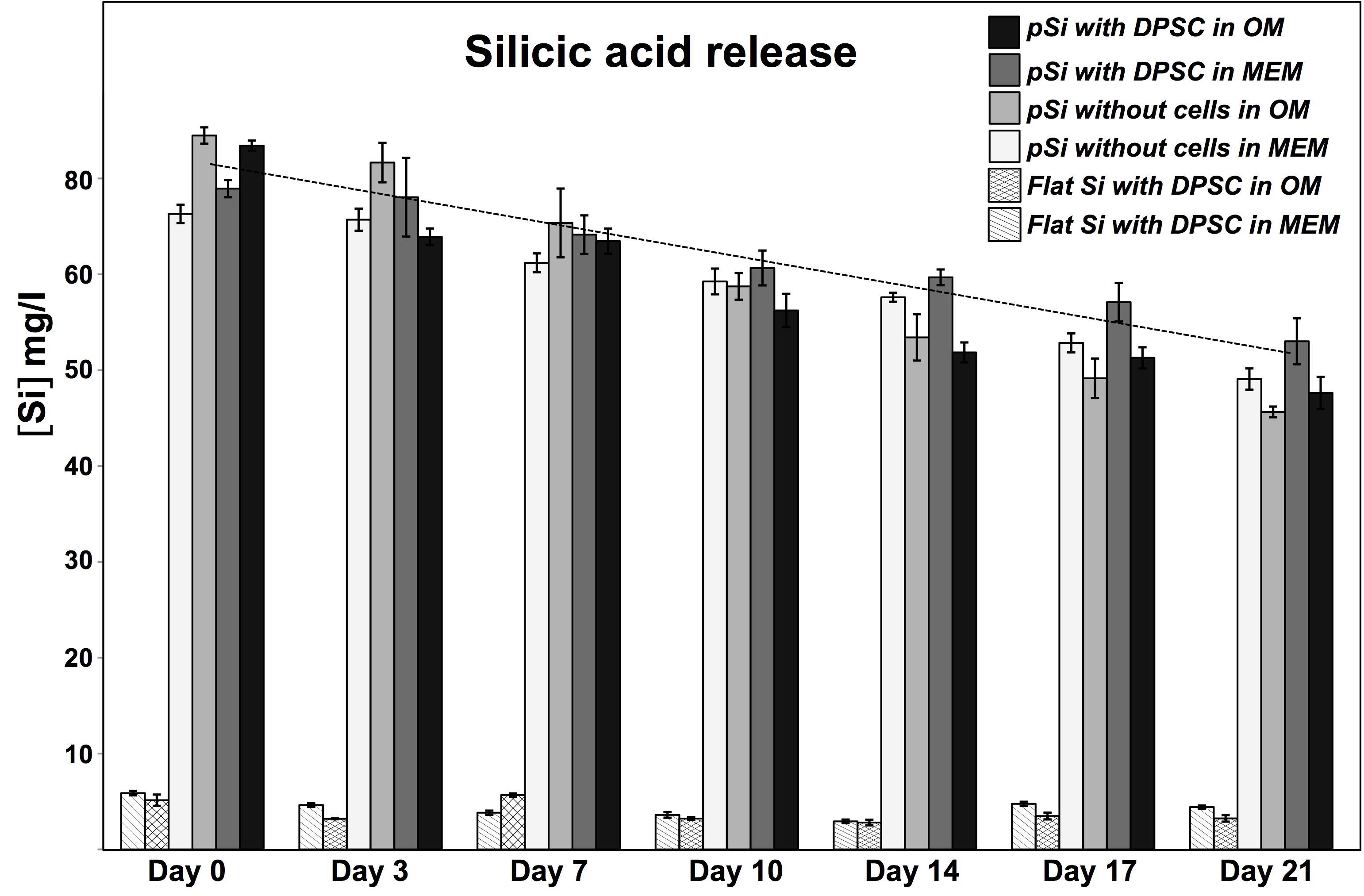
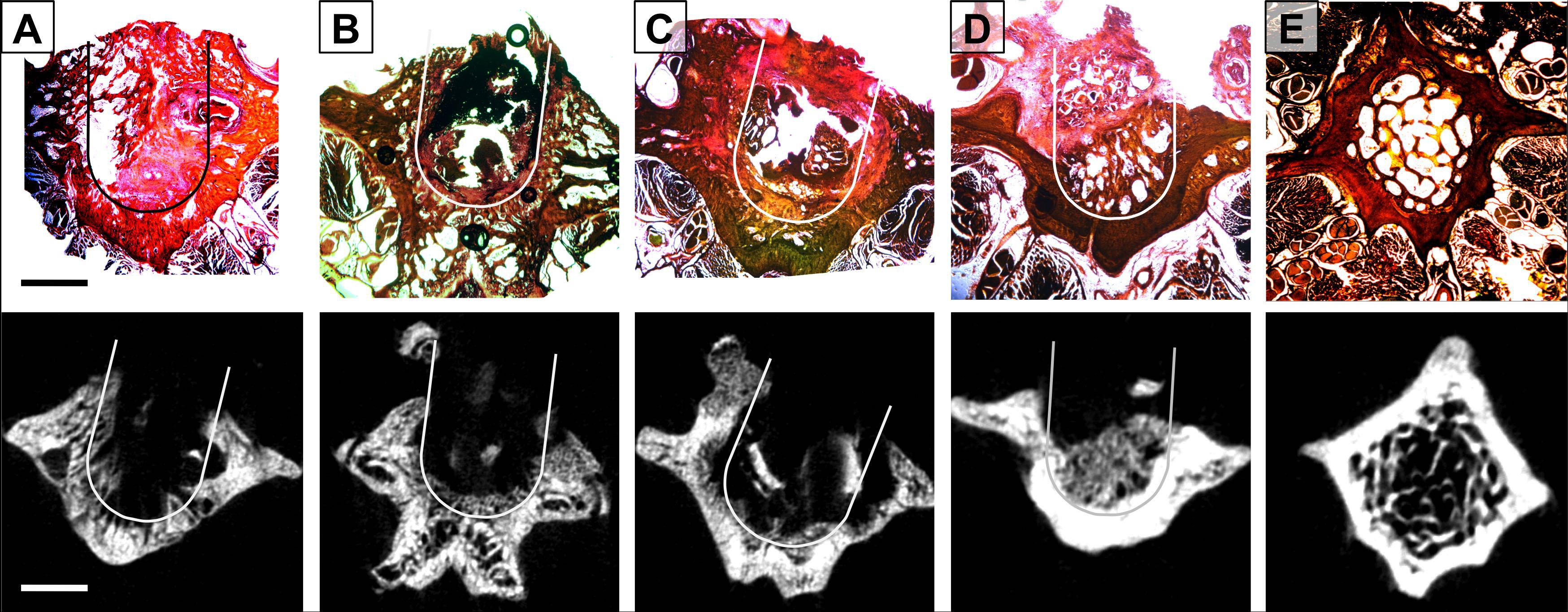
Results: ICP-MS revealed that pSi dissolved regularly during 2 months, with released silicic acid decreasing over time. Some particles were still visible after 1 month. M6Pn was efficiently released during 1 month. DPSC adhered, proliferated and produced a mineralized matrix. One month after in vivo implantation, µCT evaluation showed that pSi-M6Pn significantly promoted osteogenesis, with or without rDPSC, compared to pSi particles alone. Histological evaluation revealed the presence of vascular structure in pSi-M6Pn regenerated bone.
Conclusions: The adjunction of M6Pn promoted angiogenesis, which is a critical factor for clinical applications. The presence of stem cells grafted on the material seemed to favor regeneration but was not mandatory for efficient regeneration. These results demonstrate the efficiency of pSi-M6Pn for bone regeneration, with a positive effect on vascular regeneration. They are of prime interest when considering legislative issues of cell therapy, as they provide an efficient therapeutic approach without any animal products.
The aim of this study was to explore the capacities of pSi loaded with mannose-6-phosphanate (M6Pn) for osteogenesis and angiogenesis.
Methods: In vitro experiments were conducted with human DPSC incubated on pSi particles loaded with M6Pn. DPSC proliferation and osteodifferentiation were followed by optical and electron microscopy. Particles resorption and M6Pn release were assessed by Induced Coupled Plasma Mass Spectrometry. For in vivo experiments, critical sized defects were drilled in rat tail vertebrae, and filled with pSi-M6Pn, with or without rat DPSC. Bone regeneration was assessed by µCT and histological evaluation.
Results: ICP-MS revealed that pSi dissolved regularly during 2 months, with released silicic acid decreasing over time. Some particles were still visible after 1 month. M6Pn was efficiently released during 1 month. DPSC adhered, proliferated and produced a mineralized matrix. One month after in vivo implantation, µCT evaluation showed that pSi-M6Pn significantly promoted osteogenesis, with or without rDPSC, compared to pSi particles alone. Histological evaluation revealed the presence of vascular structure in pSi-M6Pn regenerated bone.
Conclusions: The adjunction of M6Pn promoted angiogenesis, which is a critical factor for clinical applications. The presence of stem cells grafted on the material seemed to favor regeneration but was not mandatory for efficient regeneration. These results demonstrate the efficiency of pSi-M6Pn for bone regeneration, with a positive effect on vascular regeneration. They are of prime interest when considering legislative issues of cell therapy, as they provide an efficient therapeutic approach without any animal products.
IMAGES
2634812_File000000.jpg
2634812_File000001.jpg
2634812_File000000.jpg
2634812_File000001.jpg