IADR Abstract Archives
Marginal Accuracy and Mechanical Advantages to Using Original Implant Components
Objectives: Implant performance may be impacted by manufacturing process and prosthetic “mis-matching.” We hypothesized that measurements obtained using original equipment manufacturer (OEM) components, independent of manufacturing process, would demonstrate significantly greater marginal accuracy, static load, and cyclic fatigue as compared to measurements obtained using compatible, non-OEM components.
Methods: Abutment test groups were machined stock abutments (SA), cast-to-gold abutments (GC), and cast-on abutments (CA), and further subdivided as OEM (Zimmer Biomet) or non-OEM (MIS; Implant Direct).
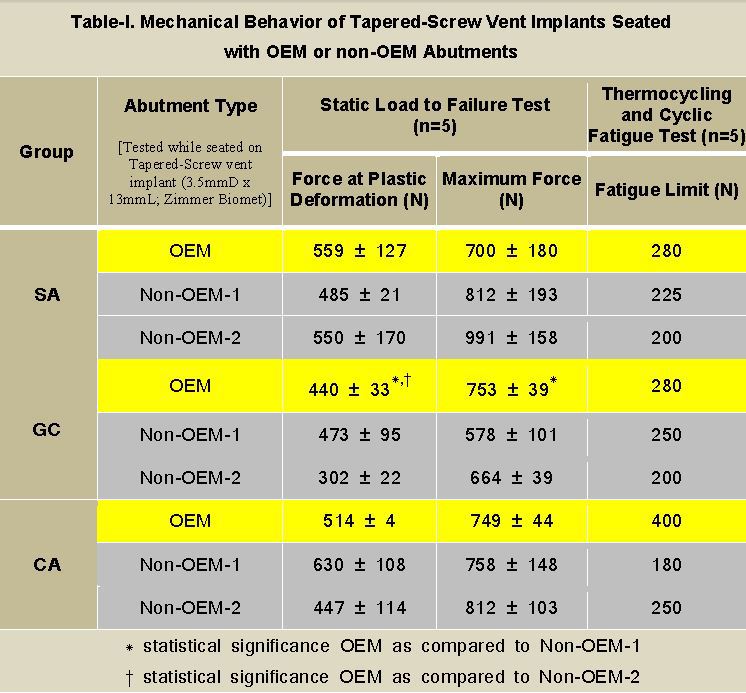
Statistical analysis used SPSS-Ver.21.0. Data is presented as mean±stdev (Table-I). Marginal accuracy/gap measurements (n=5/gp) were statistically analyzed (Kruskal Wallis test). Static load to failure was conducted per ISO14801:2007. Cyclic fatigue involved thermocycling (ISO11405:2003) and loading (2x10⁶ cycles). Fatigue and rupture zones were analyzed using fractography. Mechanical measurements were statistically analyzed (Analysis-of-Variance, p<0.05).
Results: No gaps were observed at the SA and GC implant-abutment interfaces. CA non-OEMs demonstrated significantly different gap measurements of 63.6±28.5mm and 20.2±13.4mm.
The overall force for plastic deformation (Fp) and load bearing capacity (Fm) ranged from 302-630N and 578-991N, respectively. No significant difference was found between OEM and non-OEM SA and CA. For GC, Fp was statistically significant between OEM and non-OEM; Fm was statistically significant between OEM and non-OEM-1.
OEM demonstrated a greater fatigue limit than non-OEM. No abutment fractured; the implant connection was the weakest point. For non-OEM, the most frequent failure model was implant and screw fracture at the first thread region. OEM demonstrated a consistent fracture point at the screw apex.
Conclusions: CA non-OEM demonstrated marginal gaps. For all assemblies, Fp and Fm were above 196N, the average human masticatory force for molar teeth, and above or within the range 314-640N, the maximum occlusion force for human molar teeth. The fatigue limits for OEM was greater than non-OEM; therefore, use of OEM components demonstrated a higher propensity for long-term success.
Methods: Abutment test groups were machined stock abutments (SA), cast-to-gold abutments (GC), and cast-on abutments (CA), and further subdivided as OEM (Zimmer Biomet) or non-OEM (MIS; Implant Direct).
Statistical analysis used SPSS-Ver.21.0. Data is presented as mean±stdev (Table-I). Marginal accuracy/gap measurements (n=5/gp) were statistically analyzed (Kruskal Wallis test). Static load to failure was conducted per ISO14801:2007. Cyclic fatigue involved thermocycling (ISO11405:2003) and loading (2x10⁶ cycles). Fatigue and rupture zones were analyzed using fractography. Mechanical measurements were statistically analyzed (Analysis-of-Variance, p<0.05).
Results: No gaps were observed at the SA and GC implant-abutment interfaces. CA non-OEMs demonstrated significantly different gap measurements of 63.6±28.5mm and 20.2±13.4mm.
The overall force for plastic deformation (Fp) and load bearing capacity (Fm) ranged from 302-630N and 578-991N, respectively. No significant difference was found between OEM and non-OEM SA and CA. For GC, Fp was statistically significant between OEM and non-OEM; Fm was statistically significant between OEM and non-OEM-1.
OEM demonstrated a greater fatigue limit than non-OEM. No abutment fractured; the implant connection was the weakest point. For non-OEM, the most frequent failure model was implant and screw fracture at the first thread region. OEM demonstrated a consistent fracture point at the screw apex.
Conclusions: CA non-OEM demonstrated marginal gaps. For all assemblies, Fp and Fm were above 196N, the average human masticatory force for molar teeth, and above or within the range 314-640N, the maximum occlusion force for human molar teeth. The fatigue limits for OEM was greater than non-OEM; therefore, use of OEM components demonstrated a higher propensity for long-term success.
IMAGES
2633269_File000000.JPG
2633269_File000000.JPG