IADR Abstract Archives
Hydrophobic Peptide-coated Dentin for Resisting Degradation of Composite Restorations
Objectives: Objective: Water-borne (hydrolytic, acidic, enzymatic) and biofilm-mediated degradation of composite restorations (CRs) results in secondary caries and failure. Primer/adhesive resins that penetrate the hydrated collagen at the dentin/CRs interface (d/R) are hydrophilic. Water affinity of resins compromises CRs’ long-term survival. We present a new technology that uses amphipathic antimicrobial peptides to produce hydrophobic dentin that hinders water penetration/interaction at the d/R and will enable development of fully hydrophobic CRs.
Methods: Methods: Etched bovine-dentin slabs were coated with amphipathic antimicrobial peptides, GL13K. Several coating conditions were investigated. GL13K-less buffer-soaked slabs acted as controls. Treated dentin was characterized by water contact-angle (WCA), acidic dye (CuSO4) penetration, before and after immersion in human saliva (37°C, 3d), and ultrasonication (15mins). Restored (Z250, Scotch Bond Universal, 3M) GL13K-coated and control dentin discs were hydrolytically challenged (2 months) and thermo-cycled (2500 cycles); then immersed in AgNO3. AgNO3 at the d/R was assessed by micro-computed tomography. Diametral compression on restored dentin discs was performed to assess their bond strength. ANOVA+post-hoc tests determined statistically significant differences.
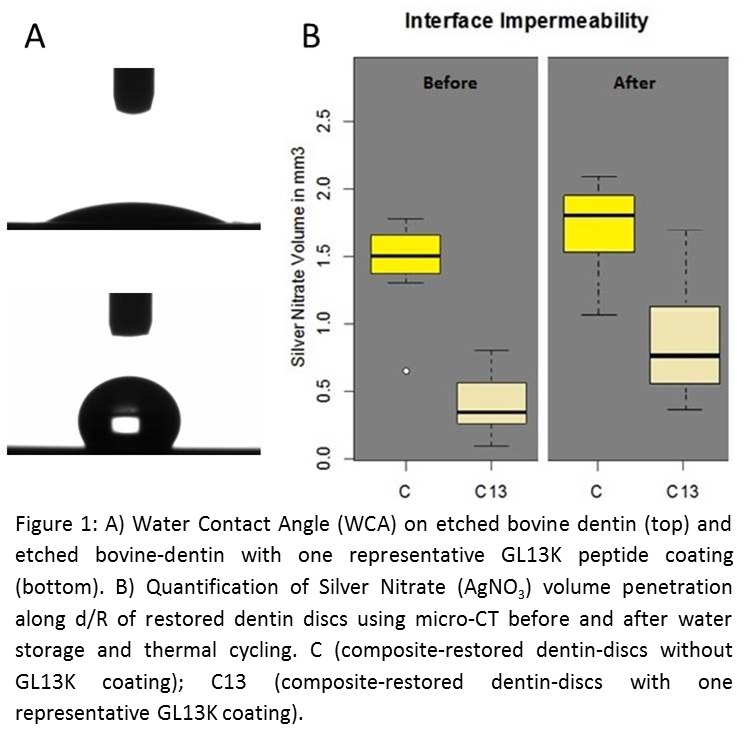
Results: Results: WCA significantly increased from 20ο (etched dentin) to 120ο (GL13K-coated dentin) (n=7, p<0.0001) (Fig.1A). Dentin remained hydrophobic (WCA>100ο) after mechanical and biological challenges. CuSO4 penetration was hindered in GL13K-coated dentin, even after saliva challenge. AgNO3 penetration was significantly reduced at the hydrophobic d/R before (n=7, p<0.0001) and after aging (p<0.005), compared to traditional CRs (Fig.1B). Hydrophobic dentin did not reduce bond strength of restored discs (n=22, p=0.87).
Conclusions: Conclusion: Hydrophobic dentin was obtained with amphipathic antimicrobial peptide coatings. GL13K-coated dentin remained hydrophobic after clinically relevant challenges, hindered water penetration/degradation at the d/R, and produced mechanically sound CRs. This new priming technology is expected to increase CRs durability by resisting water-borne degradation at the d/R. It also enables the development of new highly hydrophobic adhesives for long-lasting restorations.
Methods: Methods: Etched bovine-dentin slabs were coated with amphipathic antimicrobial peptides, GL13K. Several coating conditions were investigated. GL13K-less buffer-soaked slabs acted as controls. Treated dentin was characterized by water contact-angle (WCA), acidic dye (CuSO4) penetration, before and after immersion in human saliva (37°C, 3d), and ultrasonication (15mins). Restored (Z250, Scotch Bond Universal, 3M) GL13K-coated and control dentin discs were hydrolytically challenged (2 months) and thermo-cycled (2500 cycles); then immersed in AgNO3. AgNO3 at the d/R was assessed by micro-computed tomography. Diametral compression on restored dentin discs was performed to assess their bond strength. ANOVA+post-hoc tests determined statistically significant differences.
Results: Results: WCA significantly increased from 20ο (etched dentin) to 120ο (GL13K-coated dentin) (n=7, p<0.0001) (Fig.1A). Dentin remained hydrophobic (WCA>100ο) after mechanical and biological challenges. CuSO4 penetration was hindered in GL13K-coated dentin, even after saliva challenge. AgNO3 penetration was significantly reduced at the hydrophobic d/R before (n=7, p<0.0001) and after aging (p<0.005), compared to traditional CRs (Fig.1B). Hydrophobic dentin did not reduce bond strength of restored discs (n=22, p=0.87).
Conclusions: Conclusion: Hydrophobic dentin was obtained with amphipathic antimicrobial peptide coatings. GL13K-coated dentin remained hydrophobic after clinically relevant challenges, hindered water penetration/degradation at the d/R, and produced mechanically sound CRs. This new priming technology is expected to increase CRs durability by resisting water-borne degradation at the d/R. It also enables the development of new highly hydrophobic adhesives for long-lasting restorations.
IMAGES
2633213_File000000.jpg
2633213_File000000.jpg