IADR Abstract Archives
Wear Resistance Comparison of Glass Ionomer Materials
Objectives: We aim to show that four different Glass Ionomer materials will vary in their toothbrush wear significantly over time; affecting clinical indications for restorative purposes.
Methods: Five samples (n=5) of four different GI materials were tested, totalling 20 samples. The disc samples measured approx. 10mm thick with a 10mm diameter. They were submersed in 5 mL of artificial saliva (KH2PO4 +NaN3 +KCl + CaCl2 + MgCl2) for 1 week. The materials were IonoStar® Plus, VOCO (IS); GC Fuji IX GP®, GC America (F); Ketac™ Molar, 3M ESPE (KM); and ChemFil® Rock, Dentsply (CFR). An Oral B® Pro 3000 electric toothbrush was used with 25nm of pressure applied by a universal testing machine (Instron®5566A) to brush each sample for 2 min (~16,000 strokes). After, each sample was measured with an Ironton® electronic calipers in mm it was put through this procedure two times (~32,000 strokes), and the four types of GI were compared to see if there was significant difference of wear between the four sample types.
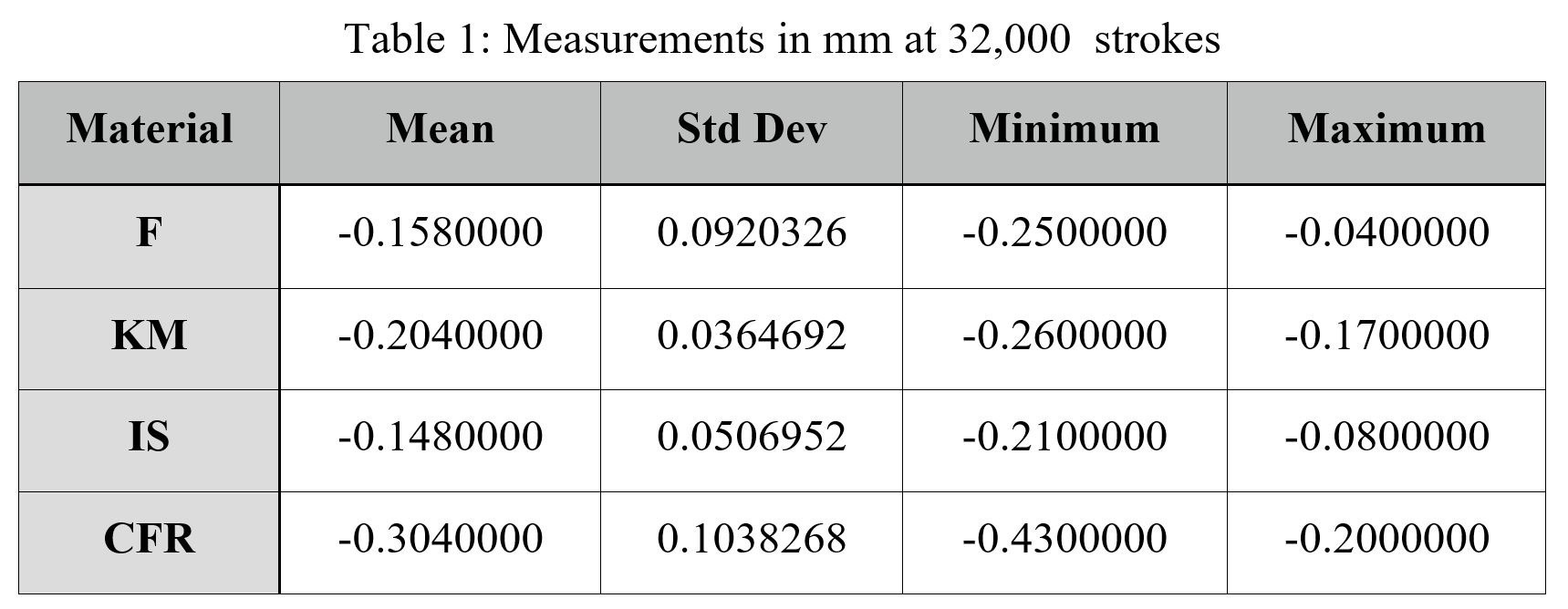
Results: Using an ANOVA one-way data analysis, it was found that CFR had significantly higher wear than IS, but not for the other two materials tested throughout the assay. The results are shown in table 1 below .
Conclusions: The findings suggest that there are possible advantages of working with specific GI materials in regard to lifespan when considering mechanical wear durability. The materials that had less mechanical wear over time will likely perform better in temporizing preparations in bruxers, and environments where a stronger material is indicated. Dentists working with GI with greater wear resistance may have greater chance of successful temporization and caries prevention in patients with need of higher strength materials. These results may influence dentists in the selection of which GI they would prefer to use in their clinical practice.
Methods: Five samples (n=5) of four different GI materials were tested, totalling 20 samples. The disc samples measured approx. 10mm thick with a 10mm diameter. They were submersed in 5 mL of artificial saliva (KH2PO4 +NaN3 +KCl + CaCl2 + MgCl2) for 1 week. The materials were IonoStar® Plus, VOCO (IS); GC Fuji IX GP®, GC America (F); Ketac™ Molar, 3M ESPE (KM); and ChemFil® Rock, Dentsply (CFR). An Oral B® Pro 3000 electric toothbrush was used with 25nm of pressure applied by a universal testing machine (Instron®5566A) to brush each sample for 2 min (~16,000 strokes). After, each sample was measured with an Ironton® electronic calipers in mm it was put through this procedure two times (~32,000 strokes), and the four types of GI were compared to see if there was significant difference of wear between the four sample types.
Results: Using an ANOVA one-way data analysis, it was found that CFR had significantly higher wear than IS, but not for the other two materials tested throughout the assay. The results are shown in table 1 below .
Conclusions: The findings suggest that there are possible advantages of working with specific GI materials in regard to lifespan when considering mechanical wear durability. The materials that had less mechanical wear over time will likely perform better in temporizing preparations in bruxers, and environments where a stronger material is indicated. Dentists working with GI with greater wear resistance may have greater chance of successful temporization and caries prevention in patients with need of higher strength materials. These results may influence dentists in the selection of which GI they would prefer to use in their clinical practice.
IMAGES
2632987_File000000.jpg
2632987_File000000.jpg